

Insights
- Travel and hospitality companies are lagging in their artificial intelligence (AI) implementation journey.
- Limited change management practices and a lack of employee engagement are contributing to this gap with other industries.
- Early workforce engagement, targeted upskilling, and building trust through visible success stories can help them overcome these barriers to AI success.
Executive summary

The travel and hospitality sector is failing to realize the benefits of artificial intelligence (AI) despite clear opportunities in areas such as price optimization, energy optimization, and fraud identification. This is in spite of AI and machine learning (ML) accounting for the largest share of technology investments in the global sector from 2018 to 2024, and that AI is now a strategic priority.
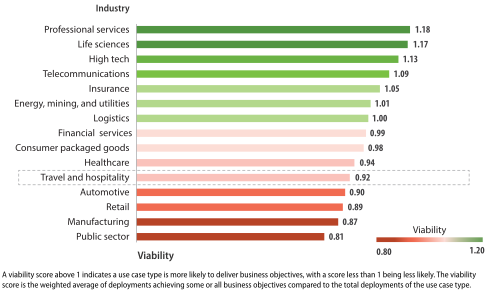
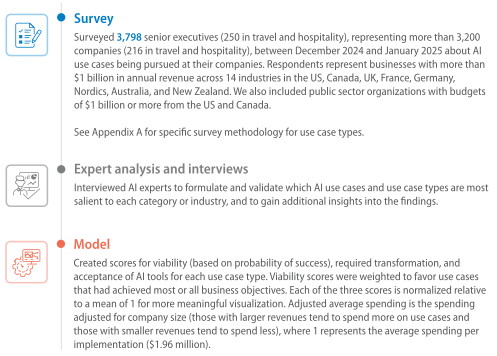
For its AI Business Value Radar, Infosys surveyed 3,798 business leaders globally. Of these, 250 were from the travel and hospitality industry. The research found that travel and hospitality ranks below the industry average on its viability score, which is the likelihood that its AI deployments will achieve all business objectives (Figure 1).
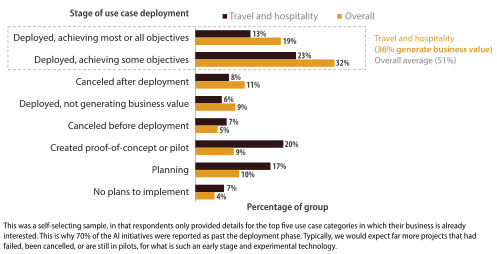
The travel and hospitality sector needs to boost its capabilities to consistently realize business value from AI. On average, 51% of AI use cases among industries surveyed are generating business value. However, in travel and hospitality, this number is well below the industry average at only 36% (Figure 2). One-fifth of the travel and hospitality companies are only in the proof of concept (POC) stage of AI implementation, with similar numbers in the planning stage.
Figure 1. Travel and hospitality lags other sectors on AI value
Source: Infosys Knowledge Institute
Figure 2. Only a third of AI use cases generate business value
Source: Infosys Knowledge Institute
Applications of AI across travel and hospitality
The Infosys research uncovered several examples of AI success in the travel and hospitality industry, showing how organizations are translating AI investments into tangible business value.
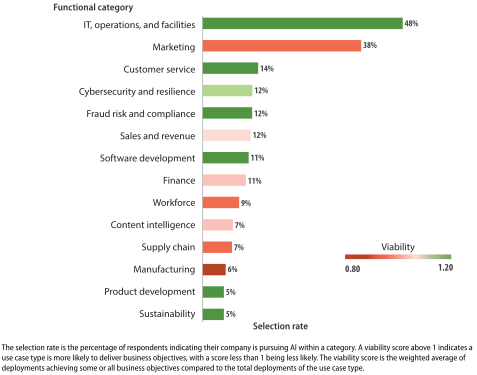
IT, operations, and facilities is the top use case category within which the travel and hospitality companies surveyed are pursuing AI, followed by marketing and customer service (Figure 3). Request for proposal (RFP) management for large hotel events, staff planning, and security management use cases require relatively less transformation to existing data architecture and operating models to generate business value.
The reason for needing less transformation lies in the nature of these use cases and the maturity of existing capabilities in the sector itself. Travel and hospitality businesses work with multiple vendors and have been using AI for the past couple of years to manage bids and RFPs across vendors and to assess their feasibility. In the last six to eight months, the use has been more widespread. As these operational optimization use cases are built on already available data and processes, they are delivering value without requiring major change or investment.
Figure 3. Popularity and viability of functional use case categories
Source: Infosys Knowledge Institute
The reason for prioritizing AI in IT, operations, and facilities could be that these functions offer the most immediate and quantifiable business value. The industry operates on thin margins and high fixed costs, so even small efficiency gains can significantly improve profitability. The travel and hospitality sector also prioritizes minimizing disruptions — ad hoc or planned — while continuously improving processes such as check-ins, customer service on websites, and maintenance operations wherever possible. Currently, several of these are not automated. Strengthening IT, operations, and facilities becomes a key focus, alongside AI application to enhance efficiency and resilience across these areas.
IT functions also benefit from AI through improved system monitoring, cybersecurity, demand forecasting, and integration across legacy platforms in large hospitality and travel organizations. These use cases are often easier to pilot, scale, and measure compared to customer-facing initiatives, potentially making them attractive starting points for AI investment.
For a large global car rental company, Infosys carried out a phased migration to move all applications and workloads from Hewlett Packard Enterprise (HPE) NonStop — a series of servers designed for environments that require continuous availability and resilience to hardware or software failures — to the AWS cloud. Applications such as batch processing, reporting, and real-time online services were handled with a tailored approach.
A key part of the program was modernizing the core business logic by converting it from COBOL, a legacy but still widely used programming language, into Spring Boot, a Java-based framework built on the Spring ecosystem that makes it easier to develop production-ready applications — in line with the client’s enterprise standards.
Infosys first completed a detailed assessment of all applications and their dependencies to create a solid migration plan. Infosys used its ILEAD platform and Microsoft Copilot, and an AI-first reengineering and forward engineering approach to execute the development in this modernization program.
Operations generate vast amounts of structured data from reservations, pricing, inventory, maintenance, and workforce management, making them well-suited for AI-driven automation and optimization. For a tier-one US-based airline, Infosys built an AI- and generative AI-based tool that uses historical data from ServiceNow and Jira, together with knowledgebase documents to generate recommended solutions for any new incidents reported by its employees. The tool reduced triaging time by 75% and delivered time savings of up to 77 hours per month.
AI enables predictive maintenance of facilities, smarter energy management, optimized staff scheduling, and real-time disruption management, which reduce costs and improve reliability. InterContinental Hotels Group (IHG) uses AI to monitor systems such as air conditioning and elevators, enabling predictive maintenance that prevents failures, lowers operational costs, and improves guest satisfaction. Hilton Tokyo Bay uses AI to predict amenity restocking needs and identify appliance maintenance requirements.
Marketing follows as the next major use case because AI can enhance revenue generation through personalized recommendations, dynamic pricing, and targeted promotions based on traveler behavior and preferences. Customer service ranks after marketing because, while AI-powered chatbots and virtual assistants improve response times and reduce call center load, these applications require designing to develop brand-aligned virtual assistants with different personalities that aim to foster meaningful interactions with guests and maintain service quality and brand trust. As a result, companies could be typically focusing first on internal efficiency before expanding AI into customer engagement.
That said, more than 80% of respondents of a hospitality industry survey anticipate AI-driven changes in prebooking and guest communications, leading to smoother, more personalized interactions. The airline industry is striving to eliminate intermediaries like travel agents and become more self-sufficient in interacting with customers on their own platform — right from first booking to the last mile. Customers are increasingly seeking ancillary services such as seat selection, additional baggage, and priority check-in and boarding that enhance convenience, comfort, and personalization, typically for an additional fee. Airlines are keen to leverage AI to better offer, personalize, and manage these ancillaries for their customers to strengthen customer loyalty and repeatability. Lufthansa Group’s AI initiatives include a concierge-style service for personalized recommendations and AI-powered support that handles over 100,000 customer queries each year.
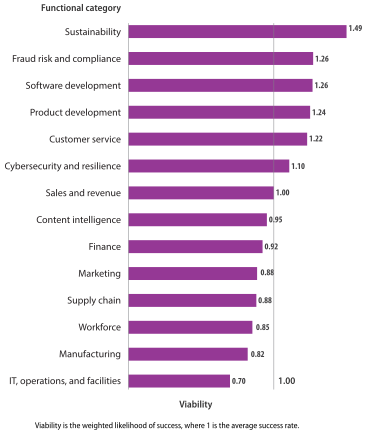
Sustainability, fraud risk and compliance, and software development use cases are most viable — likely to generate business value — however, they are less popular (Figure 4). AI helps optimize energy use by forecasting demand, managing heating and cooling systems, scheduling EV charging, and refining aircraft routes for better fuel efficiency. Flair Airlines adopted an AI-powered, data-driven solution to optimize flight paths, reduce fuel consumption, and support pilots in making better fuel-efficiency decisions, including improved anticipation of taxi times, historical shortcuts, and descent strategies.
Figure 4. Sustainability leads functional use cases
Source: Infosys Knowledge Institute
Although sustainability is a key area of concern for the travel industry, as the impact of air travel and tourism comes under increased scrutiny, initiatives in sustainability and compliance are sometimes driven by mandates rather than competitive advantage. Consequently, despite strong potential value, the travel and hospitality industry has tended to focus on more visible, near-term AI use cases. While travel and hospitality businesses recognize the importance of sustainability, fraud risk and compliance, and software development — and many have initiated efforts in these areas — the focus often diminishes as these priorities take a backseat to core areas such as IT and operations.
Model context protocol (MCP) has emerged as an enabler for AI-driven transformation across airlines. Airlines rely on a mix of legacy reservation platforms, crew and operations systems, weather services, and pricing engines, which often creates integration challenges. MCP introduces a universal, model-agnostic interface that enables AI agents to connect to and work across these systems smoothly.
For airlines, it helps with autonomous rebooking, baggage tracing, disruption recovery, intelligent operations support, and personalized customer engagement, reducing staff burden while elevating service quality. It enables airlines to serve AI-powered travel shopping agent systems that autonomously search, compare, and book fares, reducing reliance on global distribution systems and online travel agencies intermediaries. It has been proven to reduce operational costs.
As MCP allows AI assistants to connect with enterprise systems and external services, it also brings new cybersecurity risks. A custom enterprise platform can help by adding multiple layers of security to support safe MCP adoption.
Core challenges
Although travel and hospitality has its fair share of applications of AI, it has experienced a slower pace of technology adoption compared to other industries. Limited technology expertise among industry professionals constrains the resources available to support transformation initiatives, exacerbating this challenge.
High AI implementation costs lead many businesses in this sector to prioritize core operational technologies, including booking and reservation systems, property management systems, point-of-sale platforms, and foundational customer relationship management and revenue management tools, over advanced AI capabilities.
As a result, other sectors are further ahead on the technology as well as the AI implementation curve. This is likely to change for travel and hospitality businesses once they start seeing more value from their AI implementations.
Infosys research has identified that preparing workforces for AI is a critical factor for successful implementation. Respondents to the survey were grouped into four archetypes based on which of the following definitions matched their employee engagement with AI:
- Watchers: Organizations with minimal engagement with employees on AI, and limited or no training, education, or change management initiatives.
- Explorers: Companies taking initial steps to address AI with limited change management practices; employees have minimal involvement or support in understanding AI’s role.
- Pathfinders: Organizations with regular training and educational programs on AI and growing employee engagement.
- Trailblazers: Companies fully engaged in continuous AI training, education, and change management, with employees fully supported in understanding and adapting to AI.
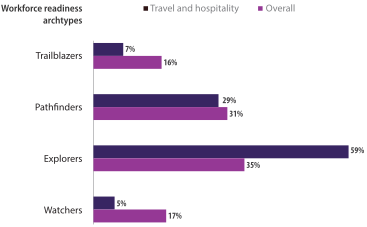
Infosys research found that travel and hospitality has been slower and more cautious than other sectors about adopting AI, with 59% classified as explorers (Figure 5). They have limited change management practices, and staff have minimal involvement or support in understanding AI’s role.
Figure 5. Mostly explorers in travel and hospitality
Source: Infosys Knowledge Institute
Even the most advanced AI solutions fail to deliver value if employees don’t understand, trust, or use them. Strengthening change management and employee adoption strategies is critical for organizations seeking to advance from exploratory AI efforts to leading positions in AI maturity. By investing in structured change management and actively engaging employees, companies can overcome these challenges and progress in their journey from early AI exploration to becoming pathfinders and trailblazers.
The gap between ambition and execution
Engage the workforce early
In travel and hospitality, employees such as hotel staff, cabin crew, ground operations teams, and contact center agents are the closest employees to guests and to daily operations, making their involvement critical to successful AI adoption. Engaging these employees early in the development process well before any AI solutions are deployed helps to ensure that technology aligns with workflows, service standards, and guest expectations.
Additionally, building AI use cases with the early engagement of these frontline teams allows organizations to capture practical insights on peak periods, service bottlenecks, and guest pain points. Incorporating frontline feedback during design and testing reduces resistance, improves usability, and ensures that new AI tools enhance, rather than disrupt, service delivery and operational efficiency.
Upskill employees to use AI effectively
For travel and hospitality businesses, AI delivers value only when employees know how to interpret and act on its insights. Operations teams should be trained to use AI outputs for dynamic workforce scheduling, predictive maintenance, and energy optimization across hotels, airports, and transport assets.
Revenue and marketing teams need to understand AI-driven pricing and demand forecasts, while managers must learn when to rely on AI recommendations and when human judgment is required. Upskilling programs should focus on practical, role-based learning rather than technical complexity, enabling employees to trust AI as a decision-support tool that enhances service quality, efficiency, and guest satisfaction.
Develop an AI foundry and factory
Travel and hospitality companies can accelerate AI adoption by establishing an AI foundry and AI factory model. The AI foundry helps identify, prototype, and test high-value use cases such as dynamic pricing, demand forecasting, energy management, fraud detection, and guest personalization.
Once proven, the AI factory turns these into tools that can be standardized, industrialized, and scaled across properties, routes, or regions. By narrowing focus to between three and five high-impact use cases, organizations can move beyond fragmented experimentation and achieve enterprisewide impact. This structured approach ensures faster time to value while building reusable capabilities across the business.
Evangelize AI success stories to build trust
Highlighting real examples — such as improved occupancy through smarter pricing, reduced energy costs in hotels, faster guest issue resolution, or lower fraud losses — makes AI relevant to everyday work. Communicating these wins through town halls, internal platforms, and leadership messaging reinforces how AI supports employees rather than replacing them. When staff see clear outcomes tied to service quality, cost savings, or workload reduction, they are more likely to trust AI, adopt new tools, and actively contribute ideas for future innovation.
Establish a centralized AI task force
A centralized AI task force is critical for travel and hospitality organizations to manage AI responsibly and at scale. This group should define governance frameworks, ethical guidelines related to responsible AI, data standards, and decision-making processes related to AI use across brands, regions, and functions. Clear policies help address risks around guest data privacy, regulatory compliance, and algorithmic bias while ensuring consistency in AI deployment. The task force also aligns AI initiatives with business strategy, prioritizes investments, and monitors outcomes. With strong governance in place, companies can scale AI confidently while maintaining trust, accountability, and operational discipline.
Conclusion
The future of AI in travel and hospitality will be defined less by technology availability and more by an organization’s ability to embed intelligence into everyday decision-making and service delivery.
As competitive pressures intensify and guest expectations continue to rise, companies will need to move beyond incremental experimentation, treat AI as a business-wide capability, and recognize people as critical enablers of value creation. They must ensure to align leadership intent, workforce readiness, and operational priorities to translate AI potential into sustained performance improvements.
Companies will need to create an environment where employees are empowered to work alongside AI, governance structures provide clarity and confidence, and innovation is disciplined yet scalable. This requires a deliberate shift from fragmented pilots to repeatable models that can be deployed across brands, geographies, and functions. Organizations must foster trust both in the technology and in the change process by making outcomes visible and relevant to employees’ daily roles.
By closing the gap between aspiration and execution, travel and hospitality companies can realize AI benefits — resilience, efficiency, and differentiated guest experiences — and position themselves to lead rather than follow in an increasingly AI-driven industry.
Appendix A: Use cases
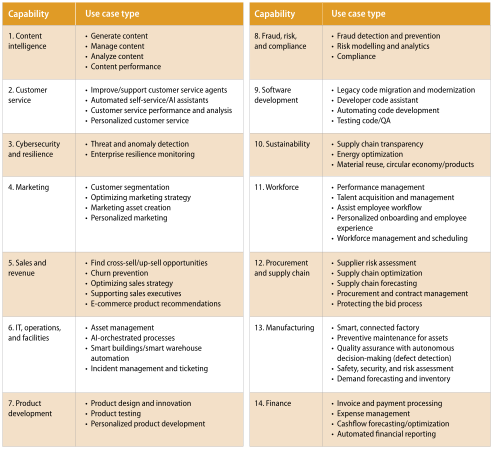
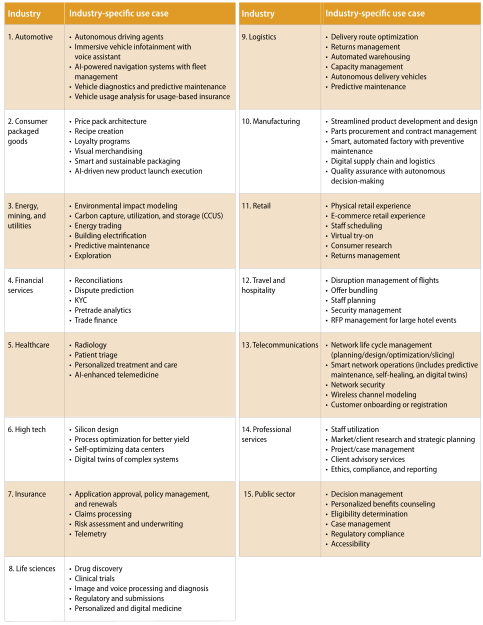
Based on interviews with subject matter experts and desk research, we collated 55 use case types across 14 categories (Figure A1). We similarly collated 77 industry-specific use case types across 15 industry sectors (Figure A2). All these use case types are themselves at a level of abstraction higher than a specific use case, to make the survey manageable — but they are also relevant for all respondents. The survey asked respondents to select up to five functional categories out of 14 (Figure A1), where their companies are pursuing AI initiatives.
Figure A1. Functional categories and their use case types
Source: Infosys Knowledge Institute
Respondents provided details on these categories, which were the top five that their company is already interested in. As such, this is a self-selecting sample. In Figure 1, for example, we would typically expect far more projects that had failed, been canceled, or been in pilots for what is an early stage and experimental technology. Each category had between two and six common use case types (for example, product recommendation use cases in the sales and retail category). For each use case type within a category, respondents were asked about the stage of implementation of their initiative(s). Options for this question were: No plans to implement; planning; created POC or pilot; canceled before deployment; deployed, not generating business value; canceled after deployment; deployed, generating some business value; deployed, achieving most or all objectives. Respondents were then asked about the amount of spending for that use case type to date (from any start date). This was followed by questions about the amount of operational or business model change as well as the amount of change in data structures and technical architecture needed for each use case type.
Finally, respondents were asked about the proportion of their user base that accepted and used the AI tool deployed (if any) for each use case type. The same series of questions was asked for industry-specific use case types for the industry of the respondent (Figure A2).
Figure A2. Industry-specific use case types
Source: Infosys Knowledge Institute
Appendix B: Research approach
Source: Infosys Knowledge Institute


For retailers, the AI advantage will come from building the organizational muscle that lets employees use AI confidently.
- 09 Sep, 2026
- 6 min read

Retailers must prioritize AI-powered supply chain intelligence, seamless omnichannel experiences, and personalization to drive growth and resilience.
- 08 Sep, 2026
- 15 min read

Companies that tailor their offerings and messaging to evolving consumer priorities will be better equipped to sustain demand as spending becomes more selective.
- 30 Jul, 2026
- 12 min read
