
Insights
- Security's old patch rhythm is breaking because agentic technology such as Mythos compresses vulnerability-to-exploit cycles beyond human response speed.
- Defensive AI helps, yet AI-generated code replicates insecure patterns, expanding enterprise attack surfaces quickly.
- We advise a four-stage roadmap: seven-day scope, one-month hardening, four-month governance, and six-month normalization at board level.
For decades, enterprise security followed a predictable cycle. A software vulnerability was discovered, usually by a researcher or through a breach. It was then reported to the vendor, patched, and eventually deployed across affected systems. This could take months. The attacker had a window, but so did the defending organization. The cycle was slow, but manageable for teams with a mature cybersecurity posture and a good defense strategy, including red teaming and targeted responses for every threat vector.
That rhythm may just have collapsed in April 2026.
Anthropic announced Project Glasswing, a coalition that includes Amazon Web Services, Apple, Broadcom, Cisco, CrowdStrike, Google, JPMorgan Chase, Microsoft, NVIDIA, and Palo Alto Networks. This first-of-its-kind coalition was built around a single, disquieting insight. Claude Mythos Preview, a new frontier AI model developed by Anthropic, has demonstrated capabilities that could reshape enterprise cybersecurity. This is not a small step change; it is a fundamental reset.
Enterprise resilience on uncertain footing?
So why does Claude Mythos Preview, an AI agent that autonomously finds and can exploit complex software vulnerabilities, change the game for enterprise security?
In the years leading up to the Mythos announcement, AI agents had already begun making inroads into competitive security research. On platforms like HackerOne and Bugcrowd, agentic AI-assisted processes that generate reports of security vulnerabilities were becoming standard. Researchers documented cases where agentic pipelines and models paired with code execution, browser access, and iterative reasoning loops were completing vulnerability discovery workflows end-to-end, without meaningful human intervention at each step. This significantly accelerated enterprise cyberwarfare, but also made CISOs nervous as attackers could use the same agents to probe the enterprise perimeter for weaknesses.
By 2024 and into 2025, the race was moving faster. Agentic AI models were not just pattern-matching against known vulnerability signatures. They began reasoning about the intent behind the code, linking these observations, finding the weak links, and exploiting the vulnerabilities. All of this was worrying.
However, in April 2026, Mythos moved out of the lab, at least in name. The agent was shown to exploit code in 83.1% of cases, compared to 66.6% for Claude Opus 4.6 on the CyberGym benchmark. Most significant was what the UK AI Security Institute (AISI) found in its own independent evaluations. Expert-level “capture the flag” challenges, a puzzle competition where teams try to hack each other while protecting their own systems, were effectively beyond any AI model's reach before April 2025. Mythos Preview now solves them 73% of the time.
That said, the same agentic capabilities that make Mythos so good can also make AI systems themselves a growing attack surface.
In audits of AI-assisted codebases, the responsible AI (RAI) office at Infosys has found that AI models, across many different providers, both open-source and closed, often reproduce insecure patterns that are hardcoded into the software. This same software contains insufficient input validation and is at risk of being attacked far more quickly than enterprise software developers can keep up with.
Companies are using AI to find security problems faster, but are also creating and releasing more vulnerabilities without realizing it.
Enterprise risk is not child’s play
Not all enterprises face the same cybersecurity risk profile. Mythos-type systems are most effective against environments that are broad, complex, and full of security vulnerabilities. This is particularly acute for large enterprises with massive digital estates, along with those smaller ones with significant regulatory problems, or those that work in industries where data sensitivity is important — think oil and gas, or financial services.
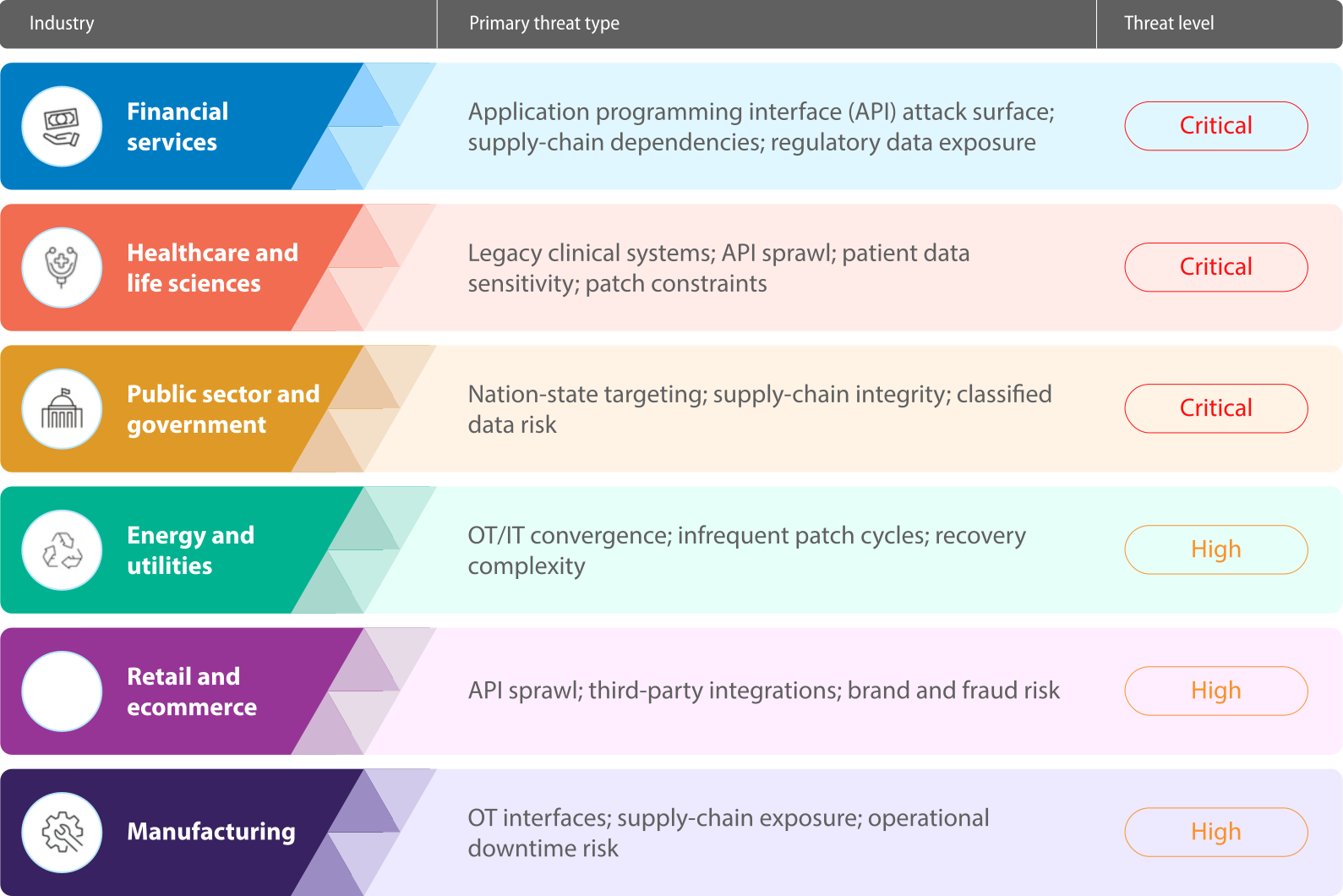
Figure 1 details the primary threats by industry, with threat levels depending on exposure to threat from Mythos-type AI software.
Figure 1. Financial services, healthcare, and public services are most at risk
Source: RAI Office, Infosys
Three recommendations for enterprises
The onus is to act now. Agentic AI systems are compressing threat attack timelines, making it vital for CISOs and RAI practitioners to build a continuously updated cybersecurity resilience. Three recommendations stand out:
- Reinvent cyber-response and risk models: Treat Mythos‑class AI as a step change. Attackers will move from discovery to exploitation in hours, or even minutes, often before the organization can even see the attack coming. Shift from patch-when-told to a continuous cycle of early detection, immediate exposure reduction, and strong responsive control. Deploy security updates quickly when available. Update governance and metrics to measure end‑to‑end time to mitigation, not just patch rates or control effectiveness.
- Don’t just find the vulnerabilities but fix the right ones: Make vulnerability management a decision system, not just a detection exercise. CISOs must be able to answer within hours whether an issue affects the organization, where it sits, and what to fix first. Use metrics such as complete asset inventory, reachability, and business criticality. Focus capacity on the most exposed vulnerabilities, with clear ownership and response service level agreements (SLAs).
- Build now, plug in Mythos later: Assume attack volumes will increase. Build automated remediation pipelines now to manage a greater threat surface without losing control. Use today’s models to implement, test, and harden the workflow. Once this is set up, plug in the Mythos‑class capabilities without redesigning core processes. Build platforms with strong data integrations, controls, and good user experience so CISOs can benefit quickly.
The Manhattan moment
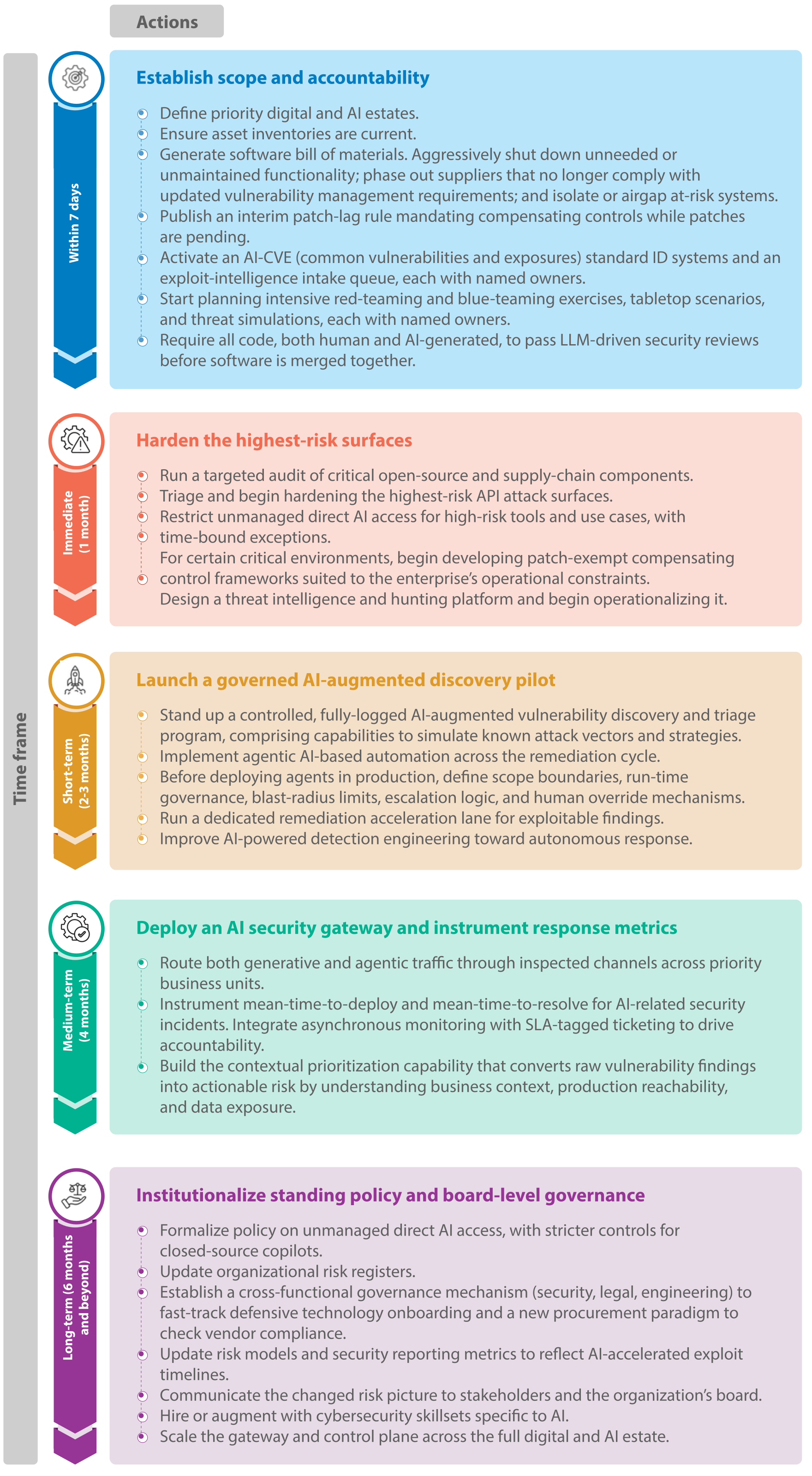
The response to Mythos-class risk should not be a single intervention, but a sequenced program of capability building, exposure reduction, and governance adaptation. AISI’s published evaluation of Anthropic’s Claude Mythos Preview model was specific about how organizations should move forward in the face of this Manhattan moment, namely by prioritizing security updates, adding robust access controls, reconfiguring security profiles, and ensuring comprehensive logging as an immediate first step.
Figure 2. Infosys RAI Office roadmap, building on AISI
Source: RAI Office, Infosys
Move quickly now
Anthropic Claude Mythos Preview-class AI, deployed defensively, is the most powerful tool enterprises have ever had for finding their own weaknesses before adversaries exploit them.
The organizations that will benefit most are those that move quickly to build a controlled, governed capability of their own, built on open-source software with a development team composed of RAI researchers and practitioners, AI developers, and sponsored at the top by the CISO.
The window to establish that advantage is open now. It will not remain open indefinitely.


For retailers, the AI advantage will come from building the organizational muscle that lets employees use AI confidently.
- 09 Sep, 2026
- 6 min read

Retailers must prioritize AI-powered supply chain intelligence, seamless omnichannel experiences, and personalization to drive growth and resilience.
- 08 Sep, 2026
- 15 min read

Companies that tailor their offerings and messaging to evolving consumer priorities will be better equipped to sustain demand as spending becomes more selective.
- 30 Jul, 2026
- 12 min read
