
Insights

- Data, automation, and AI can create value across enterprise functions, but legacy complexity, fragmented data, and uneven execution remain significant barriers.
- Expectations of SAP S/4HANA have expanded from system modernization to enabling resilient operations, real‑time insight, and intelligent, AI‑driven execution.
- Survey findings show that while most organizations expect S/4HANA to enable automation and AI within core business processes, only a minority report being very confident in their ability to sustain continuous optimization after go‑live, highlighting a gap between ambition and execution.
- Many organizations underestimate the impact of one‑time decisions around data, process, and architecture simplification, which strongly influence the scalability and effectiveness of AI over time.
- The Shades of Blue perspective highlights that transformation is not a binary choice between minimal change and wholesale reinvention, but a spectrum of options shaped by business context, risk tolerance, and ambition.
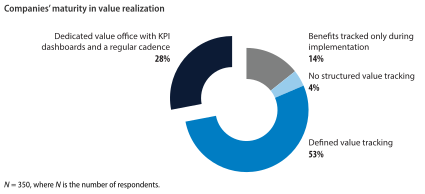
- Survey results also indicate that fewer than one‑third of organizations have a dedicated post–go‑live value realization model with defined KPIs and a regular governance cadence, reinforcing the importance of sustained execution discipline beyond migration.
- Organizations that balance continuity with deliberate redesign and maintain governance after go‑live are better positioned to translate S/4HANA investments into continuous improvement and enterprise‑wide AI adoption.

Foreword

Enterprise transformation has reached a point where outcomes matter more than activity. Many organizations have already modernized their core platforms, but what differentiates them today is how effectively those platforms translate into everyday execution and how reliably they support automation and AI as part of core operational workflows, rather than as isolated pilots.
For many organizations, SAP S/4HANA is already established as the operational core. What has changed is how much the business now expects from it. While migration is often initiated by practical considerations such as timelines, platform constraints, or the need to retire legacy systems, the conversation does not stop there. Leaders are now focused on what S/4HANA enables in practice, including better decision‑making, more resilient operations, and intelligent execution across core business processes, enabled by simplified data models, standardized processes, and embedded AI capabilities such as real‑time insights, automated decision support, and intelligent exception handling, delivered with greater clarity and predictability rather than amid ongoing disruption.
What we consistently observe is that outcomes vary widely, even among organizations that appear to have made similar investments. Some carry momentum forward, using S/4HANA to strengthen operational discipline and continuously improve how the business runs, and in doing so create the one‑time structural conditions required for AI and automation to scale across the enterprise. Others complete the migration successfully yet struggle to sustain progress once program business and IT teams step back and the demands of running the business take precedence. The difference rarely comes down to the maturity of the platform itself.
Instead, it reflects how organizations approach change. The clarity of intent they bring to transformation, the trade‑offs they are prepared to make, and the discipline they maintain after go‑live all shape what becomes possible. Decisions around data harmonization, process simplification, and architectural cleanup are often one‑time opportunities that strongly influence how effectively AI can be embedded into business execution over time. Where execution remains focused and deliberate, automation, analytics, and AI capabilities compound, and complexity is contained. Where that focus fades, value often plateaus even when the underlying platform is robust.
These patterns have led Infosys to view S/4HANA transformation not as a binary choice, but as a continuum of options captured in the Shades of Blue perspective. Shades of Blue reflects how organizations balance business continuity with transformation depth deciding consciously how much to reuse, how much to redesign, and which one‑time opportunities to address, based on context, risk tolerance, and long‑term ambition.
The perspectives in this journal are grounded in these observations, shaped by hands‑on experience with large SAP transformations and ongoing dialogue with leaders navigating similar challenges under significant operational pressure. They reflect the factors that determine whether S/4HANA delivers lasting value and becomes a foundation for scalable, AI‑enabled operations, or simply marks another milestone in a longer transformation journey.
Executive summary

SAP S/4HANA is now the established operational core for many large enterprises. While transformations are often initiated by timelines, platform rationalization, or end‑of‑support requirements, expectations have broadened significantly. Organizations increasingly look to S/4HANA to support more adaptive operations, embedded analytics and automation, and AI‑enabled decision‑making across core business processes. Yet similar transformation paths continue to produce very different outcomes.
This journal examines why those differences arise. The findings are based on a global survey of 350 enterprises using SAP as their primary ERP platform, all with annual revenues exceeding $1 billion, supplemented by research, executive workshops, and interviews with SAP transformation leaders across Infosys. Together, these inputs point to a consistent conclusion: outcomes depend far less on migration mechanics and far more on how organizations approach enterprise intent, program execution, and long‑term sustainment.
The report is structured around five themes that reflect the progression of a typical SAP S/4HANA journey.
Figure 1. Compliance pressure drives S/4HANA adoption
Source: Infosys Knowledge Institute
Chapter 1: Intent determines outcomes
Most organizations agree that moving to SAP S/4HANA is unavoidable, but many still approach it primarily as a deadline‑driven exercise. Survey insights show that even as S/4HANA is positioned as an enabler of analytics, automation, and AI, the dominant motivation for migration remains compliance with end‑of‑support timelines. When intent is framed around getting it done, organizations often replicate existing ways of working in the cloud rather than using the transition to create new value.
This chapter reframes S/4HANA as an opportunity to reset how the enterprise operates, emphasizing that value depends on clarity of intent, not just technical completion.
Chapter 2: Pressure limits momentum
Once transformation begins, execution pressure quickly dominates. Deadlines compress decision‑making, capacity is stretched, and teams are asked to transform while continuing to run the business. Under these conditions, attention narrows to stability and continuity. Momentum slows not because leaders lack ambition, but because execution absorbs focus.
This chapter explores how execution pressure disrupts sequencing, why transformation energy often drops as go‑live approaches, and why deliberate governance and prioritization are required to maintain focus on long‑term outcomes rather than short‑term program milestones.
Chapter 3: Choices define potential
There is no single right way to transform to S/4HANA. Organizations choose among brownfield, selective, and greenfield approaches based on risk tolerance and operational reality. However, the chapter shows that the specific approach matters less than how consciously trade-offs are made. Survey results indicate a strong bias toward continuity-preserving options, which is understandable — but these early decisions often hardcode constraints around data, processes, and customization. Once embedded, those constraints limit future flexibility, automation, and AI enablement.
This chapter explains how design choices define what will or won’t be possible later.
Figure 2. Business continuity dominates S/4HANA choices
Source: Infosys Knowledge Institute
Chapter 4: Transformation depth
Organizations following the same migration path frequently arrive at very different endpoints. The difference lies in how much change they are prepared to absorb. While most leaders recognize the importance of depth, data complexity, legacy configuration, and risk concerns frequently limit how much redesign can happen in practice.
This chapter introduces the Shades of Blue perspective, based on Infosys’ experience, to help leaders position transformation depth deliberately along a spectrum: from conservative continuity to progressive reinvention. The goal is not to prescribe how far to go, but to make depth an explicit enterprise‑level decision aligned to long‑term objectives.
Chapter 5: Impact sustained after go‑live
Go‑live marks a transition, not the point at which value is secured. After migration, organizations move from a structured project environment to everyday operations, where ownership dissipates and governance relaxes.
Survey findings show that while confidence in post‑go‑live improvement is high, few organizations have mature mechanisms to sustain it. Without run‑phase discipline, incremental changes reintroduce complexity and stall automation and AI adoption.
This chapter shows that sustaining value requires treating governance, adoption, and execution discipline as permanent operating capabilities so that early transformation gains compound over time. Ultimately, S/4HANA outcomes reflect organizational choices and discipline more than technical capability. Leaders who approach S/4HANA as a staged, intentional transformation balance continuity with deliberate change and sustain discipline beyond go‑live.
Done well, this turns a transition into a durable foundation for continuous improvement, automation, and intelligent execution.
Chapter 1
The imperative to transform
Enterprise resource planning (ERP) systems have long formed the operational backbone of large organizations, enabling finance, supply chains, and core operations to function reliably at scale.
SAP ERP Central Component (SAP ECC) was built to serve this role, supporting business models that emphasized stability, standardization, and control. For decades, it fulfilled that purpose well.
That operating context has now shifted. Enterprises are increasingly expected to operate in real time, integrate across complex internal and external ecosystems, and respond to volatility with speed, intelligence, and automation. Artificial intelligence (AI), advanced analytics, and automated decision-making have moved from experimental capabilities to baseline expectations for modern enterprises and core determinants of competitiveness.
This shift has changed the nature of ERP modernization. The question has shifted beyond efficiency gains or technology refresh cycles. ERP architecture increasingly determines whether AI can be embedded into everyday business execution at enterprise scale. While isolated AI proofs of concept remain feasible in legacy environments, scaling AI into core operational processes requires consistent data models, standardized processes, and real-time insights that traditional ERP architectures struggle to provide.
AI isn’t usually what makes organizations start an S/4HANA migration, but it increasingly shapes the consequences of how that migration is done. It exposes structural limits in legacy ERP systems that may have been acceptable before but now get in the way of operating quickly and intelligently.
In effect, AI raises the stakes of early design decisions rather than prompting the migration itself. While AI solutions can be integrated alongside ECC through external platforms, doing so often requires extensive custom integration and typically limits AI to peripheral use cases instead of embedding intelligence directly into core processes.
With this, SAP’s innovation focus has shifted to SAP S/4HANA, its next-generation ERP platform. Built on in-memory processing for faster data access, simplified data models, and native analytics and AI capabilities, S/4HANA represents a fundamental redesign of the enterprise core. It provides the structural foundation required for intelligence-driven, adaptive operations.
For many, the move to SAP S/4HANA can be framed as a compliance obligation, driven by support timelines as well as a strategic opportunity to modernize the business and establish an AI-ready enterprise platform.
An ERP core built for a different era
SAP ECC was designed for business processes that used to work on batch processing and static data models. Built more than two decades ago, it was optimized for business models that prioritized stability, periodic reporting, and tightly controlled transactional execution. For many years, that architecture served organizations well. It enabled scale, compliance, and reliability in environments where change was incremental, and decision cycles were measured in weeks or months rather than minutes.
Business demands today look very different. Enterprises are expected to respond in near real time, coordinate across increasingly complex internal and external ecosystems, and automate decisions as conditions change. These requirements expose the limits of an ERP core designed around static data models, batch processing, and heavily customized logic. While ECC systems continue to run reliably, they are structurally mismatched with the speed, flexibility, and intelligence modern operating models require.
SAP S/4HANA represents a fundamental upgrade of that core. Built on in-memory processing and simplified data models, S/4HANA was designed to support real-time insight, standardized processes, and continuous execution visibility. Rather than layering new capabilities onto legacy structures, it rethinks how enterprise data and processes are represented, creating a foundation that is easier to standardize, scale, and evolve.
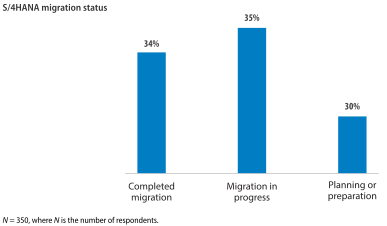
This shift helps explain why so many organizations have already begun the move to SAP S/4HANA. Figure 1 shows that nearly 60% of the 350 organizations surveyed by the Infosys Knowledge Institute report that they have either completed their S/4HANA migration or are actively executing it.
Figure 1. Most enterprises have already begun their SAP S/4HANA journey
Source: Infosys Knowledge Institute
A small number of organizations reported no immediate plans to migrate. In most of these cases, the hesitation was not driven by objections to the platform itself, but by internal considerations such as budget timing, competing priorities, or satisfaction with current systems for the moment. These responses were scattered across reasons rather than pointing to a single dominant concern, suggesting that nonmigration reflects localized organizational circumstances rather than broad resistance to the shift.
Why AI drives the case for S/4HANA
The most significant difference between ECC and S/4HANA emerges when organizations consider AI. It has moved from experimental use cases to an operational expectation, increasingly expected to assist decisions, automate processes, and surface insights directly within everyday execution. Scaling this requires consistent data and processes with real-time visibility, which is difficult in tightly customized ECC environments.
SAP’s product strategy reflects this shift. Advanced analytics, automation, and business AI capabilities are being natively embedded into the S/4HANA digital core rather than delivered as peripheral add-ons. This allows intelligence to operate inside core business processes instead of alongside them.
Survey responses reflect this expectation. Most organizations associate their S/4HANA transformation with AI-assisted decision-making, embedded intelligence within SAP applications, and automation of core business processes. AI is no longer viewed as an optional enhancement layered on top of ERP, but as a capability that depends directly on how the ERP core itself is designed.
S/4HANA is not a compliance exercise
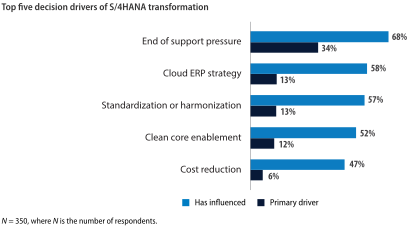
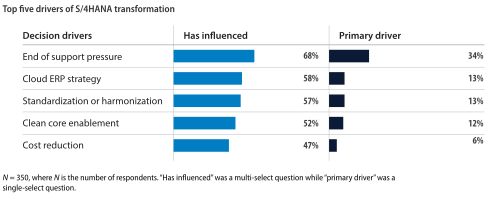
Yet the same data that confirms widespread migration activity reveals an imbalance in what drives action. While organizations increasingly associate S/4HANA with strategic outcomes such as standardization, clean‑core enablement, and AI readiness, execution is most often triggered by urgency. As shown in Figure 2, nearly seven in 10 organizations cite end‑of‑support pressure as a driver of transformation, and one in three identify it as the primary reason for moving, with AI enablement rarely serving as the initiating trigger.
Figure 2. Deadlines drive action
Source: Infosys Knowledge Institute
This imbalance shapes transformation behavior from the outset. Programs launched primarily to meet deadlines tend to optimize for speed, continuity, and risk avoidance rather than structural change. As a result, early decisions are made under constraint, long before deeper architectural and process‑level considerations are addressed.
Experience from previous transformations also plays a role here. Many organizations have lived through large, disruptive SAP programs that took far longer and consumed far more business efforts than expected. Promises to stick to the standard often gave way to extensive customization, leaving teams fatigued, skeptical, and wary of embarking on another multiyear transformation. Viewed through this lens, today’s preference for keeping existing processes unchanged comes as a reaction to hard-learned lessons.
Under these conditions, internal positioning becomes a critical turning point. Survey findings illustrate this gap clearly. While 39% of organizations frame their S/4HANA initiatives as business transformation and 33% as IT modernization, only a small minority positions the transition as operating model redesign (6%) or explicit AI platform enablement (4%). This framing matters because it determines how success is defined, which stakeholders remain engaged, and how much change the organization is prepared to absorb.
In these cases, the architectural consequences become visible over time: continuity dominates redesign, legacy structures are preserved, and the resulting ERP core proves difficult to evolve or extend for enterprise-scale intelligence and AI.
As Ravi Nair, vice president, SAP practice at Infosys, observed: “By delaying migration, you are going to pay a higher price. Businesses will achieve a lot more and gain much more value when S/4HANA migration is seen as an opportunity, compared to ‘I have no choice, I have to move.”
Transformations that are driven primarily by deadline pressure limit an organization’s ability to simplify the core, modernize processes, and establish the foundations required for long term adaptability and AI readiness.
By delaying migration, you are going to pay a higher price. Businesses will achieve a lot more and gain much more value when S/4HANA migration is seen as an opportunity, compared to ‘I have no choice, I have to move.
A deliberate reframing at the outset
When SAP S/4HANA initiatives are framed primarily as compliance responses or technical replacements, early enterprise‑ and program‑level decisions made under time pressure tend to favor continuity, preservation, and speed. These choices may stabilize program execution, but they also quietly constrain the foundations required for long-term adaptability, automation, and AI-enabled execution.
Addressing this imbalance does not require waiting for AI to become the trigger for transformation. Instead, it involves a deliberate reframing at the outset. Organizations that realize greater value approach S/4HANA not as an unavoidable infrastructure upgrade, but as an opportunity to redefine the enterprise core. Even when programs are initiated by deadlines, leaders who establish S/4HANA as a business and data transformation set clearer intent, elevate architectural and process decisions earlier, and ensure that AI-enabled execution is treated as a design objective rather than an assumed downstream benefit.
This shift in intent changes how trade-offs are made throughout the enterprise program. Scope, data, redesign, and governance decisions are evaluated for their impact on program objectives and timelines as well as how they shape an enterprise’s ability to operate with insight, automation, and resilience over time. Urgency remains, but it accelerates intentional decision-making rather than defaulting outcomes to continuity by inertia.
A story that changes the equation
Not all organizations fall into this pattern. A major US utility company illustrates how S/4HANA can serve as a strategic reset instead of a compliance response.
After more than two decades on SAP ECC, the organization faced increasing complexity across operations, financial management, and regulatory reporting. Leadership recognized that a straight technical conversion would preserve existing constraints instead of resolving them.
The organization defined a clear intent to modernize the digital core, streamline operations, and establish a future-ready data and analytics foundation while maintaining service continuity. Transformation choices were made deliberately. Effective processes were retained where appropriate, while those that limited agility or scale were redesigned. Data structures were simplified to improve consistency and usability, and legacy complexity that no longer delivered value was systematically removed.
The results were tangible. Real-time visibility improved decision-making and regulatory responsiveness. Operational complexity declined, reducing the cost of change. Most importantly, the organization established an ERP foundation capable of supporting advanced analytics, automation, and AI-driven capabilities directly within core business processes.
The differentiator was mindset: treating S/4HANA not as a one time upgrade, but as a platform for continuous evolution.
S/4HANA must redefine the core
The imperative driving the migration to S/4HANA today is to redefine the enterprise core around intelligence, adaptability, and AI enablement. Organizations that treat the transition solely as a reaction to support timelines risk carrying forward the same constraints that limit future competitiveness. By contrast, successful transformations focus early on clean core principles, data readiness, standardized processes, and architectural simplicity. These conditions determine whether AI can be embedded into everyday business operations instead of remaining confined to isolated analytics efforts.
Beyond enabling future use cases, AI is increasingly being applied to accelerate transformation itself by changing improving program efficiency, automating testing and documentation, and shortening time to value. Capabilities such as process analysis, testing, and adoption support reinforce the need for a modern digital core capable of sustained change.
When approached deliberately, S/4HANA becomes the structural foundation for intelligence-driven operations, continuous optimization, and long-term adaptability.
The organizations that act early retain control over the scope, sequencing, and strategic intent. Those organizations that delay risk entering the next decade with systems that continue to run reliably, but lack the capacity to learn, adapt, and compete in AI-enabled markets.
Chapter 2
Why organizations struggle to move forward
Once organizations commit to moving from SAP ECC to SAP S/4HANA, the challenge shifts from whether to transform to why progress so often proves difficult to sustain. Programs are launched with intent, investment is approved, and timelines are established. Execution, however, frequently becomes slower, more fragmented, and harder than expected to maintain. These difficulties are often attributed to technical complexity or platform readiness. In practice, many obstacles exist early but only become binding and therefore visible once transformation moves from planning into enterprise‑wide program execution.
As AI moves from experimentation to operational expectation, these execution challenges carry greater consequences. Fragmented processes, inconsistent data, and deferred structural decisions both slow programs and more broadly delay an organization’s ability to operationalize intelligence and limit how effectively AI can be embedded into the business at scale.
This chapter examines those realities, addressing a central question: why do so many SAP S/4HANA transformations lose momentum or deliver less value than anticipated once execution begins?
Awareness without momentum
Across industries and geographies, enterprises using SAP ECC broadly recognize the need to move to SAP S/4HANA. Beyond a system upgrade, the platform is increasingly viewed as a foundation for competing in environments defined by volatility, faster decision cycles, and digitally enabled operating models supported by real-time processing, tighter integration, and modern capabilities such as embedded automation and AI.
Once transformation begins, this recognition quickly collides with business, IT, and program pressure. SAP’s announced 2027 end of mainstream ECC support creates a fixed, nonnegotiable deadline that compresses decision making and elevates urgency. Teams are required to modernize core systems while continuing to run day-to-day operations, stretching capacity and forcing difficult trade-offs early in execution.Under these conditions, enterprisewide mobilization proves harder to sustain than initial intent suggests.
Large SAP-centric organizations operate across multiple business units, regions, and governance layers. While strategic intent may be shared at a high level, execution commonly advances unevenly across the organization.
The way many enterprises are designed reinforces this pattern. Most organizations are structured to prioritize operational stability rather than constant transformation. As a result, S/4HANA initiatives often progress in phases or within individual functions, instead of being driven as a single, coordinated enterprise effort. Over time, this slows more than just platform modernization. It also delays the organization’s ability to move AI beyond isolated experiments and embed it consistently into business processes.
Momentum falters during execution
As organizations move from strategy to program execution, execution reveals structural and operational frictions that are not fully visible during planning. These frictions surface through scope definition, resourcing decisions, technical inheritance, and data constraints, shaping execution choices and limiting how far transformation ambitions can be carried forward.
1. Unclear scope and shifting boundaries
One of the earliest sources of friction is the absence of a stable and well‑defined scope at the outset of execution. Infosys’s survey of 350 organizations shows that fewer than 30% of organizations have a clearly defined S/4HANA transformation scope with quantified outcomes. The majority began execution with scope that was either still evolving (49%) or defined only at a high level (21%).
When scope remains unsettled, decisions are deferred, dependencies multiply, and execution slows. This ambiguity wears down confidence and makes deeper transformation difficult to pursue, especially where standardized processes and consistent data are prerequisites for AI‑enabled automation and decision support.
2. Constraints and competing priorities
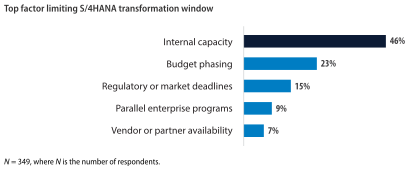
SAP S/4HANA transformation rarely occurs in isolation. Most organizations modernize ERP while running multiple enterprise initiatives in parallel, and survey data shows that internal capacity is the strongest constraint limiting the transformation window, followed by budget phasing, concurrent programs, and regulatory or market deadlines.
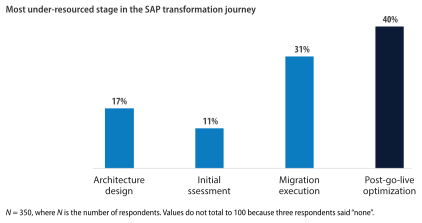
These pressures shape how attention and resources are allocated: program execution activities across business, IT, data, and change teams absorb most of the effort, while initiatives required to sustain momentum beyond go-live are often under-resourced. Survey results indicate that post-go-live optimization is the most under-resourced stage (40%), followed by migration execution (31%) and architecture design (17%).
Sustained capacity strain contributes to transformation fatigue. As Figures 1 and 2 show, momentum slows because program pressure concentrates capacity on reaching go live, leaving limited bandwidth for optimization, standardization, and AI enablement.
3. Legacy customization
The condition of the existing SAP ECC landscape introduces another significant constraint on execution. Survey results show that approximately eight in 10 organizations entered their S/4HANA transformation with moderate to high levels of custom code and bespoke enhancements.
At the same time, customization maturity is uneven. Only 15% of organizations report that their customizations were fully documented and well understood prior to transformation. The majority rely on partial documentation or institutional knowledge held by a small number of individuals.
This combination of extensive customization and limited transparency shapes transformation behavior. Under execution pressure, organizations are less likely to rationalize or redesign custom code whose business logic is not fully understood. Instead, they favor preserving existing functionality to avoid operational risk. While this approach stabilizes program timelines, it also carries forward fragmented logic and local variants that inhibit standardization, complicate testing, and constrain the scalability of analytics and AI across enterprise processes.
4. Data complexity limits redesign
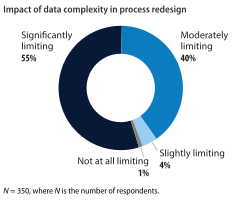
Data considerations introduce additional and often underestimated constraints on execution. Survey results indicate that 55% of organizations reported data complexity as significantly or completely limiting their ability to redesign business processes during S/4HANA transformation, including 22% who said it completely limited redesign.
When historical data volume, structure, or quality becomes a limiting factor, organizations often scale back redesign ambitions to preserve program timelines. While this approach maintains forward motion, it also carries forward legacy data structures that restrict advanced analytics and AI from being operationalized at scale, even after technical migration is complete. This shows that legacy technical debt can set a hard limit on how far process redesign can go during an S/4HANA transformation.
5. Deferred structural decisions
Under the combined pressure of unclear scope, limited capacity, and data complexity, organizations frequently postpone difficult but foundational decisions. Survey results show that high‑disruption, high‑coordination decisions particularly reporting model redesign (60%) and custom code rationalization (55%) are most often deferred. These decisions cut across multiple functions and data domains, making them harder to resolve under program governance and execution pressure than more contained structural choices.
Deferring these decisions offers short-term relief by keeping the program moving. However, as deadlines close in, decisions that were deferred become difficult to undo, leaving organizations with fragmented reporting and legacy customizations that constrain standardization, automation, and future AI adoption.
6. Cumulative impact on AI outcomes
The constraints discussed above do not operate independently. This is reflected in survey findings that show organizations expecting limited AI enablement after transformation more frequently report conservative overall outcomes.
Their combined effect shapes how organizations assess future potential following S/4HANA migration. Programs might succeed technically, but they preserve fragmentation and legacy structures that limit strategic change and reduce confidence in the organization’s ability to embed AI into core operations.
Weak governance amplifies this effect. Without clear decision rights, standardized processes, and defined data ownership, AI initiatives fragment quickly, reinforcing pilot behavior rather than enterprisewide adoption.
Figure 1. Transformation pressure concentrates before and during go live
Source: Infosys Knowledge Institute
Figure 2. Execution resources drop just as optimization becomes critical
Source: Infosys Knowledge Institute
Regain momentum within constraints
The constraints described in this chapter are not exceptional, nor do they indicate flawed program design. They are a predictable feature of enterprise-scale SAP S/4HANA transformations. What determines outcomes is not whether these constraints exist, but whether they are addressed or are allowed to accumulate.
The experience of a large US utility organization illustrates how SAP S/4HANA transformation momentum can be sustained even under significant pressure. Operating in a highly regulated environment, the organization faced challenges with extensive legacy customization, large volumes of historical data, limited tolerance for operational disruption, and finite transformation capacity.
Rather than attempting broad, simultaneous change, the organization focused early on stabilizing the conditions required for execution. Governance structures were clarified at the outset, decision authority was centralized, and a clear enterprise mandate was established. This reduced internal friction and prevented scope and prioritization decisions from being negotiated repeatedly across functions and regions.
The transformation scope was deliberately focused to keep momentum strong. The intent was to maintain forward progress by concentrating on areas where legacy complexity directly affected reporting accuracy and operational insight. At the same time, stable processes essential for continuity were left unchanged. Making these trade-offs clear from the outset helped the program maintain direction and avoid the gradual drift that often slows execution as program pressure builds.
Momentum continued because organizational constraints were recognized early and actively managed. Clear guardrails prevented deferred decisions, localized optimizations, and competing priorities from shaping outcomes by default. This approach kept program execution predictable and steady, even as underlying complexity remained part of the environment.
This disciplined approach did more than meet program milestones. It created a foundation that could support future standardization, analytics, and AI-enabled capabilities over time.
Momentum starts with governance. When it is done well, governance simplifies rather than complicates execution. Clear decision rights and priorities reduce repeated negotiation, shorten decision cycles, and limit rework as the program progresses. Organizations that invest early in governance do so to create focus, reduce fatigue, and keep execution on track, especially as enterprise program pressure starts to build.
As Ramesh J Chougule, vice president, SAP practice, Infosys, observed: “The program has to be front, right, and center for everyone that drives it. Programs are wide-reaching. You need to look at the process, people, value, change management, and technical aspects together. That’s what truly makes it a transformation.”
Make constraints explicit
To avoid stalled execution in SAP S/4HANA transformations, organizations must move beyond accommodating organizational constraints and instead actively govern around them. This requires treating execution not as a linear implementation effort, but as a coordinated enterprise change that demands explicit leadership direction and sustained decision discipline.
Clear sponsorship, an integrated enterprise roadmap, and empowered internal ownership create the conditions needed to resolve trade-offs as they arise rather than deferring them. When governance, capacity, and change readiness are managed deliberately, programs retain room to adapt without diluting intent.
Organizations that establish this foundation early are better positioned to sustain momentum through and beyond go live. Rather than concluding with a technically successful migration, they preserve the optionality required to standardize processes, scale analytics, and realize the longer term business value S/4HANA was intended to enable.
The program has to be front, right, and center for everyone that drives it. Programs are wide-reaching. You need to look at the process, people, value, change management, and technical aspects together. That’s what truly makes it a transformation.
Chapter 3
Make the right strategic choices
Once organizations start moving from SAP ECC to SAP S/4HANA, the conversation quickly shifts from whether to transform to how far they want to go and what capabilities they want to unlock along the way.
This choice has become more important as AI moves from supporting work on the side to being built into everyday business processes. As AI moves from experimentation into day-to-day use, the transformation approach determines whether intelligence becomes part of everyday execution or stays limited to isolated analytics and automation.
SAP S/4HANA supports multiple transformation paths, each carrying different implications for continuity, redesign, risk, and long‑term flexibility. Choosing between these paths is a strategic trade-offs between preserving legacy structures and creating the standardized processes and data foundations required for scalable, enterprisewide AI enablement.
This strategic choice determines how the organization creates and sustains business value over time. Transformation choices extend beyond technology, directly influencing operational agility, the economics of change, responsiveness to external volatility, and the ability to scale automation and AI across the business.
This chapter examines how organizations navigate that choice, the criteria that influence approach selection, and why early decisions can define the ceiling for future transformation outcomes, including the organization’s ability to operationalize AI at scale.
Transformation options and implications
SAP S/4HANA doesn’t prescribe a single path forward because there isn’t one. Every organization comes into this transformation with different constraints, priorities, and aspirations. Some need to move quickly and keep the lights on; others see this as a chance to fundamentally redesign how the business operates, and many are trying to balance both. This flexibility is intentional. S/4HANA supports multiple approaches so organizations can move at a pace and depth that fits their own context.
At one end of the spectrum, brownfield transformations focus on speed and stability. The existing ECC system is converted with minimal redesign, so most processes, data structures, and customizations are retained. This approach is often chosen when minimizing disruption is critical and the priority is to keep operations running smoothly while meeting migration timelines.
At the opposite end, greenfield transformations start fresh. S/4HANA is implemented as a new system, creating the opportunity to redesign processes, simplify data structures, and rethink operating models more fundamentally. This approach offers the strongest foundation for standardization, automation, and AI-enabled business execution, but it also requires a much higher tolerance for organizational and operational change.
Between these two extremes, selective or bluefield transformations strike a balance between reuse and redesign. Organizations keep elements of the current landscape that continue to perform well, while modernizing areas that limit visibility, scalability, or adaptability. This path suits organizations that want to progress without triggering widespread operational disruption.
Each of these approaches establishes a different starting point for how capabilities such as embedded analytics, automation, and artificial intelligence can be introduced and scaled within core business processes.
The decision goes beyond the mechanics of migration and reflects how much change the organization is ready to take on from the start.
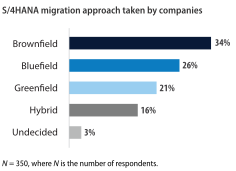
What organizations choose varies widely, shaped by their circumstances. Survey results show that roughly one third of organizations adopt a brownfield approach, about a quarter pursue a selective path, and around one fifth choose a greenfield transformation. The remainder combine elements of multiple approaches, reflecting the complexity of their operating landscapes and the trade-offs they are trying to manage (Figure 1).
Figure 1. Most choose incremental change over reset
Source: Infosys Knowledge Institute
Why approach selection becomes a risk
The risk in S/4HANA transformations comes from how strategic choices are made.
In many organizations, early decisions are taken under program and operational pressure. The focus is on keeping programs moving and minimizing disruption. Over time, those early preferences start to harden into defaults, before leaders have agreed on what the future operating model should actually look like. What feels like a sensible, low-risk decision early on can narrow the range of options available later.
To see why this happens, it helps to look at how business priorities influence transformation choices in practice.
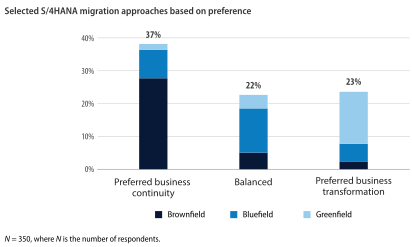
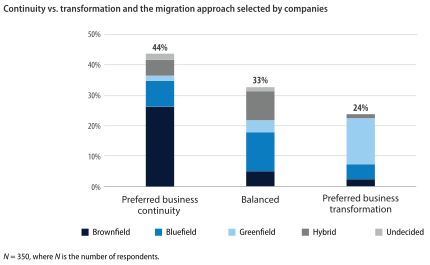
Figure 2 shows a clear pattern. When organizations prioritize business continuity, nearly half (44%) gravitate toward conservative migration paths, with brownfield and selective transformations dominating. Even when modernization is a stated goal, the desire to preserve existing processes and avoid disruption often carries more weight when decisions are made.
Figure 2. Business continuity is the preferred approach
Source: Infosys Knowledge Institute
Organizations that describe their intent as balanced show more variation in approach, spreading choices across selective, hybrid, and greenfield paths. This suggests that these organizations recognize the need for change, but delivery feasibility, risk, and time constraints still shape what ultimately gets approved.
Only a smaller share of organizations (24%) expresses a clear preference for business transformation. In this group, greenfield approaches are much more common, reflecting a greater willingness to accept disruption in exchange for standardized processes, simpler data structures, and long‑term flexibility.
What the data makes clear is that approach selection is rarely driven by ambition alone. It’s shaped by how organizations weigh risk, disruption, and continuity at the point of decision. Even when leaders want to drive transformation, concerns about stability often take over, pushing programs toward incremental changes instead of a fundamental reset.
This is reinforced by how decisions are evaluated internally. Most organizations don’t select a transformation path based on a single objective. Instead, they balance timelines, budgets, disruption risk, data complexity, process harmonization goals, and existing SAP investments. In these situations, the promise of automation, analytics, and AI tends to take a back seat as program execution certainty becomes the priority. Once program execution begins, these trade-offs start to stick. Decisions about data scope, process redesign boundaries, integration architecture, and custom code retention quickly become embedded in the new S/4HANA core. Although plans may look flexible during early discussions, reversing these choices later is costly and disruptive.
As Balasubramanian V, vice president, SAP practice, Infosys, puts it: “Sometimes people make the mistake of saying, ‘I’ll do a brownfield first and then I’ll do the transformation afterward.’ While that might be true to some extent, there are certain things that you’ll miss out on that you can’t correct later.”
In an AI‑driven context, this matters even more. Choices that preserve local process variants, fragmented data models, or tightly coupled custom logic can speed up migration in the short term, but they make it harder to automate consistently or embed intelligent decision support across the enterprise later on because automation and AI depend on standardized processes and shared data definitions to scale.
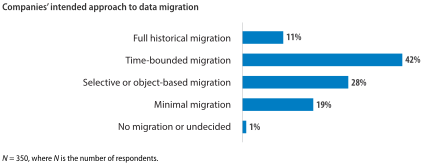
These effects show up clearly in early data decisions. Only a small number of organizations fully migrate historical transactional data to S/4HANA (Figure 3). Most adopt time‑bounded, selective, or minimal approaches to reduce complexity and risk. While these choices help deliver in the short term, they’re among the hardest decisions to revisit later. Limiting historical data may preserve continuity, but it also limits analytical depth, process redesign, and the ability to train and scale AI across core operations.
Figure 3. Early data decisions limit future change and AI potential
Source: Infosys Knowledge Institute
Sometimes people make the mistake of saying, ‘I’ll do a brownfield first and then I’ll do the transformation afterward.’ While that might be true to some extent, there are certain things that you’ll miss out on that you can’t correct later.
How strategic choices take shape
Organizations that achieve stronger outcomes recognize this early and treat approach selection as a strategic commitment rather than a technical step. Instead of defaulting to continuity under program pressure, they decide where preservation is necessary and where change is essential.
The following examples illustrate how different organizations made these trade-offs deliberately choosing approaches aligned to their operating context while protecting long-term analytics, automation, and AI potential.
A large US utility organization operating in a highly regulated environment faced extensive customization, significant historical data volumes, and limited tolerance for disruption. A purely technical conversion would have met timeline pressures but preserved constraints that limited analytical insight and future flexibility. A full greenfield redesign was not feasible.
The organization therefore chose a selective approach, retaining stable operational processes while modernizing data structures and reporting where legacy complexity most constrained visibility and decision making. This approach preserved momentum while improving the foundation for future analytics and AI‑supported capabilities without overstretching program execution capacity.
In contrast, a water utility organization based in North America with a fragmented ERP landscape reached a different conclusion. Inconsistent processes and data across the enterprise limited operational transparency and standardization. Retaining large portions of the legacy environment would have perpetuated complexity.
This organization pursued a greenfield approach, establishing standardized processes and a unified data foundation across operations. While more disruptive, the decision aligned with long‑term objectives to simplify the operating model and embed intelligence consistently across the enterprise.
Successful organizations make these trade-offs consciously. Whether adopting a selective or greenfield approach, they clarify where continuity is essential and where redesign is non-negotiable to support long-term analytics, automation, and AI integration.
Make the strategic choice explicit
To make the right strategic choice, organizations should:
- Define future operating intent upfront: Articulate how automation and AI are expected to function within core business execution and use this to evaluate and design transformation approaches.
- Evaluate approaches against long‑term capability: Recognize that approaches chosen to minimize near-term risk could constrain future flexibility and intelligence enablement.
- Treat data strategy as a strategic decision: Historical data migration choices are among the most difficult to reverse and should be aligned explicitly to the ambition around the transformation.
- Make trade-offs explicit rather than deferred: Deferring foundational decisions could preserve short-term momentum but could also narrow future options as execution progresses.
The selection of an approach is what establishes the path of migration. Whether that path leads primarily to transactional stability or to an AI-enabled operating model depends on how deliberately the choice is made.
Chapter 4
Process transformation at the right depth
Selecting an SAP S/4HANA transformation approach is often treated as the defining decision in an organization’s modernization journey. Yet experience shows that approach selection alone does not determine outcomes. Organizations that follow similar migration paths frequently realize very different levels of business value.
The real differentiator is the level of change an organization is prepared to absorb, rather than the technical path it follows. Some enterprises and program leadership teams focus on continuity, limiting change to what is required to progress. Others use the transition to simplify how the business works, rationalize data, and strengthen decision-making. Many try to strike a balance, but often without clearly defining what that balance means.
As expectations of enterprise resource planning (ERP) platforms continue to rise, particularly around analytics, automation, and AI‑enabled execution, this distinction becomes critical. The value realized from SAP S/4HANA depends less on migration mechanics and more on the depth of transformation the organization commits to.
This chapter explores how organizations decide how far to go, why that decision is difficult in practice, and what it takes to make deliberate, enterprise-level choices about the scale and direction of change.
Depth determines what really changes
Once an organization commits to moving to SAP S/4HANA, a less visible but far more consequential decision quickly emerges: how much change it is willing to absorb as part of the transition.
Depth determines what really changes during migration. It influences whether existing processes are largely carried forward or meaningfully redesigned, whether historical data is migrated as‑is or selectively rationalized, and whether legacy logic embedded in custom code is preserved or replaced with more standardized foundations. Together, these choices shape how flexible, consistent, and insight‑ready the enterprise becomes after go‑live.
This is why organizations that follow the same migration approach can end up in very different places. Some prioritize continuity and aim to minimize disruption. Others push further, using the move to improve transparency, reduce complexity, and prepare for future capabilities. In practice, outcomes vary less by the technical path chosen and more by how deeply transformation is applied across the enterprise.
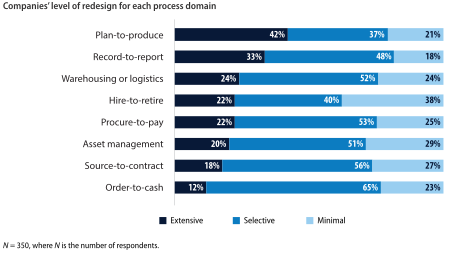
The Infosys survey of 350 organizations shows that full, end‑to‑end process redesign is still the exception (Figure 1). While most organizations make some changes, nearly half limit redesign to specific process areas, and only a small minority pursue comprehensive transformation across the enterprise.
Figure 1. Most S/4HANA transformations stop at selective process redesign
Source: Infosys Knowledge Institute
As S/4HANA increasingly serves as the digital foundation for analytics, automation, and AI‑supported decision‑making, depth becomes a deciding factor. These capabilities rely on standardized processes and consistent data. Whether those conditions exist after migration depends directly on how far the organization chooses to move away from legacy structures.
Most leaders understand this in principle. The challenge is putting it into practice.
Why getting depth right is so hard
While the importance of depth is widely acknowledged, executing it deliberately is much harder. Survey data shows that even among organizations following similar migration approaches, the level of redesign achieved varies significantly. Most stop at selective change, leading to very different outcomes after go-live. In most cases, the gap reflects the realities of execution rather than a lack of intent.
Data sits at the center of these constraints. Organizations typically go into an S/4HANA program aiming to simplify processes, improve transparency, and enable advanced analytics, automation, and AI capabilities. All of that depends on having data and process logic that can support change at scale. These goals collide with decades of accumulated complexity: large volumes of historical data, fragmented master data, tightly coupled integrations, and extensive custom logic embedded throughout the legacy landscape.
Survey results confirm this pattern. More than half of organizations report that data complexity significantly or completely limited how far they could redesign business processes (Figure 2). Even when leaders intend to change more, existing data structures often set a hard ceiling on what is feasible.
Figure 2. Complexity caps how process redesign
Source: Infosys Knowledge Institute
As execution progresses, additional realities reinforce this limit. Data quality issues, legacy custom code, and integration dependencies often surface later than expected, forcing teams to scale back redesign in order to keep programs moving. These challenges are frequently underestimated during planning but become unavoidable once program execution begins.
Data also introduces financial pressure. S/4HANA licensing and operating costs are increasingly tied to data footprint, turning legacy data volume into a cost issue as well as a technical one. Under deadline and budget pressure, program leadership and execution teams often narrow redesign scope to maintain momentum, reinforcing a preference for lighter transformation.
Early decisions become especially powerful because they are difficult to undo. In ECC, business variation was often captured through duplicated structures like multiple profit centers, accounts, or organizational units. S/4HANA allows the same business meaning to be represented more cleanly, using fewer core entities enriched with attributes instead. But this kind of simplification is easiest during the transition itself. When legacy structures are carried forward unchanged, the opportunity to simplify at scale is largely lost.
As Ravi Nair, vice president, SAP practice, Infosys, explains: “This shift is about embracing a design principle. S/4HANA enables structural simplification only if legacy data and configuration are intentionally rearchitected during the transition.”
Time pressure adds another layer. As milestones approach, broader redesign is often deprioritized to protect operational stability. In the short term, this helps programs meet schedule and stability objectives. Over time, it preserves fragmentation that limits insight, automation potential, and adaptability.
Going too far brings its own risks. Deep redesign increases disruption, extends timelines, and raises execution complexity. Most organizations agree that transformation needs to happen: the tougher question is how much change they’re ready to take on. If depth isn’t positioned intentionally, it tends to drift toward safer, short-term choices instead of what supports long-term success.
This shift is about embracing a design principle. S/4HANA enables structural simplification only if legacy data and configuration are intentionally rearchitected during the transition.
Set the enterprise on the blue spectrum
Organizations that succeed are deliberate about transformation depth, choosing it consciously rather than letting it emerge under pressure of executing the program. Infosys has developed a practical way of helping leaders position their transformation deliberately along a spectrum of change called shades of blue.
Shades of blue is not a migration method or a single answer that works for everyone. It reflects patterns observed across many S/4HANA transformations, where organizations struggle to balance continuity with the need for meaningful redesign. Instead of framing transformation as a binary choice between preservation and reinvention, the concept offers a structured way to decide how far to go, based on business priorities, regulatory context, risk appetite, and long-term ambition.
At the lighter end of the spectrum, organizations emphasize stability, operational continuity, and reuse of existing structures. As organizations move toward darker shades, the scope of change increases, introducing progressively deeper redesign of processes, data structures, and decision logic. The spectrum serves as a visual metaphor for flexibility with coherence, allowing organizations to calibrate how far they transform without fragmenting the enterprise or the program.
For practical decision-making, Infosys describes different shades in this continuum using three enterprise-level postures: Conservative, Balanced, and Progressive. These are not separate approaches, but named reference points along the same continuum, each representing a coherent set of trade-offs across transformation scope, cost, risk, timelines, and future readiness.
A conservative shade reflects an enterprise decision to prioritize compliance, system stability, and rapid transition over innovation. The core focus is technical modernization and data volume management, keeping the target S/4HANA footprint optimized while leaving business processes largely unchanged. Scope is limited to changes required for compatibility, regulatory compliance, and basic system refresh.
This posture results in short timelines, low resource complexity, controlled cost, and minimal disruption to ongoing operations. Execution risk remains low, but opportunities for innovation and advanced capability enablement are intentionally deferred.
A major railroad organization exemplifies this conservative shade of blue. Operating in a highly regulated environment where service continuity was paramount, the organization pursued a bluefield conversion that minimized business impact. The organization simplified its S/4HANA migration by leaving behind data from older, no longer critical ECC modules, while keeping the core business processes unchanged to ensure a smooth transition. This enabled a fast, compliant S/4HANA go-live with very little risk or disruption.
A balanced shade is about finding a middle ground, keeping the business stable while making targeted improvements where legacy structures are holding performance back. Organizations following this path focus on reducing technical debt and fixing structural issues that limit transparency or efficiency, often by harmonizing core structures, redesigning a few high impact processes, and improving data quality. The aim is steady, visible progress that supports modernization without introducing excessive risk, cost, or disruption.
Core processes are retained where they continue to perform well, while targeted redesign enables adoption of embedded S/4HANA capabilities such as advanced analytics and modern finance functionality. Costs, timelines, and resource requirements are moderate, and risk is managed by leveraging proven operating foundations.
A pharmaceutical major demonstrates this balanced shade of blue. The organization used a bluefield approach to modernize finance and planning processes while selectively excluding data related to divested businesses. This simplified reporting structures and improved consistency without overstretching organizational capacity or introducing excessive execution risk.
A progressive shade reflects an enterprise-level commitment to strategic reinvention. Organizations choosing this approach pursue comprehensive redesign of processes and systems, adopt clean-core principles, and aggressively leverage S/4HANA capabilities to maximize agility, scalability, and long-term competitiveness.
In any shade of blue, there is reuse and there is redesign. What changes is the balance. The shade allows organizations to choose how far they go, without forcing an all or nothing decision.
Here, the scope is broad and transformative. Legacy modules and processes are retired, data is purposefully detached from historical configurations, and operations are harmonized across geographies or business units. Timelines are longer, cost and resource demands are significantly higher, and execution risk increases — but so do potential rewards.
A global pharmaceutical leader took this approach by using an S/4HANA Selective Data Transition, which allowed the organization to redesign core processes and restructure data more deeply as part of the move.
The organization reengineered core processes, standardized operations globally, and established unified master data foundations. While the transformation introduced significant complexity during execution, it created a robust, adaptable platform capable of sustaining innovation, automation, and AI-enabled execution.
Across all three scenarios, the migration mechanics were secondary. The deciding factor was where the enterprise positioned itself on the shades of blue spectrum, a choice that ultimately determined scope, risk profile, cost, and the future potential of the digital core.
As Ramesh J Chougule explains: “In any shade of blue, there is reuse and there is redesign. What changes is the balance. The shade allows organizations to choose how far they go, without forcing an all or nothing decision.”
With this framing, the data strategy becomes the defining constraint. Decisions about historical data, what is migrated, selectively transitioned, or intentionally left behind, set hard boundaries on future simplification, harmonization, and capability enablement. The organizations positioned in lighter, more conservative shades prioritize continuity, accepting limits on future flexibility. Those positioned in darker, more progressive shades are more likely to detach data from legacy configuration and custom logic, enabling standardization and adaptability after go-live.
Choosing the appropriate position on the spectrum requires evidence, not intuition. Visibility into current process performance, data quality, and architectural dependencies helps organizations assess how much change is feasible and where structural constraints truly lie.
Capabilities such as SAP Signavio and SAP LeanIX support this assessment by making operational variation and technical complexity visible. These insights do not dictate a specific outcome, but they enable a grounded, deliberate enterprise choice.As Nair further observes: “Once you take everything forward unchanged, your room to harmonize later is very limited. Where you place yourself on the spectrum largely determines what becomes possible after go-live.”
Make depth an explicit decision
To get real value from SAP S/4HANA, organizations need to decide upfront how much change they want to drive, rather than letting depth emerge as the migration unfolds.
This requires leadership alignment on where the enterprise intends to position itself along the shades of blue spectrum, based on business objectives, data realities, regulatory considerations, and tolerance for change. Once chosen, this positioning should guide scope decisions, data strategy, and redesign ambition consistently throughout the program.
Making depth explicit reduces late‑stage scope changes, limits rework caused by deferred data decisions, and focuses transformation effort where it delivers meaningful value. It also establishes data and process foundations that determine whether capabilities such as advanced analytics, automation, and AI can be embedded over time.
Sustaining and building on those changes after go‑live introduces the next challenge: maintaining momentum. The following chapter examines how organizations extend transformation beyond deployment and embed continuous improvement into the enterprise.
Chapter 5
Execute and sustain value over time
Going live on SAP S/4HANA is a major milestone, while the real measure of value takes shape over what follows. For most, it marks a shift in focus from completing program execution the program to making the system work for the business every day.
What happens after go-live determines whether S/4HANA becomes a platform for continuous improvement, automation, and AI-enabled execution, or whether it settles into place as a modernized system whose impact gradually levels off.
In the earlier chapters, we explored why organizations need to transform, how they select a transformation approach, and how deeply they rethink processes and data. This chapter looks at what comes next. It focuses on how value is sustained once the formal program phase closes, project teams disband, and responsibility moves back to the business.
For many organizations, this stage arrives alongside a sense of transformation fatigue. After years of planning, program execution, and organizational change, teams want to restore stability and return their attention to running the business. As a result, sustaining value becomes as much about leadership and organizational behavior as about technology.
At the same time, expectations continue to rise. S/4HANA is increasingly designed to support automation and AI directly within core business processes. The Infosys survey shows that nearly two thirds of organizations view S/4HANA transformation as an enabler of AI-driven decision-making and execution spanning business AI for analytics and insights, SAP embedded AI within core applications, and service AI that supports intelligent process automation. Far fewer associate S/4HANA with limited or experimental AI use, underscoring that organizations expect intelligence to be operational and embedded in everyday work, not peripheral.
While the platform provides the foundation, whether those capabilities take hold depends on what happens after go-live. When execution discipline weakens, governance relaxes, or data consistency slips, AI can end up confined to isolated pockets instead of becoming part of everyday work. In practice, leadership reinforcement and enterprise operating discipline matter far more than system features alone. This brings us to the core question addressed in this chapter: once S/4HANA is live, how can organizations ensure that transformation continues to deliver value year after year?
Work begins when the migration ends
After go-live, the work changes. What was once a project becomes an ongoing responsibility to adopt, optimize, and keep building new capabilities.
Post-go-live, paths diverge quickly. Some organizations maintain momentum by improving performance, strengthening data quality, and expanding the use of standardized processes, automation, and analytics. Others lose traction as governance relaxes, priorities shift, and legacy behaviors reemerge. This is a predictable consequence of formal program structures being wound down, incentives shifting back to business as usual, and organizations prioritizing short-term stability after prolonged transformation effort.
What this highlights is that value is something organizations build over time, through deliberate action, rather than something delivered automatically at go-live.
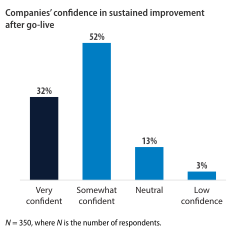
The Infosys survey of 350 organizations indicates that organizations have strong expectations that value will continue beyond initial deployment (Figure 1). However, confidence is uneven. While many organizations express general optimism, only 32% report being very confident in their ability to sustain continuous improvement after go-live. This highlights that post-go-live value is widely expected, but fewer organizations view it as a managed outcome requiring persistent ownership.
Figure 1. Confidence in optimization after go-live
Source: Infosys Knowledge Institute
Organizations also hold high expectations for advanced capabilities after go-live. Many expect S/4HANA to support AI-assisted decision-making, embedded analytics, and automation within core business processes to position SAP S/4HANA as a foundation for more intelligent, insight-driven execution.
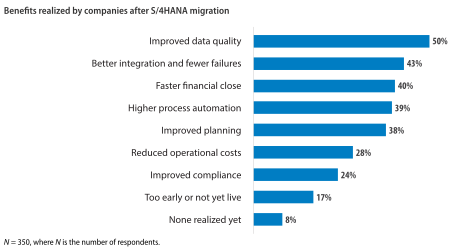
Realized outcomes to date, however, remain largely foundational. Organizations most commonly report improvements in data quality, faster financial close, system stability, and incremental automation, while deeper operational change is less consistently achieved. This pattern suggests that S/4HANA is delivering early value, with more transformative benefits expected to emerge later and unevenly.
How organizations sequence their transformations helps explain this gap. Nearly 90% plan to phase innovation after their initial S/4HANA migration, treating transformation as a process that unfolds over time rather than a single event. That approach creates flexibility and reduces pressure up front. At the same time, as the chart shows, most organizations are seeing early improvements like better data quality and system stability, while more meaningful operational change and cost reduction are still to come.
Phased innovation works only if momentum, discipline, and clear ownership are carried forward once formal program structures are wound down. When that doesn’t happen, transformation stalls at the foundation instead of building toward its intended impact.
That said, the real challenge begins after go-live: sustaining execution discipline so expectations translate into durable outcomes.
Why value erodes after go-live
Value erosion after SAP S/4HANA go-live is rarely caused by the technology itself. More often, it occurs as transformation shifts from a structured enterprise program into routine operations without equivalent operating discipline.
During migration, organizations operate with a high degree of structure. Governance is clear, milestones are defined, funding is ring-fenced, and leadership attention is focused. Accountability is shared across business and IT, and decision‑making is aligned around a common enterprise objective: achieving go‑live.
After go-live, that focus frequently falls away even as the need for optimization, adoption, and capability development increases. While many organizations have deep experience running transformation programs, far fewer have built the operational maturity needed to sustain value once those programs end. Project teams disengage, priorities shift back to business as usual, and responsibility for improvement becomes diffuse. This is when many organizations assume momentum will continue on its own.
And it’s here where run-phase governance becomes critical and where gaps most often emerge. This is the operating discipline that ensures someone remains accountable for whether processes are improving, whether data quality is sustained, and whether changes introduced after go-live reinforce or undermine the original transformation intent. Without it, optimization becomes optional, decisions become reactive, and improvements must compete with daily operational pressures.
Figure 2. Realized benefits skew foundational post-go-live
Source: Infosys Knowledge Institute
Survey findings reinforce this transition risk (Figure 3). While expectations for post-go-live value are high, only 28% of organizations report a dedicated realization model with defined key performance indicators (KPIs) and a regular governance cadence for the same. The majority rely on ad hoc tracking or discontinue structured value management once implementation concludes.
Figure 3. Post-go-live value realization governance maturity
Source: Infosys Knowledge Institute
In the absence of run-phase governance, organizations often rely on informal fixes or individual heroics to address issues as they arise. Over time, small local deviations accumulate. Architectural discipline weakens, process variation increases, and complexity begins to reenter the system. Gradually, the organization drifts away from the transformation posture it initially chose, limiting its ability to scale automation, analytics, and AI consistently across the enterprise. This erosion is particularly stark given that most organizations expect S/4HANA to support AI directly within core business processes, not just analytics on the side.
Going live is one thing. Delivering value is another.
Done well, run-phase governance is less about control and more about making outcomes predictable over time. Organizations that treat post-go-live execution as a managed operating capability design for predictability through clear ownership, transparent metrics, and repeatable decision mechanisms. Issues surface earlier, trade-offs are made deliberately, and improvement becomes more stable and confidence-building for business leaders.
Without this discipline, systems may remain technically stable, but value erodes slowly over time.
As Balasubramanian V, vice president, SAP practice, Infosys, observed: “Going live is one thing. Delivering value is another.”
Govern value beyond go-live
Organizations that sustain value build governance into everyday operations. Here, governance acts as an enablement mechanism that makes outcomes predictable and decisions easier. Rather than allowing operating discipline to fade once program milestones are reached, leading organizations embed execution models into everyday operations, reinforcing architecture, data ownership, and incremental change so day-to-day decisions don’t undo the progress made during transformation.
Together, these mechanisms restore predictability and ensure that transformation intent continues to shape execution.
Clear ownership of master and transactional data is built into everyday processes, rather than being fixed later through manual workarounds. Over time, enhancements are judged less by immediate payoff and more by how they contribute to stable, predictable operations that can evolve as needs change. This helps prevent small, well-intentioned changes from reintroducing fragmentation that weakens automation and AI potential.
Organizations that reach this level of control rely on ongoing visibility across how work runs. Variations in execution are spotted early, architectural dependencies stay visible, and changes are assessed against clear design principles, so decisions are made deliberately instead of reactively.
Large-scale S/4HANA programs that adopt this model demonstrate how these disciplines work in practice. In one global aerospace manufacturing environment, an integrated tool chain spanning process analysis, architecture planning, life cycle governance, and post-go-live monitoring was used to connect process insight, architectural governance, and execution management into a single operating backbone. This integrated approach reduced execution risk, improved predictability, and enabled sustained optimization well beyond initial go-live. In these environments, automation and AI grow naturally over time because execution remains coherent and well managed.
An operating model for sustained value
Organizations that sustain value from S/4HANA establish an explicit run-phase operating model built around four core actions:
1. Institutionalize value governance:
Establishing value governance means making value realization a continuous management responsibility, not a one‑time exercise. Ownership for targeted business outcomes such as cycle-time reduction, automation coverage, or data quality improvements must persist after go-live and be clearly assigned. A focused set of operational and data KPIs should be reviewed regularly to understand whether processes are improving or drifting. These measures allow leaders to prioritize optimization based on evidence rather than anecdote and to intervene early when value begins to erode.
2. Carry transformation discipline into change:
The discipline applied during transformation must continue into the post-go-live environment. Any new enhancement or local request shouldn’t be approved because it’s convenient in the moment. It needs to support consistent processes, remain upgradable, and keep the organization ready for AI down the line. Without this filter, incremental decisions can gradually reintroduce variability and structural debt, undermining the foundations needed for scalable automation and AI. Sustaining discipline ensures that change compounds value instead of diluting it.
3. Embed tools into operating rhythm:
Enterprise tools create real value only when they are used to guide everyday decisions. As the Infosys survey shows, most organizations already invest in AI‑capable platforms and supporting tools during their S/4HANA transformation, and increasingly rely on them after go‑live to sustain value. S/4HANA provides the core analytics and AI foundation, SAP Signavio helps teams understand how processes run, SAP Cloud ALM supports enterprise program execution and life cycle governance, and digital adoption platforms such as WalkMe reinforce consistent user behavior. The real challenge is not having these tools, but bringing them together into a clear run‑phase operating model. When process insights, delivery metrics, and architectural visibility become part of regular prioritization and governance discussions rather than reports reviewed after the fact, organizations spot issues earlier and turn tooling from visibility into a driver of sustained execution.
4. Reinforce adoption continuously:
Adoption does not stabilize at go-live, it requires ongoing reinforcement. Skills development, usage patterns, and behavioral change should be treated as continuous leadership responsibilities, supported by visible sponsorship and evolving enablement. As processes, tools, and automation mature, users must be guided to adopt new ways of working rather than reverting to workarounds. Sustained adoption ensures standardized processes, high-quality data, and AI-enabled capabilities are consistently used in daily execution, allowing value to scale beyond initial deployment.
Closing thoughts
The period after S/4HANA go‑live determines whether transformation compounds or fades. Across industries, outcomes reflect the same five forces examined in this journal: clarity of intent, ability to manage execution pressure, early architectural choices, depth of transformation, and most critically, the discipline to sustain impact after go‑live.
Organizations that carry these principles into everyday operations reinforce early decisions, govern change deliberately, and embed automation and AI into how the business runs. In doing so, S/4HANA becomes not just a completed migration, but a durable foundation for continuous improvement, intelligent execution, and long‑term enterprise resilience.


For retailers, the AI advantage will come from building the organizational muscle that lets employees use AI confidently.
- 09 Sep, 2026
- 6 min read

Retailers must prioritize AI-powered supply chain intelligence, seamless omnichannel experiences, and personalization to drive growth and resilience.
- 08 Sep, 2026
- 15 min read

Companies that tailor their offerings and messaging to evolving consumer priorities will be better equipped to sustain demand as spending becomes more selective.
- 30 Jul, 2026
- 12 min read
