
Insights
- Optimizing telecom network operations is mission-critical. Networks must reliably function at low cost, low latency, and high quality.
- But telecom companies lack a clear, unified path to scalable, efficient, and automated network operations.
- Challenges such as integrating AI into legacy infrastructure, energy costs, and labor availability, have forced telcos to rethink their business strategies and implementation roadmaps for the AI era.
- The benefits of getting to L4 autonomy are significant, including more efficient operations and, with increased autonomy, enhanced capabilities and experiences for both public and business-to-business customers.
- However, telcos face different challenges depending on where they operate, shaped by regional regulatory environments and business goals. The key, then, is to tackle each region’s needs, focus, and challenges separately.

Internet connectivity has become a commodity. Customers want good, reliable networks, but they want them cheap, and are willing only to spend more on the additional services and products that run on top of the network — think streaming and location-based services for consumers, and network usage analytics for marketing and business operations. Price-sensitive customer demand has driven telecom providers to seek leaner, more efficient operating models to remain competitive.
The need for efficient operations
Optimizing telecom network operations is mission-critical. Networks must reliably function at low cost, low latency, and high quality. This usually means that network operators work around the clock to monitor performance, ensure reliability, resolve outages, optimize traffic, secure infrastructure, and coordinate maintenance. And they don’t come cheap. To get ahead, telecom companies globally should automate their networks as much as possible.
But telecom companies lack a clear, unified path to scalable, efficient, and automated network operations. Many network functions like operations support systems (OSS), service provisioning, and network exception handling still involve manual oversight, leaving them stuck in inefficient partial automation, as of early 2026. Together, with other challenges such as integrating AI into legacy infrastructure, energy costs, and labor availability, have forced telcos to rethink their business strategies and implementation roadmaps for the AI era.
The imperative of getting to L4
To address these challenges, telcos need to work toward network autonomy, where networks run with little, if any, human involvement and can self-heal when incidents occur (Figure 1). They should adopt technologies such as agentic AI and secure model context protocol servers, while simultaneously evolving their cultures and processes in a staged, careful manner. The aim should be to reach at least the L4 stage.
This aligns with the Infosys Frontier Telco framework, which describes how a modern telco should be structured to operate as highly autonomous and AI-native organization.
Figure 1. TM Forum’s six-level autonomous network (AN) maturity model
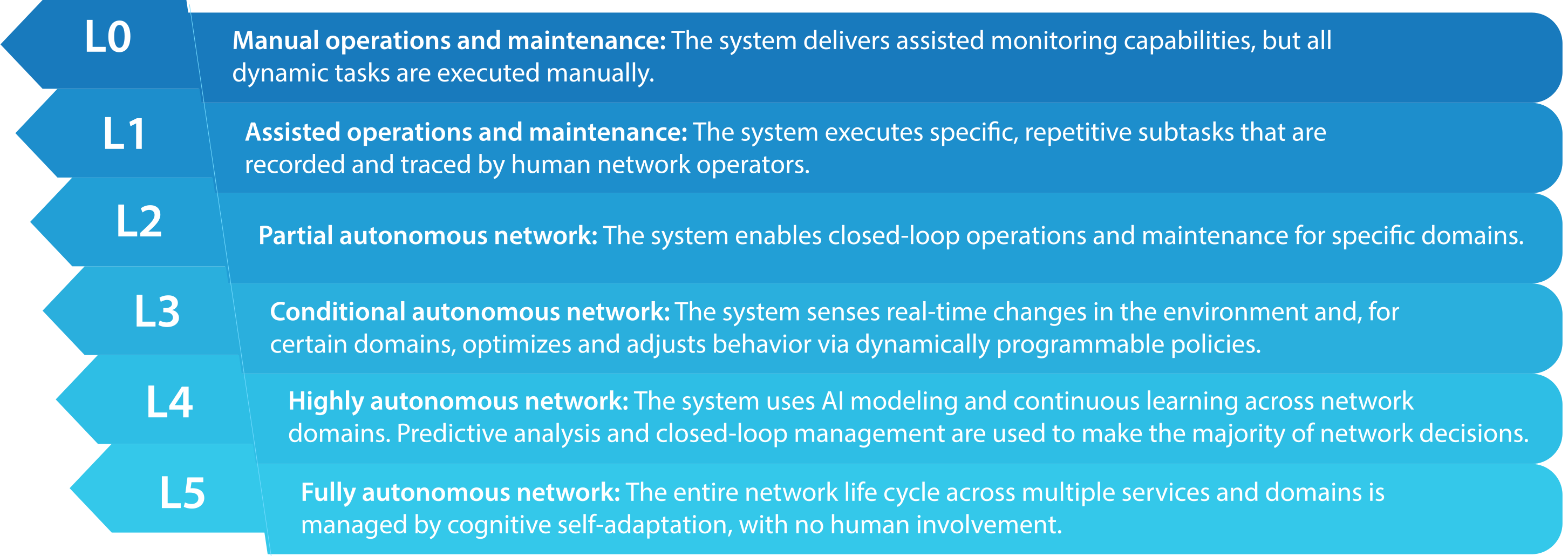
Source: Adapted from TM Forum’s autonomous network project
Most telcos now operate between L1 and L3, the partial autonomy stage; and achieving L4 or L5 will take a lot of work, including significant restructuring of operating models, talent, and infrastructure.
One barrier to achieving L5 is a growing business concern around the safe governance of autonomous systems, rather than the technical innovation needed. Cost considerations also limit the case for L5. For example, giving a network full autonomy can lead to significant brand damage and penalties if the network fails, while return on investment is hard to justify when even getting to L4 gives 80% of the benefit at much lower upfront capital expenditure.
These challenges notwithstanding, many communication service providers intend to achieve L4 autonomy in the next few years, including China Mobile, Orange, and Telecom Argentina.
China Mobile, in particular, is well placed for L4, having already successfully completed agentic AI implementations for network operations and maintenance, reducing the number of site visits by engineers to one per ticket and replacing 5,500 full-time manual roles with software bots as of 2025.
While achieving L5 is more challenging, the benefits of even getting to L4 are significant, including more efficient operations and, with increased autonomy, enhanced capabilities and experiences for both public and business-to-business customers.
A region-specific approach to autonomous networks
Telcos face different challenges depending on where they operate, shaped by regional regulatory environments and business goals.
The key, then, is to tackle each region’s needs, focus, and challenges separately.
North America
To make progress on autonomy, North American telcos like AT&T and Verizon should reskill teams with a focus on site reliability engineering (SRE), while also prioritizing cost reduction and unlocking AI use cases by modernizing legacy infrastructure and breaking down organizational and data silos.
Prepare data and make it accessible: Autonomous networks depend on well-prepared, structured data to teach AI systems, and on real-time streaming data to run the network. However, most data is trapped in siloed systems, and is improperly defined or incomplete, lacking the depth needed to train the AI system adequately. Though this challenge isn’t unique to North American telcos, KPMG reports that 59% of telco CEOs globally cite data readiness as a top challenge, struggling to access reliable, clean, and well-structured data; the problem is compounded in North America.
There is less data regulation than in Europe, leading to fewer unified governance systems, while Asian telcos like Rakuten in Japan are further ahead in building modern, product- and platform-operating models that enable clear ownership of data domains.
North American telcos should create data pipelines that deliver real-time or near real-time streams into AI models. Building a self-managed platform for moving data between systems in real-time — such as an Apache Kafka fleet, which is like an open-source postal service for data that provides real-time data streaming and messaging — is difficult at carrier scale, and brings substantial hidden costs, including monitoring and headcount. Instead, communications, media, and technology (CMT) organizations can adopt managed streaming services. Comcast in the US is doing this through Amazon Kinesis Data Streams, an AWS proprietary, fully managed streaming service that enables real-time data processing, much like Apache Kafka, while offering greater control over implementation roadmaps.
Restructure talent: Telcos should build SRE teams with deep understanding in AI-driven orchestration and closed-loop automation. These teams must know how AI systems monitor, analyze, and adjust themselves to optimize network performance, along with expertise in observability, or network troubleshooting, platforms.
Upskilling in telemetry, and continuous integration, continuous deployment, continuous testing (CI/CD/CT) automation in both cloud and hybrid software stacks will be important, along with skills in network resilience engineering to harden these networks and enable self-healing.
As telcos progress toward L4, the network operating model will be reshaped by redesigned processes, organizational structures, and talent requirements. For instance, Entel Chile in South America, a leader in 5G operations in the region, focuses on talent that implements product roadmaps rather than project coordination, while simultaneously organizing teams so they can create and run software from start to finish without handing it off to different groups.
Modernize legacy assets: Legacy infrastructure remains prevalent in North America and continues to support a large share of customer services. This infrastructure lacks modern connectivity standards, preventing near-real-time data streaming and the dynamic, software-defined control needed for autonomous operations. Research from TXO, a sustainable technology provider, found that ageing infrastructure in the US and Canada will remain operational until at least 2028. Some 81% of respondents said these legacy networks hinder the rollout of new services, limiting effectiveness compared with operators in other global regions.
Most telecom network vendors are now re-architecting their network controllers and management systems to bring them in line with modern requirements. Investing in these capabilities will simplify interactions between the OSS and the network.
CSPs can modernize legacy systems using large language models (LLMs) that automate and optimize the code migration process, maintaining operational efficiency while ensuring software compatibility. Care must be taken, however, as LLMs and the agents that run on top of them will be accessing commercial off-the-shelf systems, so tailoring and supervising the AI technology is a must, with teams prepped on the as-is and to-be state of the system and documentation in place to reduce complexity and risk.

South America
According to Infosys experts, South American telcos like Claro, Telefónica, Vivo, and TIM should invest in automation selectively and incrementally. These CSPs must also focus on energy-efficient network operations and selective 5G optimization while building up both AI and data talent pipelines.
Go green: Energy costs can come down through more energy-efficient network tuning and selective shutdown of networks when not in use. This is one of the emerging and increasingly popular use cases where telcos are applying autonomous network design principles to optimize energy costs.
Optimize what you already have: Maximizing the efficiency of current 5G investments will go a long way toward reducing costs on the journey to autonomy and will provide South American CSPs with the capital to invest in lower-margin revenue streams. Telcos like Claro and Vivo have a much lower ability to invest in outright 5G expansion compared to other regions and are also in the early stages of 5G maturity. It is often assumed that achieving higher AN maturity requires telcos to retire existing network devices, controllers, and OSS. However, with careful consideration of technology evolution, especially in budget‑constrained environments, telcos can progress toward their AN goals without large‑scale equipment replacement.
Partner with hyperscalers: Partnering with open-source communities and telco alliances will give South American talent greater awareness of fast-moving innovations in the AI space, while hyperscalers can bring training and co-development opportunities.
As momentum toward higher AN maturity increases, hyperscalers are introducing architectural patterns for AN enablement — design approaches that use AI and data collection for network self-monitoring, self-healing, and self-optimization — and actively engaging with telcos through their service catalogs. Partnering with a hyperscaler for rapid proofs of concept on relevant use cases can deliver significant value by demonstrating the art of the possible and accelerating broader adoption.
Europe
European telcos like Vodafone, Orange, and Deutsche Telekom need to take a different approach than North and South America. With margins stretched thin due to the number of players in the European market, they must focus on leveraging collective standardization and sustainability initiatives, while simultaneously navigating limited investment capacity, complex market dynamics, and strict regulations.
Prioritize use cases collectively: European CSPs should prioritize AN use cases in domains that other European telcos are already working on, such as intelligent service design, smart field operations, and closed-loop assurance, winning market share by making these use cases production-ready without taking on too much scale, margin, or risk.
Use case prioritization is critical. Infosys Consulting supported a telco partner by assessing each use case and classifying it across four dimensions: possible (technically viable), feasible (data‑ready), doable (commercially justified), and practical (aligned with stakeholder acceptance). This structured approach helped direct investment and effort toward the right opportunities, building confidence to expand the use‑case pipeline and scale adoption further.
Hyperpersonalize services: Intent‑based autonomous network design patterns enable hyperpersonalized network services for superior customer experience. For example, a customer requirement, or intent, such as uninterrupted live sports streaming, can be translated into technical parameters like latency, bandwidth, and reliability requirements.
The network then configures itself to meet these specifications and continuously monitors for any disparity between intended goal and network behavior, taking corrective actions to restore the target operating state. This is predominately being applied for 5G standalone dynamic slicing, where the network can spin up purpose-built virtual networks and adjust them in real time, guaranteeing different network behaviors, all on the same physical infrastructure. Intent-based control is a big achievement and shifts the telco into L4 for many network functions, according to Infosys experts.
Minimize and localize data: European telcos operate under strict regulations like the general data protection regulation and data sovereignty legislation. Ensuring data minimization principles are applied to all systems, while localizing that same data within the EU, will ensure agentic AI systems don’t do anything that results in fines, or worse, reputational damage.
Asia
Many Asian CSPs are at L3 (partial autonomy) and are ahead of other regions, running cloud-native, fully virtualized networks, and closed-loop monitoring. To progress further toward full autonomy, telcos in this region must sustain investments in radio access network optimization, energy management, and monitoring, while accelerating AI-native innovation and cross-industry service bundling.
Go product-centric. Product-centricity provides the structure, alignment, and feedback mechanisms that make autonomous systems purposeful, scalable, and governed. For instance, Rakuten Mobile in Japan has created excellent customer journeys across e-commerce, streaming, and payment solutions by using a product-centric delivery model, ensuring innovation, agility, and stickiness across its platforms. This move toward organizational agility and a modern, product-centric company culture has set it up well for the autonomous era.
Enhance responsible AI and cybersecurity posture: Because of the higher levels of autonomy in this region, the attack surface increases and failures cause greater impact. Attackers can manipulate automated workflows, and widely distributed application programming interfaces create more entry points for cyberattacks. Asian telcos also often use multivendor open radio access networks, instead of a single-vendor closed system; and cloud, and edge infrastructures, where more vendors equate to more supply-chain risks and configuration vulnerabilities. Here, systems should be protected by making advanced AI secure by design. CSPs should establish RAI hygiene measures such as human-in-the-loop controls to override or halt AI decisions, and a red teaming practice that probes the network for vulnerabilities, all while integrating AI model security with overall network security.

The importance of the operating model and change management
Regardless of region, higher levels of autonomy are only possible with the right operating model. Rakuten, for example, organizes itself around distinct, customer-focused products like fintech, mobile, e-commerce, advertising, security, and payment. Each product line is supported by a shared platform that enables speed, engineering discipline, and efficiency. The product-centric approach also gives executives a bird’s-eye view of the business, allowing them to synchronize investments across operations, 5G, cloud, and IoT.
Achieving L4 also requires telcos to establish a roadmap for introducing a network data fabric — the architecture layer that connects, standardizes, and makes network data accessible to autonomous systems — along with a network ontology, or nomenclature for how data is organized. Talent with expertise in knowledge graphs will be critical: people who understand the meaning and intelligence behind the data and how it all relates to each other along with the data architecture.
Change management will be central in all of this. It ensures that the right change initiatives are in place and that operators are moving from L2 and L3 to L4 at the right speed, with metrics to indicate what’s working and what isn’t. The goal can be defined by a coherent set of objectives and key results.
With the organization focused on deriving more value from network operations, telcos can do much to increase the perception that they’re not cutting jobs needlessly, and remain faithful to long-term shareholders in the US, South America, Europe, and Asia.


Regulatory change is accelerating and breach costs are rising, yet most institutions still rely on periodic, manual risk assurance. Three structural gaps, spanning visibility, third-party oversight, and governance, leave institutions unable to keep pace. Building risk assurance as a continuous, AI-augmented capability closes these gaps. A four-phase roadmap helps institutions get there.
- 11 Sep, 2026
- 15 min read

The difference between AI work and AI that works lies in the discipline to scale adoption, governance, and value realization
- 10 Sep, 2026

Learn how automated integrity checks and human oversight can help enterprises control AI agent sprawl, reduce duplication, and manage risk at scale.
- 08 Sep, 2026
