
Insights
- Member services span more channels, but resolution remains slow because eligibility, benefits, claims, provider, and pricing data remain disconnected across systems. Agentic AI can assemble a complete member view and resolve more requests in a single interaction.
- Prior authorization is slow because documentation, policy checks, and clinical review are poorly coordinated. Agents can manage submissions and routine checks while clinicians retain authority over decisions that require judgment.
- Care coordination often fails at transitions between organizations. An agentic system can track dependencies, manage handoffs, and intervene before stalled care leads to missed follow-ups, longer stays, or avoidable readmissions.
- Claims systems process straightforward cases efficiently, but exceptions still lead to queues, rework, and appeals. A coordinated agentic workflow can gather evidence, apply policy, route the case, and document why a decision was made.
- Compliance is moving from periodic sampling to continuous, population-level oversight. Agentic AI can capture supporting evidence as work happens, monitor operations continuously, and flag emerging risks before they become regulatory findings.
- However, technology alone will not deliver results. Payers must redesign workflows, integrate fragmented data, define where human approval is required, and expand autonomy only when performance, fairness, security, and auditability are proven.
Foreword
The execution gap in healthcare payer operations
Healthcare payers occupy one of the most complex positions in the American health system. They sit at the intersection of clinical need, financial accountability, and regulatory obligation. They are responsible for decisions that affect millions of members, often in moments that matter most.
I have spent more than two decades working with healthcare organizations, and what strikes me most is the persistence of the same underlying problem: work that stalls at the handoffs between systems and teams.
Payers have invested significantly in automation, analytics, and digital tools. Those investments have delivered real value. But the coordination gaps in member services, prior authorization, care transitions, claims, and compliance have remained. The reason is that most of these investments were designed to optimize individual steps, not to keep work moving across all of them.
This is the gap that agentic AI can close, and the implications are profound.
Agentic AI is a fundamentally different operating model in which specialized, goal-directed agents can interpret context, manage dependencies, trigger follow-ups, and escalate exceptions across systems and teams.
In our work with payers, we are beginning to see what is possible when this model is applied well. It can help resolve member inquiries in a single interaction, make prior authorization decisions faster and more consistent, manage care transitions end to end, and embed compliance in daily operations.
I am excited to share that this playbook moves the conversation from theory to practice and reduces friction as we seek to serve patients more effectively and humanely.
Successful organizations will approach this with discipline, starting with the right use cases, building the right governance, and keeping humans accountable for the decisions that matter most.
This playbook is designed to make that path clearer. It reflects the insights of Infosys experts who work alongside payers every day, and it is grounded in what we have learned from implementation, not just observation.
My hope is that it helps payer leaders move from asking whether agentic AI can work in their environment to knowing exactly where to start and how to succeed.

Venky Ananth
Executive vice president and head of healthcare, Infosys
Executive summary
Beyond automation: Agentic AI for healthcare payers
Health insurers in the US are under mounting pressure. Medical costs are rising, regulators are increasing scrutiny, and members expect faster, more transparent service. Investments in automation, contact center platforms, and compliance dashboards have helped improve individual functions. But how work moves between them is still largely manual, fragmented, and reactive.
Agentic AI can address this gap. Its value is in keeping work moving across tasks rather than optimizing isolated steps. It can track dependencies, manage handoffs, and ensure cases progress across systems, teams, and people, while preserving human judgment where it matters.
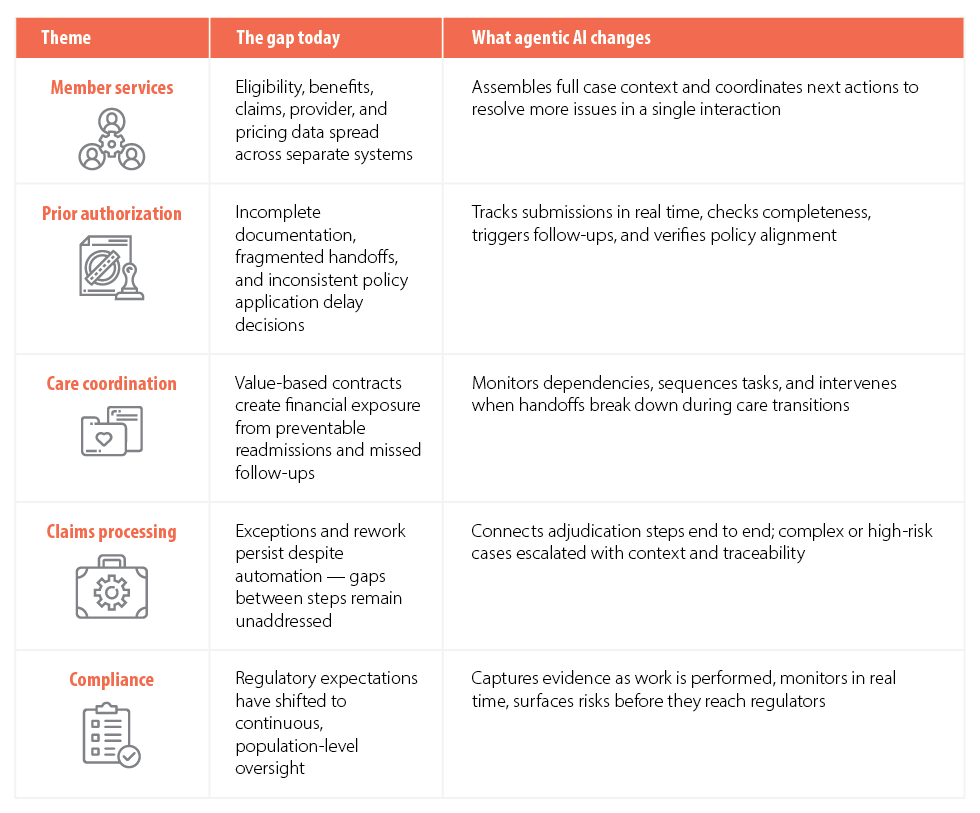
This playbook is structured around five themes (Figure 1), each focused on a core payer function and how agentic AI can reshape it in practice:
- Member services: Eligibility, benefits, claims, provider, and pricing data are spread across separate systems. This leads to lower first-call resolution rates, repeated member contacts to solve even routine issues, and greater strain on contact center capacity, all of which undermine the member experience. By assembling the full case context and coordinating next actions across systems and teams, agentic AI can help resolve more issues in a single interaction.
- Prior authorization: Incomplete documentation, fragmented handoffs across teams, and inconsistent application of coverage rules and clinical policies delay determinations and lead to rework and inconsistent outcomes across similar cases. Agentic AI can address these breakdowns by tracking submissions in real time, checking completeness before review, triggering follow-ups, and verifying eligibility, benefits, coding, and policy alignment. Human clinical reviewers remain in charge. What changes is the reliability of the process that puts cases in front of them.
- Care coordination: Value-based contracts create financial exposure from preventable readmissions, missed follow-ups after discharge, and unresolved care gaps. Agentic AI can monitor dependencies, sequence tasks, and intervene when handoffs break down, particularly during care transitions such as hospital discharge.
- Claims processing: Exceptions, rework, and audit cycles remain common despite years of investment in automation. This shows that automation has addressed individual steps without closing the gaps between them. Agentic AI supports a more connected adjudication flow, ensuring that validation, review, routing, decisions, and documentation remain aligned. Straightforward claims can progress efficiently, while complex or high risk cases are escalated with clear context, rationale, and traceability.
- Compliance: Regulatory expectations have shifted from periodic, sample based audits to continuous, population level oversight. Agentic AI can capture evidence as work is performed, monitor activity in real-time, and surface risks before they reach regulators. Compliance teams can focus on cases requiring judgment, remediation, and policy interpretation rather than retrospective review.
Across all five domains, the problem is the same: Work stalls because nothing is built to keep it moving.
This playbook sets out what agentic AI can change in each domain and what it takes to deploy it in ways that work.
Figure 1. Five payer domains — the coordination gap and what agentic AI changes
Source: Infosys
Chapter 1

More channels, less resolution: The member services gap
Insights
- Member services are expanding across channels, but fragmented backend systems still prevent fast, consistent resolution.
- Traditional tools such as interactive voice response (IVR) and generative AI improve interaction quality, but do not solve end-to-end member needs.
- Agentic AI offers a new operating model by coordinating specialized agents across systems to complete service tasks.
- This approach can improve first-contact resolution, reduce wait times, lower service costs, and create a smoother member experience.
- A phased rollout with clear governance and human oversight can help payers adopt agentic AI safely and effectively.
Payers are expanding how members can reach them — phone, web portals, chat, and mobile apps — but more access has not translated into faster, easier service.
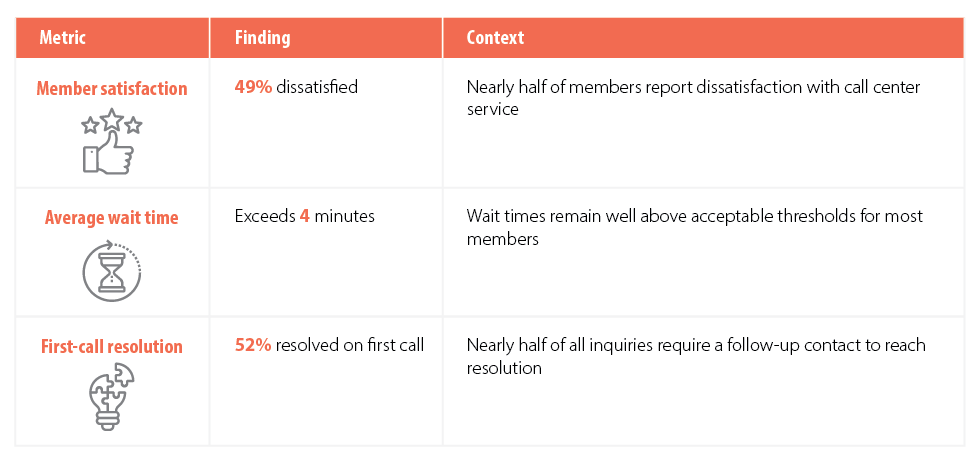
A recent industry survey of 200 healthcare call center leaders found that 49% reported that members were dissatisfied with call center service. Also, average waiting time exceeds four minutes, and only 52% of inquiries are resolved on the first call (Figure 1).
Investments have expanded member service channels, but disconnected systems continue to limit their effectiveness. A member trying to find a provider, verify coverage, address a billing question, or clarify treatment costs still needs to have several back-and-forth exchanges because each step requires the customer service representatives to manually navigate disconnected systems.
This is a structural problem. Expanding channels further, hiring more staff, or upgrading the IVR systems will not close the gap. It requires a different operating model built around completing requests end to end, not managing contacts one at a time. That is what agentic AI makes possible.
Figure 1. Member services performance - industry survey highlights
Source: Hyro Industry report: State of healthcare call centers 2025
Where the current model breaks down
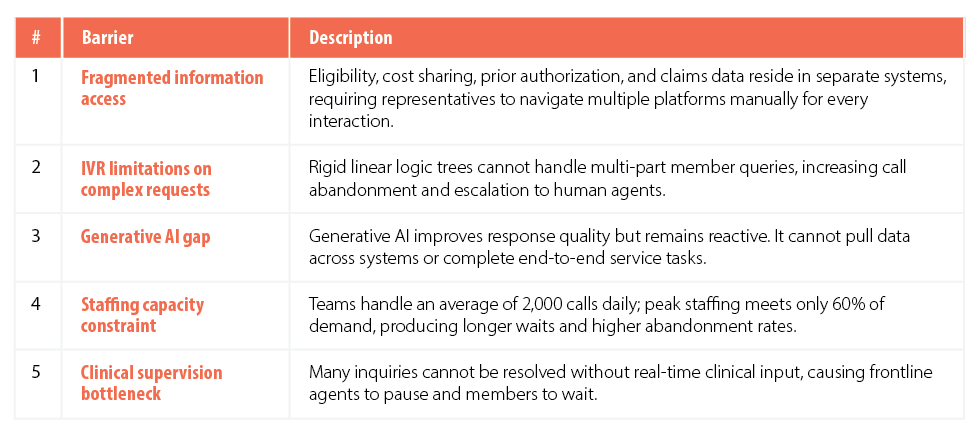
Despite significant investments in staffing, IVR systems and generative AI-powered conversational tools, contact centers across the US remain structurally unable to meet member expectations. Five structural barriers (Figure 2) explain this:
- Lack of integrated information accessibility: Contact center representatives must still navigate multiple platforms to access member information. Eligibility may reside in one system, cost-sharing details in another, prior authorization rules in PDFs, and claims data housed in a separate engine. This leads to slower service, inconsistent answers, and repeat contacts.
- Traditional IVRs fail on complex requests: Most IVRs are built on rigid, linear logic trees designed for narrow, routine queries. They cannot handle the multipart questions members now ask, which increases abandonment and pushes more interactions to human representatives.
- Generative AI improves responses but not resolution: Generative AI can draft responses and summarize calls, but it remains reactive. It cannot coordinate multiple service tasks on its own.
- Demand now exceeds staffing capacity: Member services teams handle an average of 2,000 calls daily, with peak staffing meeting only 60% of demand, according to a 2025 US healthcare call center benchmarking report. The result is longer waiting times and higher abandonment.
- Clinical supervision as a constraint: Many healthcare contact centers cannot resolve a growing share of inquiries without real‑time input from scarce clinical staff. Frontline agents pause while waiting for clinical reviews. These stalled interactions directly translate into longer waits and lower member satisfaction.
Addressing these challenges requires a fundamentally different operating model for member services.
Figure 2. Five structural barriers to member services resolution
Source: Infosys
The case for agentic AI
Agentic AI deploys multiple AI agents, each assigned a specific role, to complete service tasks across systems. Unlike generative AI, which responds to prompts, agentic AI plans, coordinates, and acts across a full process. However, while the model is promising, most deployments in member services are still in pilot or early implementation stages rather than at full scale.
How the experience changes
To understand what this looks like in practice, consider a typical member interaction:
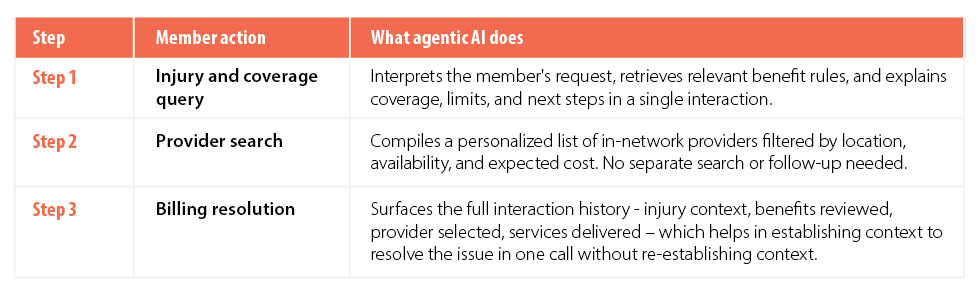
A member twists her ankle on the way to work. She opens the health plan portal and asks what treatment options are covered. An agentic AI interprets her request, retrieves relevant benefit rules, and explains coverage, limits, and next steps in a single interaction. As she considers care options, the system compiles a personalized list of in‑network providers filtered by location, availability, and expected cost. The member does not need to search across multiple tools or follow up to clarify options.
After her appointment, she receives a bill that seems higher than expected and calls customer support. When the call begins, AI agents surface the entire interaction history, including the injury context, benefits reviewed, provider selected, and services delivered. The representative does not need to re-establish context or ask the member to repeat information. The issue is resolved in a single interaction, improving first-call resolution while reducing average handle time and operational effort.
This is the shift agentic AI enables (Figure 3). It does more than generate answers. Agentic AI can interpret intent, coordinate actions across fragmented payer systems, and support resolution across the entire process. The result is a smoother member experience with fewer calls, faster resolution, and lower service costs.
Figure 3. How agentic AI resolves a member interaction end to end
Source: Infosys
Four design principles for agentic member services
- Self-service by default: Agentic AI interprets the member’s intent and context, then coordinates multiple specialized agents to complete the task across systems without routing them through static options or transferring them to a representative for routine requests. Data‑retrieval agents securely access eligibility, benefits, claims, and provider information using plan‑specific rules. Workflow orchestration agents execute steps such as checking coverage, identifying in‑network providers, or validating claim details. Search and knowledge agents surface relevant, personalized information, while explanation and guidance agents translate complex policy details into clear next steps. Guardrail and escalation agents ensure human support is engaged only when judgment or clinical review is required.
- Continuity across channels: As members move across channels — phone, chat, email, apps, portals, SMS, and in‑person interactions — the AI agents preserve intent and history, guide them to the fastest resolution path through AI-driven logic, and ensure backend systems operate from a single, unified view, thus reserving human involvement for only the most complex cases.
- Personalized member support: Personalized services build trust. Agentic AI enables this by deploying multiple agents to assemble and apply context in real time. An identity and context agent aggregates and maintains a unified member profile by synthesizing prior interactions, claims history, utilization patterns, and stated preferences, ensuring every interaction starts with full awareness of the member’s situation. An intent and task agent interprets the member’s request in that context — for example, recognizing whether a coverage question relates to an upcoming procedure, a recurring claim issue, or a life event — and translates it into the appropriate personalized action.
- Improvement through every interaction: Each member engagement becomes a learning input. Automation handles repetitive tasks, while the system continuously learns and adapts to improve accuracy, speed, and overall service quality.
An Infosys case study
A leading technology company was facing rapidly increasing product support volumes. More than 950 human support agents were managing over 12,000 technical issues each month, yet average resolution times remained close to 14 days.
- Infosys addressed rising product support volumes and long resolution cycles by deploying an agentic AI-powered research assistant built as a coordinated system of specialized agents. Rather than using a single AI model, the team distributed the support workflow into distinct capabilities and orchestrated them through a central control layer.
- Ingestion and retrieval agents continuously collected and indexed data from logs. A context and case memory agent maintained the full life cycle state of each ticket, tracking what had been investigated, attempted, or resolved, and preserving continuity across tier handoffs.
- A diagnosis and hypothesis agent analyzed and correlated evidence to generate ranked root cause possibilities with supporting data, while a resolution recommendation agent surfaced proven fixes from similar past cases, or suggested next best actions where no direct match could be found. All steps were coordinated by a workflow orchestration agent that managed task sequencing, dependencies, and progress across teams.
- Governance and management agents enforced security, monitored accuracy, logged outcomes, and captured feedback for continuous learning.
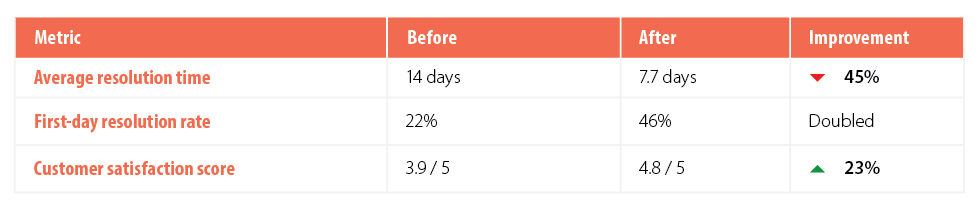
This modular approach significantly reduced resolution time while scaling support efficiency and knowledge reuse (Figure 4).
- Average resolution time dropped from 14 days to 7.7 days, improving turnaround by 45%.
- First-day resolution rose from 22% to 46%, doubling the share of issues solved within 24 hours.
- Customer satisfaction scores increased from 3.9 to 4.8, reflecting sharper accuracy and quicker response.
While drawn from technology support rather than healthcare, this case illustrates how agentic AI can reduce resolution time and improve satisfaction by orchestrating work end-to-end, a capability that member services teams urgently need as inquiries grow more complex and cross-system.
Figure 4. Agentic AI deployment outcomes - Infosys case study
Source: Infosys
How the model works
Agentic AI works through multiple, specialized agents that can be orchestrated to enable end-to-end processes. There are three main architectural models: centralized, decentralized, and hybrid. In a centralized model, one main agent directs the work of other agents. In a decentralized model, agents coordinate directly with one another through the Agent-to-Agent Protocol. A hybrid model combines both approaches, offering control with flexible execution.
In member services, agentic AI deployment in either of these patterns can also reduce compliance risk. AI agents can be configured through an agentic AI gateway — a transport layer that determines what agents are allowed to do — to follow payer policies, apply rules consistently, and produce audit-friendly logs of actions. Unlike humans, who can get overwhelmed during extreme spikes in calls such as during enrolment or regulatory events, AI agents can ensure consistent service delivery even under extreme volume.
A phased roadmap
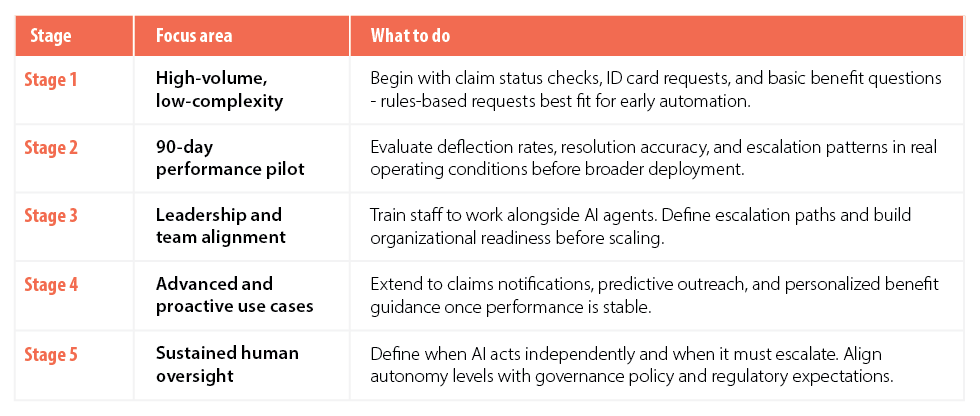
Healthcare payers should introduce agentic AI in stages (Figure 5). This helps minimize operational and regulatory risk while allowing teams to validate performance before scaling.
Stage 1. Start with high volume, low-complexity inquiries: Begin with rules-based requests that rely on structured data and represent a meaningful share of inbound demand such as claim status checks, a request for a member ID card, and basic benefit questions. These cases are best fit for early automation.
Stage 2. Validate performance through a 90-day pilot: Run a focused, timebound pilot before broader deployment. This allows teams to evaluate performance in real operating conditions, identify gaps, and build confidence in the model. Key metrics should include deflection rates, resolution accuracy, and both the rate and appropriateness of escalations.
Stage 3. Align leadership and frontline teams: Successful adoption depends as much on organizational readiness as on technology. Before scaling, teams should be trained to work alongside AI agents, and escalation paths should be clear.
Stage 4. Expand into advanced and proactive use cases: Once performance is stable and safeguards are in place, extend coverage to more complex and proactive scenarios, including claims notifications, predictive outreach, and personalized benefit guidance.
Stage 5. Maintain human oversight: Agentic AI still requires oversight. The operating model should define when AI can act independently, when it must escalate, and how human oversight aligns with different levels of autonomy.
Figure 5. Phased roadmap for agentic AI adoption in member services
Source: Infosys
What this approach delivers
A phased approach helps payers introduce agentic AI with control and confidence. It reduces risk, builds organizational readiness, and creates a clear path from targeted pilots to scaled deployment while maintaining member trust and meeting regulatory expectations.
How to measure progress
An effective way to structure performance measurement is through objectives and key results. For example, an objective might target a 25% uplift in service efficiency within six months, with key results such as reducing average handle time by 20% and increasing first-contact resolution to 65%.
Chapter 2

The case for a new prior authorization model
Insights
- Prior authorization has drifted from a targeted safeguard into a broad administrative layer that now slows routine care, specialty pharmacy, imaging, and outpatient services.
- The current model creates pressure on all sides: providers face growing administrative burden, members experience delays in care, and payers manage rising costs within tighter margins.
- Regulatory changes have raised the stakes by making turnaround times, denial patterns, and appeal outcomes more visible and comparable across plans.
- Incremental automation of individual tasks is not enough; the bigger opportunity is to orchestrate the prior authorization journey end to end.
- Agentic AI offers a path forward by combining orchestration, automation, decision integrity, and cognitive intelligence into a more scalable operating model.
Prior authorization was originally designed as a targeted intervention to prevent misuse or overuse of high-cost interventions. Over time, it has expanded beyond its initial purpose and now functions as a broad administrative layer across routine care, specialty pharmacy, diagnostic imaging, and many outpatient services.
This expansion has put the process under strain. Regulators demand faster decisions and greater transparency. Providers push back against rising administrative burden, while members increasingly associate delays in authorization with reduced access to care and declining care quality.
For payers, the challenge is even more acute. Medical costs continue to rise, therapies are becoming more complex, and operating margins are tightening. Inefficient prior authorization processes add further pressure through administrative costs, rework, and appeals.
Incremental improvements, particularly task-level automation, have not been sufficient to address these challenges. That’s why there is a need for a different operating model.
Prior Authorization today: How the burden adds up
The strain on the current model is visible across the healthcare ecosystem. A 2025 survey by the American Medical Association shows that doctors in the US and their staff together spend an average of 13 hours per week on prior authorization requests, diverting time from direct patient care. Though digital tools exist, the adoption of fully electronic workflows remains uneven, and the process continues to rely heavily on manual intervention and fragmented systems.
At the same time, regulatory expectations are rising. The Centers for Medicare & Medicaid Services (CMS), the federal agency overseeing government health insurance programs in the US, now require health plans, under 2024 and the newly proposed 2026 interoperability rules, to meet tighter turnaround times, support electronic prior authorization, and publicly report approval, denial, and appeal metrics.
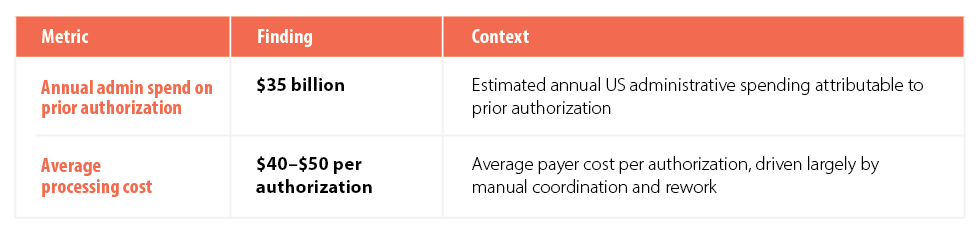
Figure 1. The administrative burden of prior authorization
Source: Health Affairs Scholar
Three structural failures in the current model
First, the process is operationally inefficient. Manual reviews, policy reconciliation, and appeal management drive significant administrative cost. Research suggests prior authorization accounts for an estimated $35 billion in US administrative spending annually, with average payer processing costs of between $40 and $50 per authorization. Much of this cost is due to poor coordination across systems and stakeholders (Figure 1).
Second, the process erodes trust across the ecosystem. Physician surveys consistently report care delays, treatment abandonment, and a perception that authorization requirements are designed to obstruct rather than protect. Members experience prior authorization delays as barriers to care, reinforcing negative perceptions of the payer.
Third, regulatory transparency has permanently changed the stakes. Inconsistencies in turnaround time, denial rationales, and appeal outcomes are no longer internal performance issues. They are publicly reported data points that regulators, providers, employers, and members can compare across plans and markets. The window to address these gaps privately is narrowing.
The shift required: From automation to orchestration
Most transformation efforts to date have focused on automating discrete tasks within the authorization workflow such as eligibility checks or document validation. While these interventions deliver incremental efficiency gains, they do not address the underlying coordination problem.
Prior authorization requires continuous alignment between providers, payers, and members. Delays and inefficiencies arise when that alignment breaks down.
The next generation of the authorization model must therefore be built on orchestration, not automation. This means coordinating the entire life cycle of a prior authorization request, from submission to decision, through a unified, real-time system that eliminates fragmentation, reduces handoffs, and ensures that each step progresses without delay.
A new operating model: Agentic AI-enabled prior authorization
Enabling this shift requires a new class of capabilities. Agentic AI, systems composed of specialized, goal-directed digital agents, provides the foundation for this transformation.
In an agentic model, prior authorization is no longer managed through static workflows. Instead, it is dynamically orchestrated by agents that can interpret policies, assemble clinical context, trigger follow-ups, and guide decisions within defined governance boundaries.
This transforms prior authorization from a reactive, document-driven process into a coordinated, intelligence-driven system.
Research indicates that 65% of private healthcare payers in the US are already considering shifting toward using AI to streamline their prior authorization processes.
The four capability pillars of agentic AI for prior authorization
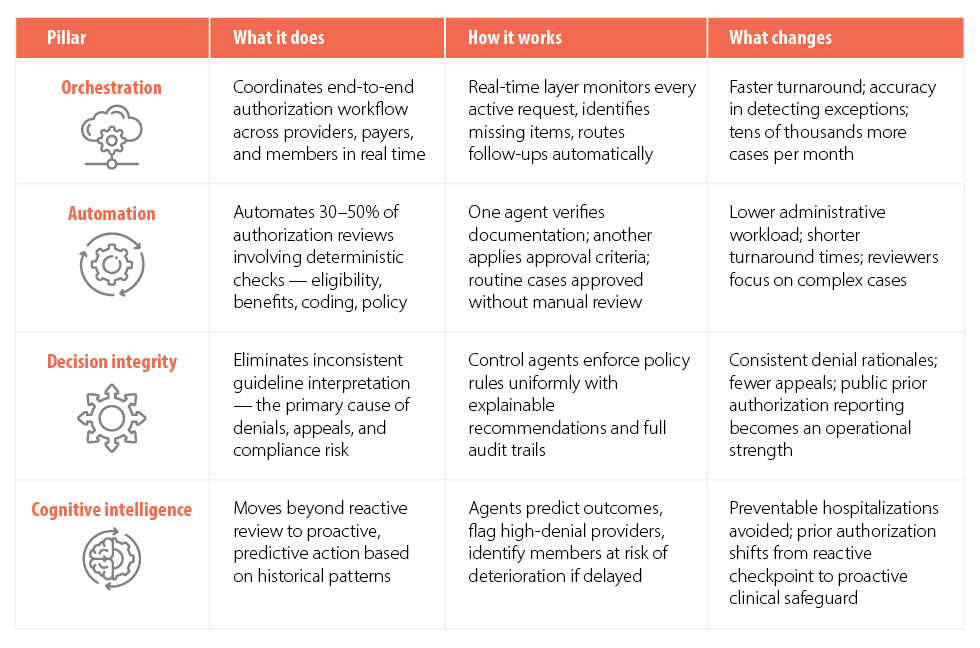
Agentic AI reshapes the entire prior authorization operating model through four capabilities (Figure 2).
Orchestration
- What it does: Coordinates end-to-end prior authorization workflow across providers, payers, and members in real time by tracking submissions, validating completeness, and proactively triggering outreach when clinical notes, lab results, or imaging are missing.
- How it works: A real-time orchestration layer monitors every active authorization request, identifies what is missing before a reviewer sees the case, and routes follow-up actions to the right party without manual intervention. This reduces the risk of cases sitting idle because a document has not arrived.
- What changes: Infosys‘ implementations in these domains have delivered measurable outcomes, including faster turnaround times, accuracy in detecting exceptions, and the ability to process tens of thousands of additional cases per month, demonstrating that agentic orchestration can materially improve both efficiency and compliance.
Automation
- What it does: Automates between 30% and 50% of prior authorization reviews that involve deterministic checks such as verifying eligibility, benefits, coding, and policy alignment. This enables immediate approval for routine cases without manual review.
- How it works: One agent verifies that required clinical documentation is present. Another applies predefined approval criteria. For well-defined cases, such as approving a continuous positive airway pressure device for a documented sleep apnea diagnosis, the system approves without manual review.
- What changes: Administrative workload drops, authorization turnaround times shorten, and reviewers’ time is focused on cases that genuinely require clinical judgment.
Decision integrity
- What it does: Eliminates inconsistent guideline interpretation, the primary cause of denials, and appeals. It also reduces compliance risk by applying clinical policy rules uniformly across every case, with explainable recommendations and full audit trails.
- How it works: Infosys Helix uses control agents to enforce policy rules and process agents to automate execution across claims, provider management, plan operations, and care workflows. For example, in the case of a request for high cost, specialty therapy, a biologic or a cell and gene therapy, the agent reviews prior treatment history, lab results, and relevant clinical criteria before producing a transparent “approve” or “deny” recommendation.
- What changes: Denial rationales are consistent and documented. Appeals decrease because the first decision is defensible. Public reporting of prior authorization metrics becomes an operational strength rather than compliance exposure.
Cognitive intelligence
- What it does: Moves beyond reactive review to proactive, predictive action. Applied to prior authorization, this enables agents to predict authorization outcomes based on historical patterns, identify providers with high denial rates and suggest presubmission fixes, and flag members likely to deteriorate if delays occur. Infosys research further points out that delays in authorization contribute to disease exacerbation, preventable hospitalizations, and prolonged inpatient stays.
- How it works: Agents predict authorization outcomes based on historical patterns. They flag providers with high denial rates and surface presubmission fixes. They identify members likely to deteriorate if authorization is delayed, for example a member with pending prior authorization request, a pattern of deteriorating lab results, and no scheduled follow-up appointment. These three signals together predict avoidable hospitalization with enough lead time to intervene.
- What changes: Delays that would have triggered preventable hospitalizations are avoided. The prior authorization process shifts from a reactive checkpoint to a proactive clinical safeguard.
Figure 2. The four capability pillars of agentic AI for prior authorization
Source: Infosys
A practical roadmap for transformation
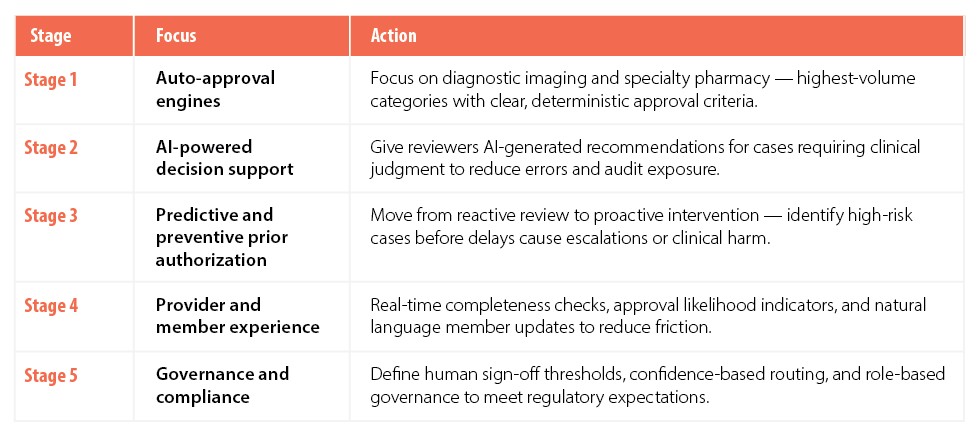
Transitioning to this new model requires a phased approach. Organizations should follow a practical roadmap (Figure 3) built around five layers, each strengthening the next and helping payers modernize without disrupting day-to-day operations.
Stage 1: Auto-approval engines for high-volume, rules-based categories
Start by focusing on diagnostic imaging and specialty pharmacy, the highest-volume categories where approval criteria are clear and deterministic. Applying evidence-based auto-approval to these requests reduces manual work and builds confidence in the system before moving to more complex cases.
Stage 2: AI-powered decision support for cases requiring clinical judgment
For cases that require clinical judgment, give reviewers AI-generated recommendations based on the member’s clinical history and coverage rules. It can help them decide quickly while reducing errors and audit exposure.
Stage 3: Predictive and preventive prior authorization
Moving from reactive review to proactive intervention. This helps to identify high-risk cases before delays cause escalations or clinical harm.
Stage 4: Provider and member experience layers
Reduce friction at the points where providers and members interact with the prior authorization process. Provider portals can show real-time completeness checks and even indicators of approval likelihood. Members gain clarity through natural language updates and simple navigation support, lowering confusion and unnecessary calls.
Stage 5: Governance, compliance, and reliability
As automation increases, strong guardrails become critical. For example, specify which decisions require human sign-off, define the confidence threshold at which AI autonomy is withdrawn, and route the case to a human reviewer. In an agentic AI system, plan and tool verifiers serve as guardrails, ensuring the correct benefit plans, coverage rules, medical policies, and approved data sources are used, and that policy engines and clinical guidelines are applied in the proper sequence. Role based governance, on the other hand, keeps agents within defined boundaries, limiting approval authority to authorized roles and routing complex or high risk cases to human reviewers to meet regulatory expectations.
Figure 3. Phased roadmap for agentic AI transformation of prior authorization
Source: Infosys
Before you scale agentic AI: A leadership agenda for responsible adoption
Adopting agentic AI without addressing structural barriers first can be risky. It can add to trust concerns, a key barrier among private payers.
The Infosys Tech Navigator: Agentic AI Systems report is direct on this point: Enterprises cannot unlock this potential without first addressing the structural and organizational barriers that stand in the way of trust, transparency, and operational readiness.
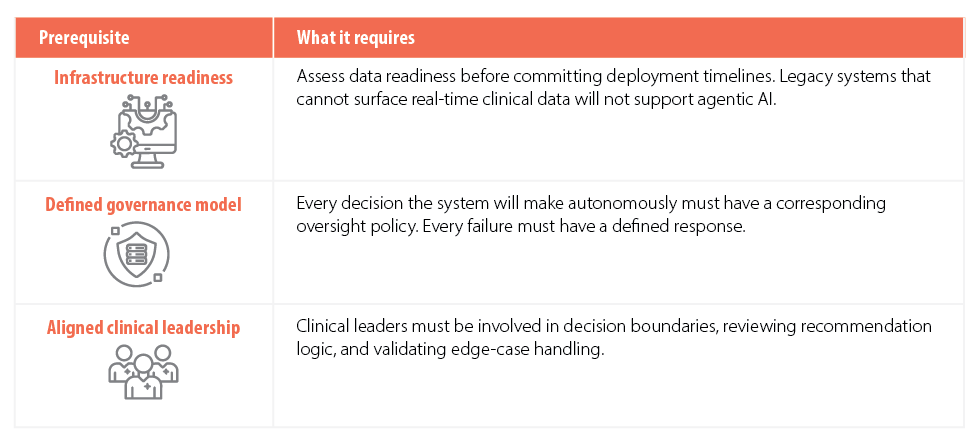
Three things must be true before a payer scales agentic AI in prior authorization (Figure 4):
- Infrastructure readiness: Assess data readiness before committing deployment timelines. Legacy systems that cannot surface real-time clinical data will not support agentic AI.
- Defined governance model: Every decision the system will make autonomously must have a corresponding oversight policy. Every failure must have a defined response.
- Aligned clinical leadership: Clinical leaders must be involved in decision boundaries, reviewing recommendation logic and validating edge-case handling.
Figure 4. Prerequisites for scaling agentic AI in prior authorization
Source: Infosys
Chapter 3

Payer coordination has a missing layer
Insights
- Care coordination has become a payer issue because breakdowns raise costs, disrupt care, and frustrate members.
- The main gap is an execution layer to manage handoffs, dependencies, and exceptions across fragmented care settings.
- Agentic systems can improve coordination by orchestrating workflows, verifying readiness, escalating issues, and triggering timely interventions.
- Strong implementation requires clear governance, human oversight, fairness controls, trust, and security.
- Payers should begin with high-volume, rules-based workflows where impact is measurable, then refine and scale gradually.
Care coordination has become a payer issue, not just a provider‑side operational concern. As healthcare payment models shift toward value-based programs, payers are increasingly accountable for the total cost and outcomes of care. That means breakdowns in care coordination that once looked like operational friction now show up as financial exposure, poor member experience, and weaker performance on quality measures.
Most payer organizations have policies, case management teams, provider relationships, and digital systems in place to address these challenges. What they often lack is a reliable execution layer that can move work across fragmented environments, connecting hospitals, laboratories, specialists, and post acute care providers while verifying that prerequisites are complete and escalating exceptions before they disrupt care.
This is where agentic systems can help: by sequencing tasks, checking dependencies, prompting the right next step, and surfacing exceptions early so care moves from authorization to completion.
The most immediate opportunities are in transitions of care, especially after hospital discharge, where even minor coordination gaps can disrupt authorizations, post-acute placement, medication reconciliation, outreach, and follow-up scheduling. When those handoffs fail, readmission risk rises and member experience suffers.
Why this matters now
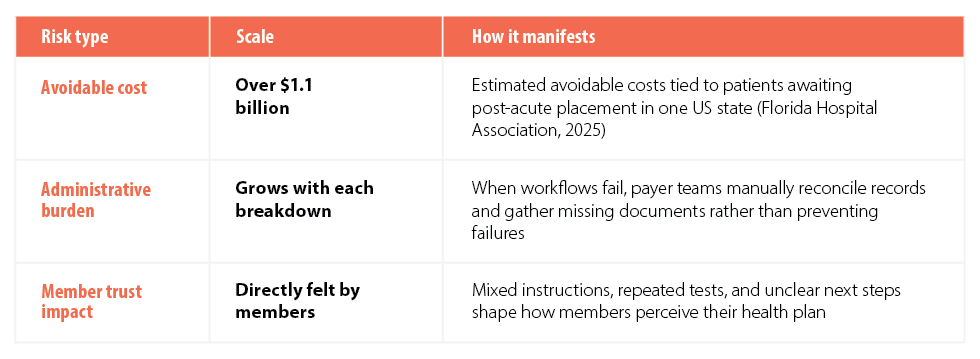
Care coordination failures create payer risk in three ways (Figure 1):
Increase avoidable cost
When discharge transitions stall, follow-up appointments are not scheduled, documentation is incomplete, or medication plans are not reconciled, utilization rises. Members are more likely to return to the emergency department, experience readmissions, or remain in higher-cost settings longer than necessary.
A 2025 analysis by the Florida Hospital Association estimated more than $1.1 billion in avoidable costs tied to patients awaiting post-acute placement, illustrating the scale of delayed care transitions in one state. That figure reflects hospital discharge delays rather than the full payer impact, but it still underscores how expensive coordination failures can become when transitions break down.
Increase administrative burden
When workflows break, payer teams step in manually to reconcile records, gather missing documents, and resolve avoidable exceptions. This creates a cycle in which the organization spends more time recovering from coordination failures than preventing them.
Weaken member trust
Members feel coordination failures directly. They receive mixed instructions, repeat tests, struggle to schedule follow-up care, or leave one setting without a clear next step. These experiences shape how they perceive their health plan.
Figure 1. Three ways care coordination failures create payer risk
Source: Florida Hospital Association, Infosys
What agentic coordination changes
Traditional analytics and decision-support tools can identify risk and route tasks. Agentic systems go further by helping execute the multistep workflows to achieve defined goals.
In a payer context, agentic coordination means a system can monitor the status of a care pathway, verify what must happen next, prompt the right party, and escalate when progress stalls. It operates within defined policy, compliance, and audit boundaries.
Recent Infosys Tech Navigatordemonstrates how this execution-focused model is already at work in other high-stakes industries. In manufacturing, agentic systems coordinate workflows across cost optimization, maintenance and repair operations that require tight sequencing across inspection, diagnosis, parts management, and safety checks. In retail and logistics, they detect and resolve inventory discrepancies across systems with minimal manual effort. Healthcare coordination has the same structural demands: interdependent steps, multiple providers, strict sequencing, and real consequences when something is missed.
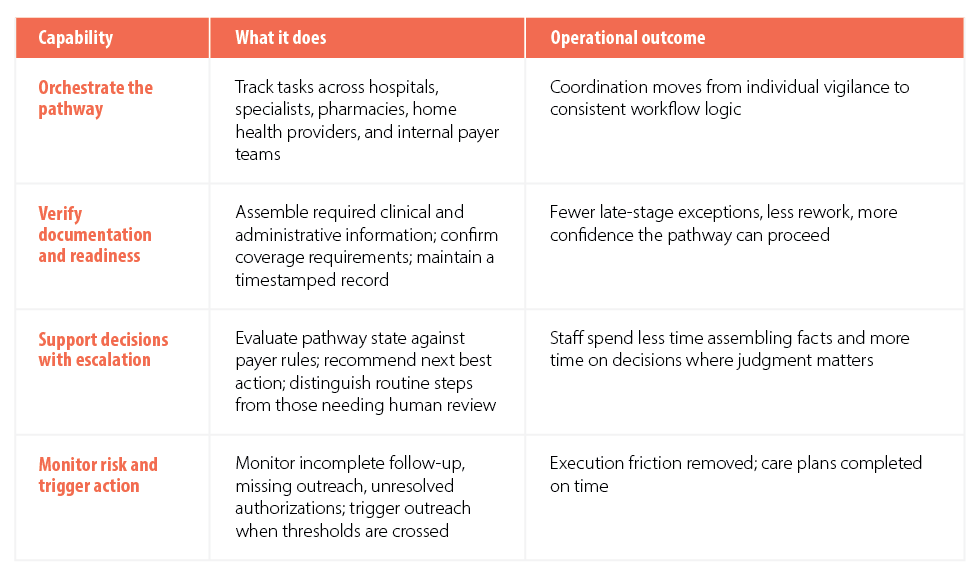
These are the four agentic capabilities that matter most (Figure 2):
Orchestrate the pathway
Payers need a way to ensure that each required step happens in the right order across providers, settings, and functions.
An agentic coordination layer can track tasks across hospitals, specialists, pharmacies, home health providers, and internal payer teams. It can identify missing prerequisites, trigger follow-up, and escalate stalled steps before delays accumulate. The operational benefit is straightforward: coordination moves from being dependent on individual vigilance to being enforced more consistently through workflow logic.
Verify documentation and policy readiness
Care transitions often fail because the next step begins before documentation, eligibility, or policy checks are complete.
Agentic systems can assemble the required clinical and administrative information for a transition, confirm that coverage and policy requirements are satisfied, and maintain a timestamped record of the actions taken. This creates better handoff readiness and supports auditability.
The practical gain is fewer late-stage exceptions, less rework, and more confidence that the pathway can proceed without preventable interruption.
Support decisions with clear escalation rules
Not every step in care coordination should be automated. But many steps can be prepared, structured, and routed in a way that makes human judgment more effective.
An agentic system can evaluate the current state of a pathway against payer rules and clinical guidance, recommend the next best action, and distinguish between routine steps and those that require human review. For more complex cases, it can provide a structured briefing rather than forcing staff to reconstruct context from multiple systems.
This can improve consistency while preserving accountability. Humans spend less time assembling facts and more time making decisions where judgment matters.
Monitor risk and trigger intervention
Care pathways can fail if warning signals are missed.
An agentic system can monitor indicators such as incomplete follow-up, patients not following medication requirements, missing outreach, or unresolved authorizations. When those signals cross defined thresholds, it can trigger outreach to the member, care manager, or provider based on governance rules.
The value of this approach lies in removing the execution friction that prevents care plans from being executed on time. While this model points to a future direction for payer coordination, realizing that potential starts with the right operating foundation.
Figure 2. Four agentic capabilities for care coordination
Source: Infosys
How to implement this reliably
Care coordination requires a multiagent architecture where swarms or networks of agents work together to complete a task. This is not easy. The right protocols will need to be onboarded, including the Model Context Protocol and Agent-to-Agent Protocol, along with appropriate integration with legacy systems and governance processes.
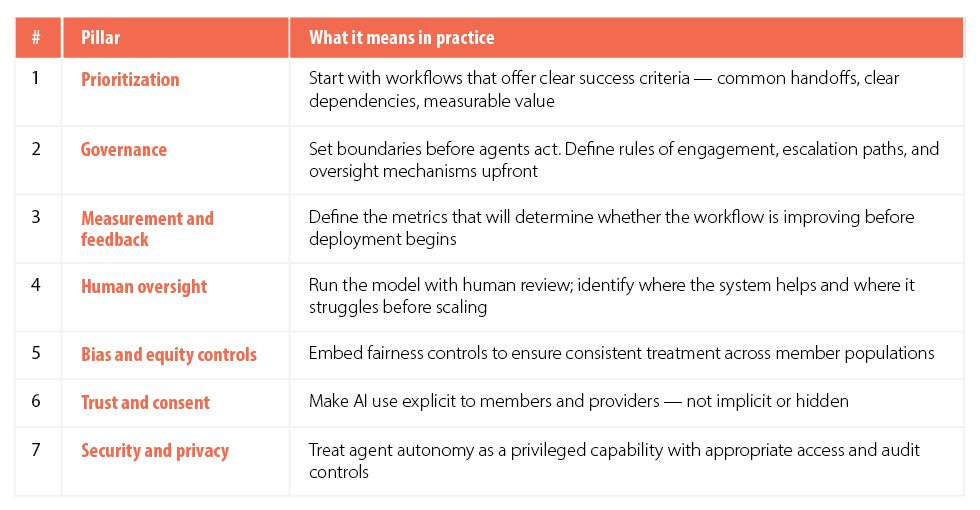
Seven pillars are pivotal (Figure 3):
1. Prioritization: Start with workflows that offer clear success criteria
Rules-based, repeatable workflows such as discharge follow-ups, authorization tracking, and scheduling alignment are the best starting points for early automation. They offer clear success criteria and limited clinical ambiguity, making them well suited to build confidence in the system’s reliability. By contrast, deploying too early in complex or ambiguous workflows can erode clinical trust and drive the override behavior that undermines adoption.
2. Governance: Set boundaries before agents act
Before deployment, organizations should define what agents are allowed to do, under which conditions, and with what level of auditability. Governance must align closely with federal and state privacy regulations, Medicare Advantage and Medicaid requirements, and internal compliance policies. Without these guardrails, autonomy becomes an operational risk. Agents can act beyond their intended scope, and the organization may be unable to demonstrate compliance when required.
3. Measurement and feedback: Prove value, then iterate
Track adoption, operational throughput, clinical outcomes, and member experience from the start, and organizations should also measure how often agents complete tasks autonomously versus escalate them to humans. That split shows where thresholds, policies, and workflow design need refinement. Without measurement, execution becomes opaque: organizations cannot prove value, improve performance, or catch failure modes before they scale.
4. Human oversight: Prevent over automation
Over automation is a real risk in care coordination, particularly in edge cases involving clinical nuance or social complexity. Systems must be explicitly designed to keep humans in the loop for decisions requiring human discretion. Reviewers should be able to pause workflows, appeal agent recommendations, and revert steps to manual handling when needed. Crucially, these overrides must be logged and explainable, preserving trust while ensuring accountability.
5. Bias and equity controls: Embed fairness in execution
Because agentic systems act at scale, small biases can be amplified if left unchecked. Training data should reflect diverse populations, and outcomes must be continuously monitored across demographic segments. Fairness thresholds and policy gates should be enforced before agents are allowed to act autonomously, particularly in outreach, prioritization, or resource allocation workflows.
6. Trust and consent: Make AI use explicit, not implicit
Member trust is foundational. Payers must be transparent about where AI supports coordination and communication, particularly in member outreach. Consent, channel preferences, and contact frequency must be rigorously honored. When members understand how and why AI is being used, agentic systems are more likely to enhance trust rather than undermine it.
7. Security and privacy: Treat autonomy as a privileged capability
Agentic systems depend on continuous access to sensitive clinical and administrative data. In this context, a security lapse is not simply a technology failure; it is a patient data breach with regulatory, legal, and reputational consequences. As autonomy increases, security cannot remain an implicit control environment. It must be explicit, verifiable, and designed into execution from the outset. Infosys’ Tech Navigator: A path to the agentic-first enterprise discusses these points in detail.
Figure 3. Seven implementation pillars for reliable agentic care coordination
Source: Infosys
What leaders should do next
Payers do not need a perfect enterprise-wide design before they begin. But they do need operational discipline.
Start by selecting one coordination workflow where the handoffs are common, the dependencies are clear, and the value of improvement can be measured. Define the rules of engagement for the agent, the escalation paths for exceptions, and the metrics that will determine whether the workflow is improving. Then run the model with human oversight, review where the system helps and where it struggles, and refine the boundaries before scaling further.
The strategic opportunity is to make care coordination more reliable. In value-based care, reliability is a competitive advantage. Payers who can consistently guide members through transitions with fewer gaps, faster intervention, and less avoidable rework will be better positioned to control cost, improve outcomes, and strengthen member experience.
Chapter 4

How to implement agentic adjudication
Insights
- Slow adjudication creates risk for every stakeholder. Patients face uncertainty, providers carry financial and administrative burdens, and payers absorb leakage, rework, and lower member satisfaction.
- Legacy adjudication breaks down under five pressures: high volume, policy complexity, data silos, evolving fraud patterns, and rising compliance demands.
- Agentic adjudication has the potential to improve speed, consistency, and defensibility by combining context, policy application, intelligent routing, and audit-ready rationale in one coordinated model.
Claims adjudication determines whether a claim is paid, partially paid, or denied based on benefit rules, clinical policy, and supporting documentation.
Traditional automation works for straightforward checks such as eligibility, pricing, and basic validation. But complex claims still require specialists to reconcile clinical, contractual, and historical context across systems, creating delays and bottlenecks.
Agentic adjudication represents a shift from task-based automation to coordinated, explainable, end-to-end decisioning. It can assemble full claim context in real time, apply policy consistently, route exceptions intelligently, and produce audit-ready rationales. Our recent Tech Navigator outlines this broader shift, showing how agent-driven systems can outperform traditional automation in complex, multistep decision environments.
Many of the building blocks for agentic adjudication already exist in payer automation and decision-support workflows. The next step is to coordinate them into a unified adjudication model that can operate at scale.
Why current adjudication models fall short
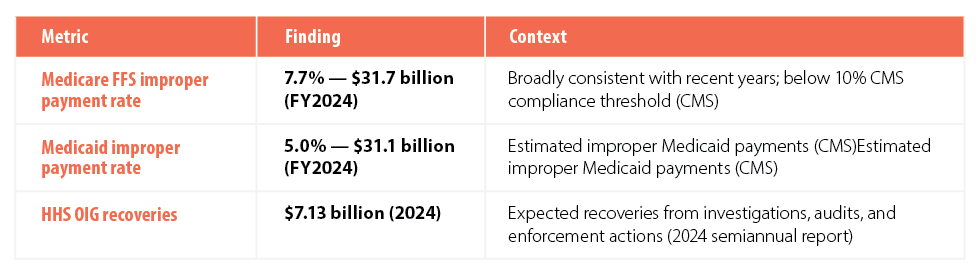
Payers are under growing pressure to make faster and more accurate decisions while also showing how each decision was reached. Improper payments, documentation gaps, and inconsistent interpretation create financial and regulatory exposure (Figure 1). In fiscal year 2024, CMS reported an improper payment rate of 7.7% for the Medicare Fee-for-Service program, representing an estimated $31.7 billion in payments that did not meet program requirements. While significant in dollar terms, the rate is broadly consistent with recent years, 7.5% in 2022 and 7.4% in 2023, and below the 10% compliance threshold CMS uses for the program. Medicaid’s improper payment rate was 5%, or an estimated $31.1 billion.
Enforcement trends reinforce the same message. In its 2024 semiannual report, the Office of Inspector General of the US Department of Health and Human Services (HHS OIG) detailed $7.13 billion in expected recoveries and receivables from investigations and audits of misspent funds, overpayments, frauds, or other violations of Medicare and Medicaid requirements, alongside 1,548 criminal and civil actions and 3,234 exclusions.
Figure 1. Scale of adjudication risk — improper payments and enforcement (FY2024)
Source: CMS, Office of Inspector General of the Department of Health and Human Services
The five forces that strain adjudication
1. Volume and variability: Large payers process millions of medical claims each year and exceptions quickly overwhelm human workflows, extending payment cycles and frustrating providers who depend on timely reimbursement. UnitedHealthcare, one of the largest health insurers in the US, reports 10% of claims require further review, but only 0.5% are denied for clinical reasons, with the rest tied to administrative errors.
2. Complexity across the claim: A single claim may touch benefit limits, cost sharing, coding rules, prior authorization, coordination of benefits, network status, and clinical evidence. CMS found that 79.1% of Medicaid improper payments were linked to insufficient documentation, showing how easily missing context creates downstream error.
3. Fragmented data: Eligibility, provider data, prior authorization records, pricing schedules, contract terms, and claim histories often live in different systems. Analysts are left to bridge those gaps manually. The cost is enormous: a national survey of hospitals in the US by healthcare company Premier Inc. found that healthcare providers spent $25.7billion in 2023, contesting claim denials, and nearly 70% of these denied claims were later overturned.
4. Fraud and improper payments: Static rules engines can catch known patterns, but they struggle with new abuse tactics, identity misuse, and cross-channel anomalies. In 2024, the HHS OIG identified $7.13 billion in misspent health and human services funds, much of it tied to billing and documentation issues that traditional controls failed to prevent early enough. Similar pressures exist at the provincial level in Canada: Ontario’s auditor general found that the provincial health insurance plan, referred to as OHIP, could not automatically flag high-risk claims, uncovering cases where at least 59 physicians billed more than 24 hours of services in a single day.
5. Compliance demands: Regulators increasingly expect payers to show not only what decision was made, but why. That means preserving evidence trails, timestamps, policy references, documentation sources, and a clear explanation of how the determination was reached.
When to use an agentic model
Agentic adjudication is most likely to create value when:
- Claims require data from multiple systems before a decision can be made.
- Documentation quality is uneven or unstructured.
- Reviewers spend considerable amounts of time gathering context instead of deciding.
- Policy interpretation varies across teams.
- Auditability, appeals, or denial overturns are recurring pain points.
- Current automation handles simple claims but stalls on exceptions.
Organizations should not apply agentic methods everywhere at the outset. The best early candidates are workflows where exceptions arise often, yet the rules, evidence checks, and escalation paths remain consistent enough to be applied in a repeatable way.
Core capabilities to implement
Assemble full claim context
Agentic systems can assemble full claim context before deciding. They can combine eligibility, provider status, prior authorization evidence, historical outcomes, pricing inputs, and supporting documentation into a single working view. This reduces the errors that occur when decisions are made with only partial or outdated information.
Validate clinical and documentation evidence
Agentic adjudication can strengthen how claims are validated against clinical and policy requirements by applying evidence checks more consistently and comparing them with the billed codes and policy criteria. This reduces reliance on codes alone, identifies missing support earlier, and ensures that the same review logic is applied across all claims.
Move to smarter routing
In this model, clean claims can move straight through, while clinically ambiguous cases are routed to nurse reviewers with concise summaries. High-risk claims can be escalated to investigation teams with supporting evidence.
Produce audit-ready rationale
Agentic adjudication can support audit-ready decisions. Each determination includes what was checked, which policies applied, what evidence was used, and why the outcome was reached. This level of transparency can support compliance, appeals, and continuous improvement. The result is a model that improves speed, consistency, and defensibility at the same time.
Coordinate the workflow
The potential value comes from coordinating the full decision flow rather than optimizing isolated steps. Instead of relying on a single system or a series of disconnected automations, an agentic system operates as a coordinated model, where specialized agents handle distinct parts of the adjudication process.
How the agentic adjudication workflow operates
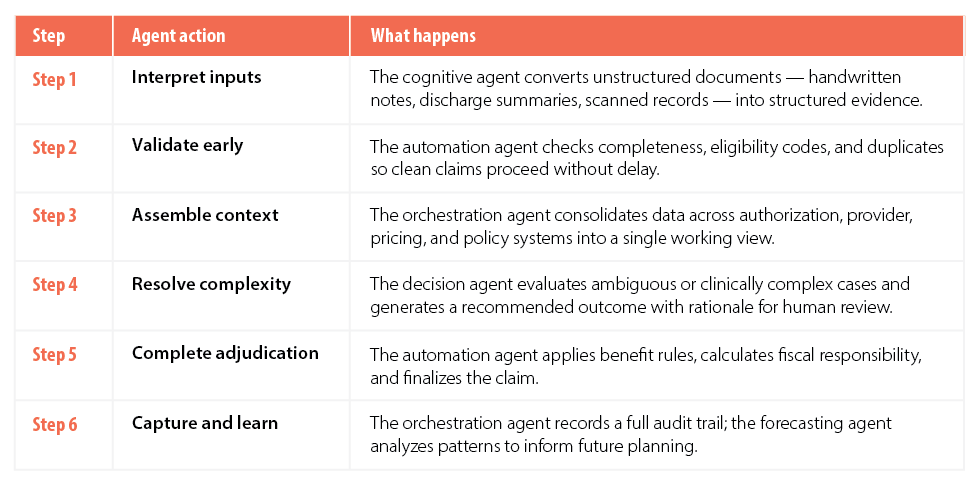
In an agent driven adjudication model, claims can be processed through a coordinated decision layer rather than isolated steps or disconnected systems. Specialized agents contribute at defined points in the workflow (Figure 2), combining automation, policy interpretation, and oversight to deliver faster, more consistent, and auditable outcomes.
Figure 2. Six-step adjudication workflow
Source: Infosys
Role of specialized agents
Orchestration agent
The orchestration agent manages the overall flow of the claim. It determines the correct sequence of actions, manages handoffs across pricing, authorization, provider, and clinical systems, and ensures claims progress within the service level agreement and regulatory timelines. For example, when prior authorization evidence is missing, the orchestration agent retrieves relevant data from the authorization system, requests missing documentation from the provider, and resumes adjudication once the information is complete.
Automation agent
The automation agent manages repeatable, rule-based tasks. This includes benefit calculation, contract pricing, cost share, and coordination of benefits checks. It applies the plan rules consistently, calculates payer and member responsibility, updates deductibles and out-of-pocket totals, and routes eligible claims directly to payment without any manual intervention.
Decision agent
The decision agent addresses complex cases that require policy interpretation and multistep reasoning. For example, when documentation does not clearly support a billed procedure, the decision agent interprets clinical notes, checks policy exceptions, and recommends an approval or denial with a complete rationale. These recommendations are further analyzed by a human reviewer who takes the final decision.
Cognitive agent
The cognitive agent converts unstructured inputs such as handwritten notes, discharge summaries, and scanned documents into structured evidence. This allows other agents to evaluate claims using complete and consistent information. For example, it can extract key clinical indicators and flag mismatches between documented severity and billed procedures.
Roadmap for implementation
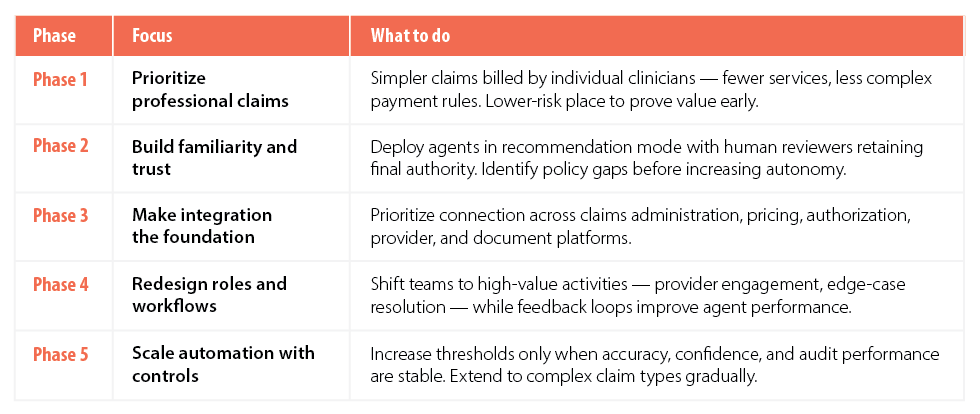
Agentic adjudication is best implemented in a phased manner (Figure 3). Each phase should deliver near-term value while building the data, governance, and operating discipline needed for broader automation.
Phase 1: Prioritize professional claims
Start with professional claims, which are billed by individual clinicians and are usually simpler than hospital or facility claims because they involve fewer services and less complex payment rules. That makes them a lower-risk place to prove value early. Hospital claims are more complex because they often combine multiple services, billing codes, and coverage rules in a single episode of care.
Phase 2: Build familiarity and trust before full automation
Deploy agents first in recommendation mode, with human reviewers retaining final authority. This helps teams identify policy gaps, documentation weaknesses, and variation in reviewer interpretation before increasing autonomy.
Phase 3: Make integration the foundation, not an afterthought
Prioritize integration across core systems, including claims administration, pricing, authorization, provider, and document platforms.
Phase 4: Redesign roles and workflows
Shift teams away from routine processing toward high-value activities, such as provider engagement and edge-case resolution, while feedback loops continuously improve agent performance.
Phase 5: Scale automation with controls
Increase automation thresholds only when accuracy, confidence, and audit performance are stable, and extend coverage to more complex claim types once earlier phases are consistently performing well.
Success can be measured with a small set of operational and quality metrics. This includes auto-adjudication rate, turnaround time, denial overturn rate, audit trace completeness, reviewer productivity, and exception volume by category.
Figure 3. Phased implementation roadmap for agentic adjudication
Source: Infosys
What to do next
Start with a focused use case where delays, exceptions, and inconsistency are already visible. Build the workflow around context assembly, intelligent routing, and audit-ready rationale. Keep human reviewers involved until performance is stable. Then expand gradually, with clear metrics, governance, and integration in place. The goal is not to automate every decision at once, but to build a model that improves speed, consistency, and control where it matters most.
Chapter 5

Agent-driven compliance for healthcare payers
Insights
- Sample-based audits create blind spots that only surface when regulators examine full populations, by which point cost is measured in penalties rather than findings.
- Task automation improves efficiency but cannot interpret rules, assess exceptions, or explain decisions to a regulator.
- Agentic AI can enable continuous monitoring, traceable reasoning, and earlier risk identification, shifting compliance from retrospective review to proactive assurance.
- Intelligent compliance can embed audit readiness into daily operations rather than treating it as a separate activity.
When healthcare payers transform operations, the focus is often on improving member services, claims adjudication, and other consumer-facing functions.
Compliance and audit functions, which ensure adherence to company protocols and local laws, frequently receive less attention. This raises the risk of compliance failures that can result in sanctions, including civil penalties, enrollment suspension, or even loss of authorization to operate.
In 2025 alone, CMS, federal agency responsible for overseeing government health insurance programs, including Medicare in the US, suspended or terminated multiple health plan contracts, and imposed enrollment suspensions and civil penalties across many plans.
These enforcement actions reflect the growing mismatch between today’s regulatory expectations and compliance models that were built for an earlier era, when periodic audits, sampled reviews, and retrospective documentation were considered sufficient evidence of oversight.
As health plans become more diversified and regulatory scrutiny increases, continuous oversight is needed to protect both operational performance and organizational reputation.
A recent Infosys analysis found that in pharmaceutical manufacturing, integrating manufacturing execution systems and laboratory information management systems into production and quality workflows reduced manual documentation errors by 70% and improved compliance readiness by 40%. While not specific to AI, it shows how embedded digital compliance systems can improve accuracy, traceability, and operational resilience in highly regulated environments. For healthcare payers, this strengthens the case for embedding more advanced approaches, including agentic AI, into day-to-day operations.
Why today’s compliance model falls short
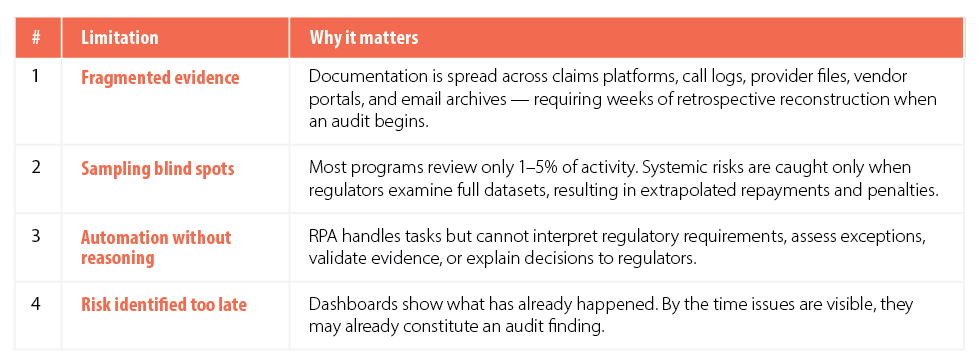
Health plans typically manage compliance through a combination of ongoing monitoring, periodic audits, and reactive issue identification. Robotic process automation (RPA), software that mimics how humans interact with computer systems, is used to complete routine and repetitive tasks such as claims submission, eligibility verification, and report generation. These tools help, but they do not solve the core complications (Figure 1) that increasingly put payers at risk.
Evidence is fragmented and difficult to reconstruct: Documentation required for audits is spread across claims platforms, utilization management tools, call logs, provider files, vendor portals, and email archives. When an audit begins, compliance teams spend weeks gathering evidence, aligning timestamps, and reconstructing the sequence of decisions and communications. This retrospective reconstruction approach is time-consuming and error-prone. CMS audit findings in 2024 highlighted the consequences of this approach, including misclassified coverage requests, incomplete decision notices, and late member communications. These issues are not usually the result of intentional noncompliance, but of fragmented evidence and manual oversight under time pressure.
Sampling creates blind spots: Most compliance programs review only a small percentage of activity, commonly between 1% and 5%, using standard sampling practices. While spot-checking can detect individual errors, it misses blind spots, or systemic risks, such as repeated delays in prior authorizations or overuse of high-cost imaging by certain provider groups. These problems are often uncovered only when regulators like CMS examine full datasets, resulting in extrapolated repayments, penalties, corrective action plans, and increased scrutiny. In 2024, CMS conducted 39 health plan compliance audits covering 494 contracts, representing 87.6% of seniors enrolled in Medicare Advantage plans, and 68.8% of total enrollment across government-run health insurance programs. This scale builds on a clear expansion in prior years. In 2022, the US federal agency audits covered approximately 33.6 million beneficiaries, about 63% of all beneficiaries enrolled in Medicare managed care and prescription drug plans nationwide, signaling a move beyond targeted or episodic oversight. In 2023, CMS did not publish an aggregate beneficiary‑coverage percentage.
Automation handles tasks, not reasoning: RPA and less sophisticated AI workflow tools automate individual steps like form-filling or routing, but they cannot interpret regulatory requirements, assess exceptions, validate evidence, or explain decisions. AI copilots help generate summaries but still require human prompts and do not operate continuously. Regulators expect timely decisions, standardized processes, and clear rationale tied to specific rules, which cannot be achieved by task-based automations.
Risk is identified too late: Dashboards and business intelligence tools show what has already happened; they do not surface emerging risks. By the time compliance issues such as late notifications, recurring denial errors, or missing documentation are spotted, the problem could already be an audit finding.
These limitations reflect a broader challenge. Manual, sampled, and retrospective compliance models cannot keep pace with current regulatory expectations for continuous oversight, population-wide analysis, and traceable evidence of early risk identification and remediation.
Figure 1. Four limitations of current compliance models
Source: Infosys
How agentic AI changes compliance execution
Traditional automation executes scripted steps: if a condition is met, a predefined action follows. This works for stable, repeatable tasks. It breaks down when context is incomplete or decisions require judgment.
Agentic AI reasons toward an outcome. As described in Infosys' production-grade agentic AI blueprint, agentic systems decompose a goal into subtasks, determine which agents and tools are relevant, and orchestrate actions dynamically based on context and feedback. Each agent has a defined role, including verification, decisioning, or resolution. The system assesses situations, evaluates options, and adjusts behavior when conditions change rather than executing a preset workflow. In a compliance context, multiple specialized agents work in coordination. Each operates continuously, without waiting for prompts, and creates an auditable record of actions, rationale, and rules or data applied.
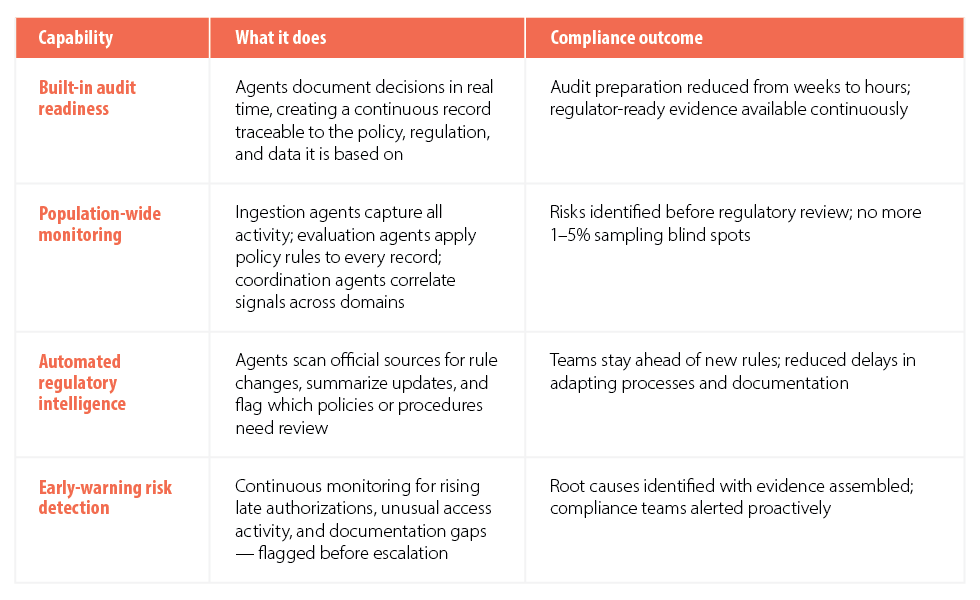
This changes compliance in four important ways (Figure 2):
Built-in audit readiness
Agents can plan and execute tasks, make decisions, and document outcomes in real-time, creating a continuous record of activity. Each decision can be traced back to the policy, regulation, and data it is based on. Unlike static automation or RPA, agents handle end to end workflows across systems and exceptions. This could produce regulator ready evidence and reduce the need for retroactive reconstruction, cutting audit preparation from weeks to hours.
Population-wide monitoring
Agentic AI enables population-level monitoring. In a payer environment, ingestion agents continuously capture activity such as claims, authorizations, appeals, grievances, call summaries, and access logs directly from the systems. Evaluation agents apply policy rules, regulatory requirements, and learned risk patterns to every record. Coordination agents correlate with signals across domains like claims and flag issues that need follow up or escalation. This systematic approach can help identify risks earlier, rather than allowing them to surface months later through regulatory review.
Automated regulatory intelligence
Agents scan official sources for rule changes, summarize updates, and flag which policies or procedures need review. Human reviewers remain accountable for final interpretation and approval.
Early-warning risk detection
Because agents can monitor operational activity continuously, abnormal patterns such as rising numbers of late authorizations, unusual access activity, and documentation gaps could be flagged before they escalate. The system can correlate context, identify possible root causes, and alert compliance teams with the evidence already assembled.
Figure 2. Four ways agentic AI changes compliance execution
Source: Infosys
What intelligent compliance looks like in action
In an agentic compliance model, oversight could become part of routine operations. AI agents could coordinate evidence collection, help enforce timelines, and maintain documentation as decisions are made.
Case files could be assembled continuously. Potential audit outcomes can be simulated. Training and controls can be tailored based on role specific risk exposure.
Decision support agents then guide regulatory submissions, validate whether processes align with requirements, and recommend targeted corrective actions when gaps are detected. At a more advanced level, cognitive capabilities forecast emerging risks, identify missing filings before deadlines are missed, and surface systemic noncompliance trends across the full population.
Together, these capabilities shift compliance from reactive oversight to continuous, intelligence driven assurance.
Steps to build intelligent compliance
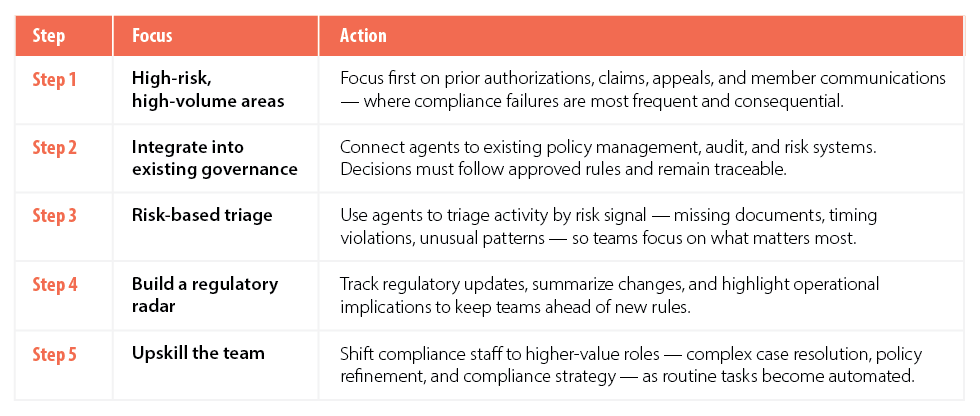
You can build intelligent compliance by following these steps (Figure 3):
Step 1: Start with high-risk, high-volume areas
Focus first on processes that generate the highest transaction volumes and regulatory exposure, such as prior authorizations, claims, appeals, or member communications. These are where compliance failures are most frequent and consequential.
Step 2: Integrate AI into existing governance structures
Agentic AI must operate under the same governance and oversight frameworks that guide other compliance tools. Connecting agents to existing policy management, audit, and risk systems ensures that decisions follow approved rules and remain traceable.
Step 3: Use risk-based triage to prioritize issues
Agentic systems can triage activities based on risk signals such as missing documents, timing violations, or unusual patterns. Compliance teams can focus on issues that matter the most rather than reviewing everything flagged by the system.
Step 4: Build a regulatory radar
Use agents to track regulatory updates, summarize changes, and highlight operational implications. This keeps teams ahead of new rules and reduces delays in adapting processes and documentation.
Step 5: Upskill the team toward higher value roles
As routine tasks become automated, compliance teams can shift to roles that require judgment such as resolving complex cases, improving quality, refining policies, and managing compliance strategy. Infosys Knowledge Institute’s research notes that AI first organizations must redesign roles and invest in upskilling to strengthen human responsibilities around oversight, interpretation, and decision making as machine led execution increases.
Figure 3. Five steps to build intelligent compliance with agentic AI
Source: Infosys
What should leaders do next
Healthcare payers do not need more dashboards, more sampled reviews, or more isolated workflow automation. They need a compliance model that matches the realities of current regulation: continuous oversight, full-population visibility, faster response, and traceable decision-making.
Agentic AI could provide a practical path to achieve this. Payers should start with a high-risk process, build evidence capture into the workflow, and use agents to monitor and explain decisions as they happen. This will help shift compliance from a reactive, audit-driven activity to continuous operational capability.


For retailers, the AI advantage will come from building the organizational muscle that lets employees use AI confidently.
- 09 Sep, 2026
- 6 min read

Retailers must prioritize AI-powered supply chain intelligence, seamless omnichannel experiences, and personalization to drive growth and resilience.
- 08 Sep, 2026
- 15 min read

Companies that tailor their offerings and messaging to evolving consumer priorities will be better equipped to sustain demand as spending becomes more selective.
- 30 Jul, 2026
- 12 min read
