
Insights
- Automotive employees are curious and broadly positive about AI, but they use it across fewer task types than peers in other industries.
- AI saves automotive employees time, but they are more likely than peers to spend that time on mundane or routine work and less likely to spend it on learning new skills.
- Automotive employees feel less empowered and report greater resistance than peers in other industries.
- To turn frequent AI use into workforce transformation, automotive companies must redesign work, build capability and trust, strengthen governance, and scale successful initiatives.
Executive summary
The automotive industry is navigating cost pressures, the growth of software-defined vehicles, complex supply chains, changing customer expectations, and the need for faster product development and operational decision-making. AI can help automotive companies improve engineering productivity, manufacturing quality, supply chain responsiveness, software development, and customer operations. As AI moves from individual tasks and isolated initiatives toward broader adoption, automotive companies have an opportunity to reshape how work gets done and how employees contribute to business value.
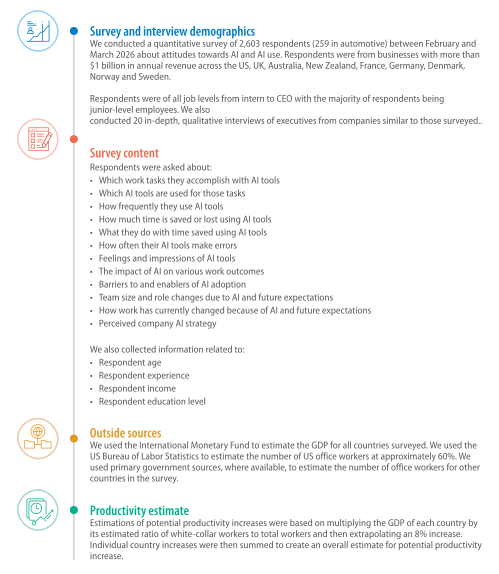
For its AI and the Future of Work report, Infosys surveyed 2,603 white-collar employees across industries globally. Of these employees, 259 were from the automotive industry. The research shows that automotive employees already use AI frequently and report productivity benefits similar to those in other industries.
However, this adoption has not yet translated into broad workforce transformation. Automotive employees use AI across fewer types of tasks, and the time saved is not always reinvested in learning new skills or in completing higher-value work. Employees are also less likely to feel empowered, while organizational guidelines and safeguards are less consistently present. In many automotive companies, AI remains concentrated in isolated projects or departments.
Addressing these gaps requires automotive organizations to move from AI usage to AI-enabled work by expanding AI across workflows, converting productivity gains into workforce capabilities, strengthening practical governance, and creating an environment in which employees can use AI with confidence.
Strong foundations for AI adoption
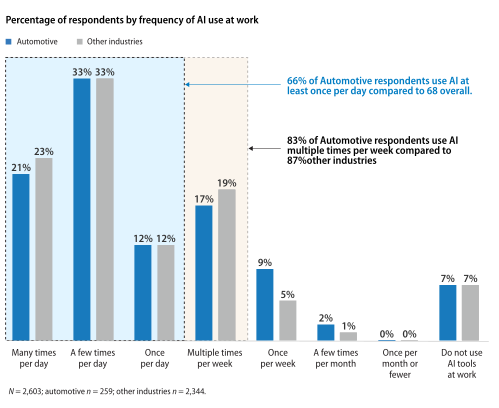
Automotive employees use AI at nearly the same frequency as employees in other industries. Around two-thirds (66%) use AI at least once a day, compared with 68% across other industries (Figure 1). Almost 83% use it multiple times a week compared with 87% in other industries. Only 7% report that they do not use AI tools, the same share as in other industries.
AI use has progressed beyond limited experimentation and become a routine layer of knowledge work. Adding tools or running broad awareness campaigns will not, by itself, unlock the next stage of value. Companies now need to examine where employees use AI, how deeply it is embedded in workflows, and whether faster task completion improves operational or customer outcomes.
Figure 1. Automotive employees’ AI use matches other industries
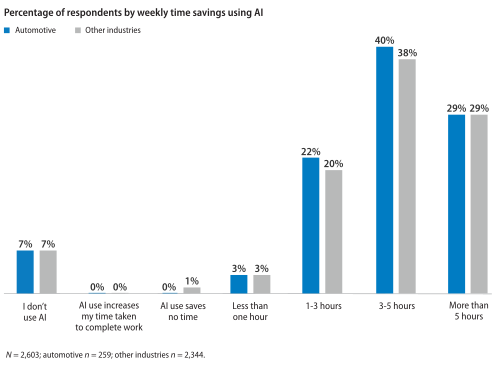
The frequent AI usage is producing visible benefits. Among automotive employees surveyed, 40% estimate that AI saves them between three and five hours each week, and another 29% report that they save more than five hours (Figure 2). The distribution is almost identical to that in other industries.
Figure 2. AI delivers time savings for automotive employees
The saved time creates capacity to improve throughput, shorten decision cycles, or free employees for more complex work. Although, time saved is an intermediate measure, its value depends on whether organizations redirect that capacity toward customer value, operational improvement, innovation, or skill development. Without an explicit choice, productivity gains are often absorbed by the existing workload and remain difficult to detect at the enterprise level.
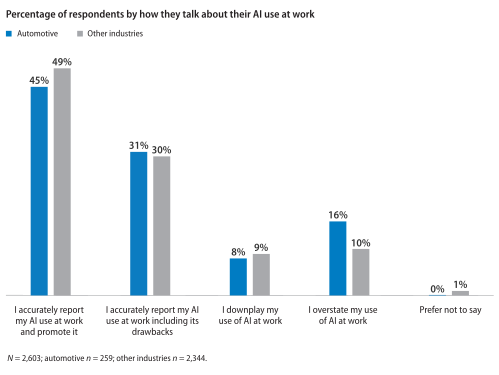
Automotive employees are broadly open about their AI use; 45% say they accurately report and promote it, while 31% say they accurately report both use and drawbacks. These proportions broadly align with the cross-industry results (Figure 3). However, 16% of automotive employees say they overstate their AI use, compared with 10% elsewhere.
Figure 3. Automotive employees are more likely to overstate their AI use at work
What employees report about their AI use does not necessarily indicate whether that use has become part of everyday work or has improved business outcomes. Companies should, therefore, complement employee surveys of AI use with measures, such as repeat use of approved tools, workflow coverage, output quality, cycle-time improvement, and realized business outcomes. These measures show whether frequent use has become embedded capability.
AI use remains narrow
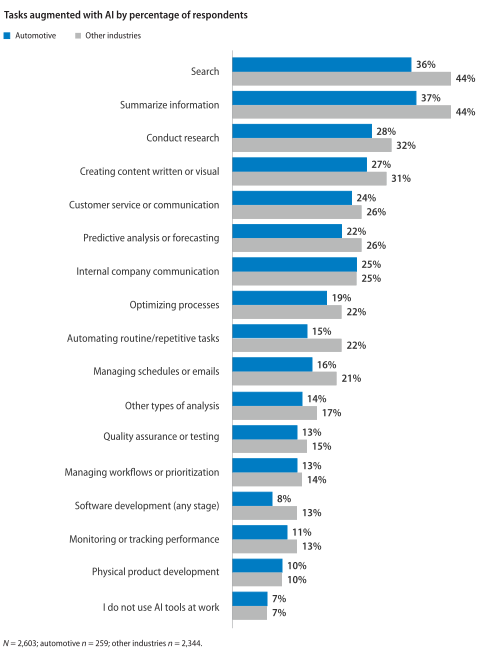
Automotive employees are less likely than their peers to apply AI for search, summarization, routine task automation, software development, and schedule or email management (Figure 4). Among automotive employees surveyed, 36% use AI for search, compared with 44% in other industries. The corresponding figures are 37% and 44% for summarization, and 15% and 22% for routine task automation. AI use for physical product development stands at 10% in both automotive and other industries, despite the central role of engineering and product development in the sector.
Figure 4. Automotive employees use AI for fewer everyday tasks
The gap is most visible among midcareer automotive employees. Elder millennials in automotive use AI for an average of 3.2 types of tasks, compared with 4.3 in other industries, and younger millennials for 3.2 versus 3.9 (Figure 5). Gen Z employees average 2.8 types of tasks compared with 3.3, while Gen X and baby boomer employees average 3.9 versus 3.4.
Figure 5. Midcareer automotive employees use AI across fewer task types
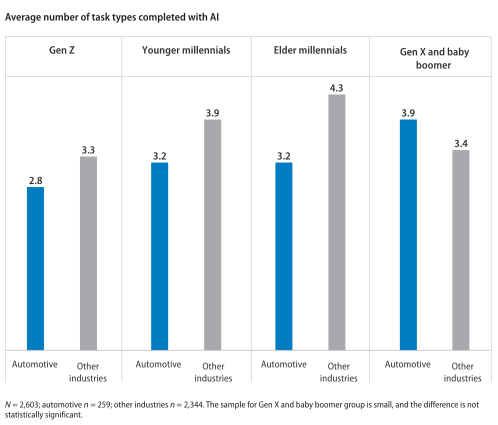
The findings do not suggest that automotive companies lack significant AI initiatives. The survey captures day-to-day use across broad task categories, and it shows that this use has not spread evenly across the workforce. The AI Business Value Radar: Automotive Edition also finds that functional use cases can create value, while automotive-specific use cases require changes to data architecture and the operating model.
The productivity gains from AI are not consistently strengthening workforce capability. Automotive employees are more likely than peers in other industries to use the time saved to do mundane or routine work, and less likely to use it to learn new skills. Among automotive employees surveyed, 14% use it to do more mundane or routine work, twice the 7% reported in other industries. Only 10% use the time to learn new skills, compared with 16% in other industries (Figure 6). At the same time, 35% use it to do more interesting work, slightly above the 30% reported in other industries.
Figure 6. Automotive employees are less likely to spend saved time on learning new skills
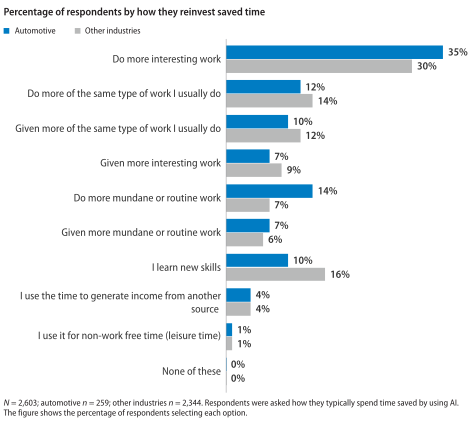
A team that shortens analysis, documentation, testing, or coordination should know whether the released capacity will address bottlenecks, improve quality, investigate recurring defects, build software and data skills, or accelerate innovation.
AI is giving automotive companies more time, but they are not using that time to broaden employees’ skills or improve higher-value work. Using AI across more of the workflow, and directing the time it frees up toward skills, can turn individual efficiency into sustained operational improvement.
Confidence and guardrails lag
Automotive employees are broadly receptive to AI (Figure 7): 76% selected at least one positive sentiment, close to the 78% reported in other industries. However, only 17% feel empowered by AI, compared with 25% elsewhere, while 15% report resistance, compared with 6% in other industries.
Figure 7. Automotive employees feel less empowered by AI
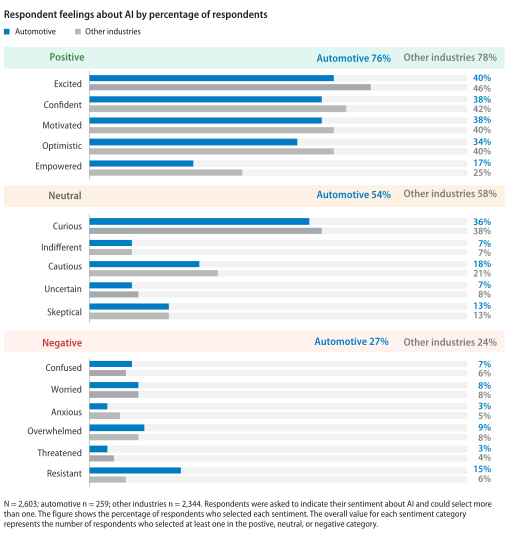
This points to a workforce that sees AI’s potential but does not consistently feel able to use it with confidence. Automotive work often carries strong requirements for safety, quality, traceability, cybersecurity, and regulatory compliance. General encouragement without practical support often increases hesitation or keeps AI confined to low-risk activities.
The barriers employees report support this interpretation. Access and basic knowledge are not material obstacles in the automotive sample. The stronger concerns involve the quality and consequences of AI outputs (Figure 8): 21% say AI creates more work because they need to check or redo the output, compared with 16% in other industries. Meanwhile, 16% do not trust AI results to be accurate, 18% worry they will be held responsible if something goes wrong, and 20% cite privacy or data safety concerns.
Figure 8. Automotive employees worry about output quality and accountability
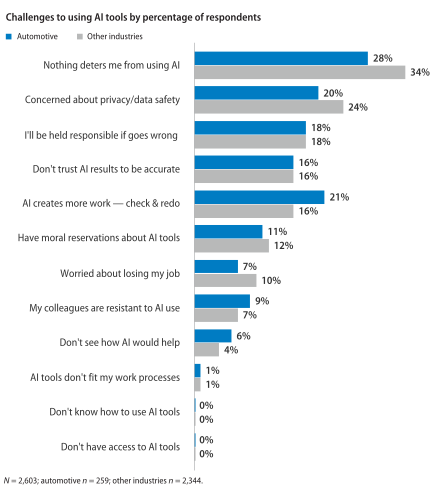
Verification is appropriate in high-consequence work. But friction rises when every employee must independently determine what to check, how much checking is enough, and who owns the final decision.
The organizational environment does not yet address these concerns consistently (Figure 9). Automotive does well on strategic clarity, with 23% saying it is always present compared with 18% elsewhere. But only 15% say AI guidelines are always present, versus 21% in other industries, and the same gap applies to defined safeguards. Regular training, leadership support, and employee co-creation are in line with other industries, though each remains far from universal.
Figure 9. Automotive employees feel AI guidelines and safeguards are inconsistent
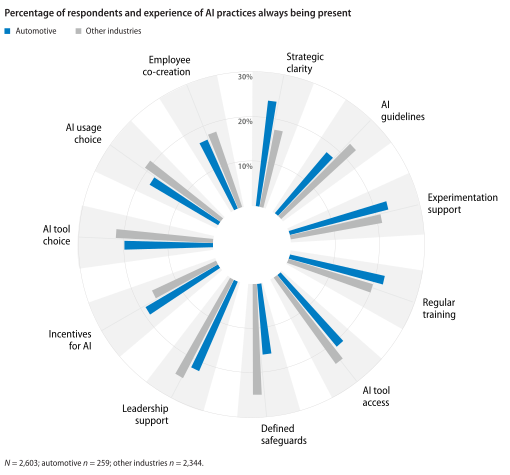
The results suggest that automotive employees have greater clarity about AI’s strategic direction than about the practical rules required to apply it consistently.
Close the transformation gap
The limits of automotive’s AI progress are most visible at the enterprise level (Figure 10). Only 19% of automotive employees say that their company is trying to transform most or all work and processes with AI, nine percentage points below the cross-industry result.
Figure 10. Automotive trails other industries in enterprisewide AI transformation
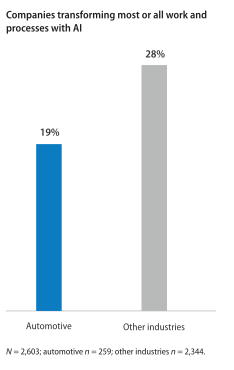
Isolated AI initiatives can prove technical feasibility, but they often use different data, controls, platforms, measures, and ownership models. This limits reuse and makes successful pilots difficult to scale. The Infosys AI Business Value Radar: Automotive Edition reports that only half of automotive AI programs show any measure of success.
Employees use AI often and save meaningful time, but its application remains narrow, saved time is not consistently turned into learning, and guardrails are inconsistent. AI usage provides an important foundation, but enterprise transformation determines whether that foundation translates into sustained business value.
The formula for success
Expand AI beyond tasks
Map the complete workflow before adding tools. Identify bottlenecks, repeated handoffs, judgment points, data dependencies, and control requirements. Redesign the sequence so AI supports decisions and execution across the process. Prioritize workflows with measurable outcomes, such as engineering change management, supplier coordination, quality analysis, demand planning, warranty intelligence, software development, and customer service.
Direct saved time
Define how released capacity will be used before scaling an AI solution. Allocate part of the benefit to learning, problem-solving, process improvement, and innovation. Track time saved and how employees reinvest it. Measures such as engineering change cycle time, first-time quality, and time spent on learning or complex judgment connect individual productivity to operational and workforce outcomes. This prevents productivity from being absorbed by routine workload and helps the workforce build skills for broader AI-enabled roles.
Make guardrails clear
Give employees clear guidance on approved tools and data, permitted and restricted uses, required human review, ownership of outputs, and escalation paths. Match safeguards to risk, so that high-consequence uses involving safety, quality, cybersecurity, privacy, and regulatory requirements receive closer scrutiny. This removes the burden on individual employees to decide how much checking is enough. Toyota’s domain-in-the-loop approach combines operational expertise with AI development and uses confidence and learning gates to maintain human involvement as AI takes on greater decision responsibility.
Scale what works
Group related use cases around business outcomes, with an accountable owner, shared data and technology foundations, a plan for the workforce transition, and risk-based governance. Fund reusable components so that successful patterns travel across engineering, manufacturing, supply chain, software, and customer operations instead of restarting with every pilot. Assess maturity by the proportion of work redesigned around AI, the quality of decisions and outcomes improved, and the number of reusable capabilities scaled, rather than by usage alone. TI Automotive connects enterprise AI efforts with accessible data, decision-focused use cases, and workforce enablement, bringing these elements together as it scales AI across the organization.
AI use among automotive employees is already strong. By broadening how AI is used, turning time saved into new skills, and giving employees clear guardrails, automotive companies can convert frequent use into lasting transformation.
Appendix: Research Approach


AI is now foundational to modern marketing, improving efficiency and performance across functions such as content creation, analytics, and campaign execution. Yet most organizations have not realized its full transformational potential. Future value is expected to come from deeper integration of AI into marketing workflows, operating models, governance, and decision-making to enhance business performance and growth.
- 02 Nov, 2026

CPG employees’ strong appetite for AI offers a solid base to close generational gaps and scale adoption enterprise wide.
- 22 Oct, 2026
- 8 min read

Healthcare payers can use agentic AI to coordinate complex workflows, improve operational efficiency, and maintain human accountability.
- 14 Oct, 2026
