
Insights
- AI has become a proven source of marketing value. More than eight in 10 marketing leaders report measurable value from AI, with the strongest gains in analytics, reporting, campaign optimization, content creation, and operational efficiency.
- AI has improved performance across nearly every marketing outcome surveyed. But most of the gains are clustered heavily in efficiency — speed, cost, and productivity — rather than revenue growth or brand equity.
- AI's benefits in marketing are broad but often shallow, with about half of reported improvements amounting to only slight gains. And personalization posts the highest failure rate of any use case.
- Marketing budgets and expectations for AI are both rising sharply, but leaders anticipate the biggest gains in effectiveness outcomes that AI has so far struggled to deliver.
- Closing the AI maturity gap requires organizations to move beyond point solutions and embed AI into workflows, decision-making, and the core operating model, with CMOs and CIOs aligned around shared goals.
- Agentic AI opens the next frontier, with humans still at the helm. Adoption remains limited, but early users report benefits in cost, customer experience, brand performance, and content production.
Executive summary
AI is approaching an inflection point in marketing. The technology is now essential to virtually every marketing team. Yet AI's promise of self-optimizing autonomous campaigns, hyperpersonalization, and new levels of revenue growth remain largely out of reach.
AI has made marketing better, but it hasn't fundamentally reshaped how the function operates or delivers value. Most marketing leaders tell us that AI's benefits are meaningful without being transformational — concentrated mostly in efficiency gains rather than supercharging marketing effectiveness.
These are real achievements, but they fall well short of AI's perceived potential. And yet marketers don't view AI as overhyped. That reaction points to something worth watching: Either marketers never believed AI's boldest claims, or they're confident the full impact is still coming.
CMOs and their partners in the C-suite face many of the same challenges as two years ago when the first Infosys CMO Radar was published. Then, marketing organizations were using a lot of AI, but not strategically. There were early wins, but organizations needed deeper AI integration to advance.
Our new CMO Radar shows clear signs of progress, if only incremental. AI-influenced marketing outcomes have generally improved from two years ago, according to our survey of 1,503 marketing leaders from 14 industries and across nine countries or regions.
The benefits of AI are widespread but often shallow. About half of marketers report only slight improvements, and even the most successful use cases only achieve their business objectives a quarter of the time. More strategic outcomes, such as revenue growth, improved customer experience, brand equity, and creativity, lag operational gains. Most organizations have secured the easiest opportunities. What remains is harder but potentially more valuable.
A majority of CMOs expect AI to deliver transformational value by the end of 2027, with the largest gains in lead generation and conversion, customer experience, and revenue growth. That represents a significant improvement from where most organizations perform today, and it must be achieved on an accelerated timeline. The gap between current performance and near-term ambition is wide — and closing it will require more than gradual progress.
Most organizations apply AI in fragmented ways, focusing on individual use cases rather than embedding AI in workflows, decision-making, and operating models. Because adoption is fragmented, benefits remain isolated across functions instead of translating into greater impact throughout the enterprise.
Our research points to a clear pattern among high-performing organizations: They embed AI into their operating model, align it with enterprise strategy, and establish formal governance. These enterprises consistently deliver stronger outcomes and higher marketing return on investment (ROI), yet only a small percentage has reached this maturity level.
Constraints have become more urgent as expectations have risen and investment accelerated. Data quality, technology integration, governance, and enterprise alignment continue to constrain scale. Organizations should use this moment to rebuild the foundations and structure of marketing to better position themselves for what follows.
Marketing has entered a new phase. Each step in AI maturity delivers measurable gains, creating a cumulative advantage that compounds over time. AI then becomes marketing's operating system, enabling leaders to unify planning, execution, measurement, and optimization into one connected process rather than separate applications.
The next 18 months will serve as a proving ground. Marketing leaders have moved beyond the debate over whether to invest in AI. The challenge now is execution — translating investment into business impact at scale and proving AI can deliver the value that justified the investment in the first place.

AI in marketing: Not hype
Hopes and fears spike with regularity in the AI era, albeit in very different directions. Depending on the perspective, this technology seems always on the verge of revolutionizing or destabilizing the world: economies, online security, workplaces, education, the environment, and every domain it touches.
So far, AI in marketing has done neither: Instead, it has been a force for optimization. AI has enabled marketers to move faster and operate more efficiently — improving content creation, insight generation, analytics, and other critical tasks. A large majority of marketing leaders (82%) say AI delivers measurable value to their organizations.
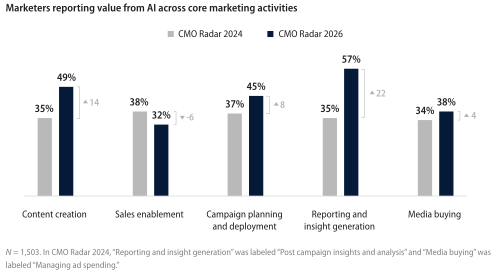
The breadth of that value has increased in multiple areas since we released the CMO Radar 2024 (Figure 1). The largest gains came in reporting and insights generation, a 22-percentage-point increase in the number of marketing leaders achieving value with AI. This sharp increase suggests that marketers are relying on AI to generate reports, uncover insights, and inform future decisions. Content creation also saw substantial growth, increasing from 35% to 49%. AI’s role in producing marketing assets at scale is still growing, even though it represents the most mature use case category. Other areas also improved, but less significantly. On a cautionary note, marketers overall tell us that AI’s value in sales enablement has actually regressed.
Figure 1. AI’s overall value in marketing increased in the past two years
Source: Infosys Knowledge Institute
Overall, the findings show AI moving beyond experimentation and becoming deeply embedded in both the creation and optimization of marketing programs, with the strongest momentum occurring in analytics-driven activities.
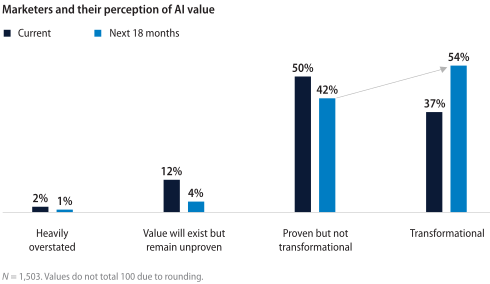
Any lingering concerns about whether AI is integral to marketing are settled (Figure 2). However, significant questions remain about how far marketers have come, and how much value AI has yet to unlock.
Figure 2. Majority expect AI to deliver transformational value in next 18 months
Source: Infosys Knowledge Institute
A significant minority (37%) says AI has already delivered transformational value to marketing. Based on interviews with marketing leaders, “transformational value” means anything from dramatically improving performance in every marketing activity to fundamentally reorganizing how the function is structured and operates.
One senior marketing leader told us AI will be transformational when it significantly changes the mix of tasks his team is doing and when it completely changes the way they engage with stakeholders.
Amy Summy, chief marketing officer and consumer business lead at Labcorp, a US-based laboratory services company, says AI transformation demands a shift in mindset. She once viewed AI primarily as a set of technologies and tools.
“As I've matured in my understanding and talked to other people, I've realized, ‘Wait, this is marketing transformation,’” she said. “Marketing transformation means we're going to have to look at how we are staffing across the board, new roles and responsibilities. What does AI do that we were doing in another way with a person?”
New processes, new roles, and new structures are coming to the marketing organization. The goal is value, measured in all the ways marketers track it. More than half (54%) count on AI to generate transformational value by late 2027. To reach these goals, marketing needs to increase the value delivered by mature use cases such as efficiency. It also needs to unlock value through use cases and outcomes where AI has fallen short.
“Productivity is just the floor. What you then think about is differentiation, creativity, and how you orchestrate different parts of the customer journey in real time and provide that hyperpersonalized experience,” according to a marketing leader who was interviewed for this report.
These are consequential decisions, from developing and executing marketing plans, allocating the large sums required for technology, and setting organizational strategy. The stakes are high: revenue growth, market share, and brand equity, along with other metrics that make or break a company's future success.

AI improves performance
Despite AI's untapped potential, a large majority of marketing leaders tells us that AI has improved performance across the dozen marketing outcomes we surveyed. So far, however, that value has been delivered unevenly, concentrated in efficiency-focused areas.
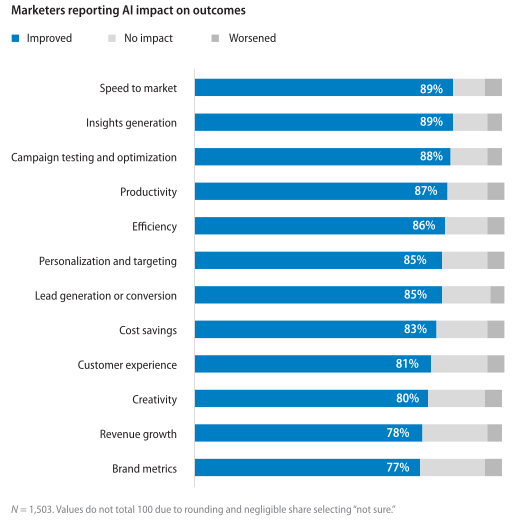
AI's strongest impact clusters around campaign testing and optimization, speed to market, and insight generation, where 90% of those surveyed report improvement.
Efficiency, productivity, and cost savings follow closely. Outcomes like brand metrics, revenue growth, and creativity also improve about three-quarters of the time (Figure 3).
Figure 3. AI benefits are concentrated in efficiency and related areas
Source: Infosys Knowledge Institute
Lynn Bautista, former vice president of portfolio marketing at Xerox, described cost savings and scalability as AI’s entry point into marketing. “It's efficiency and productivity,” she said. “You invest in the tools, and you'll get your returns.”
This tracks with a broader pattern across marketing and other business functions, where operational activities are often the first to benefit from AI.
Typically, AI excels in repetitive, well-defined processes with clear inputs and outputs. Because efficiency metrics are relatively easy to measure, organizations can more readily attribute improvements to AI.
Our survey examined the breadth and depth of AI's impact on four important outcomes: speed, cost, brand equity, and ROI.
Speed: AI's champion
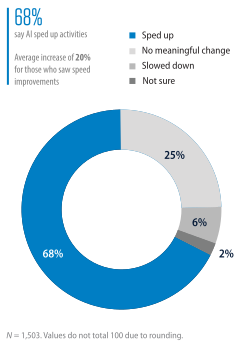
AI has made its most significant impact in how quickly marketers can now accomplish their work. Of the sample, 68% report that AI has accelerated their marketing activities, with an average improvement of 20% among those seeing gains (Figure 4).
Figure 4. Speed is a key benefit
Source: Infosys Knowledge Institute
Generative AI's first big win was allowing anyone to create written content quickly. Labcorp published a blog post every few months before ChatGPT arrived. After generative AI reached its marketing team, the company published between 50 and 60 blog posts in less than a year to gain more traction in generative AI search. “It's changed the engagement,” said Summy, the Labcorp marketing leader. “It’s changed our revenue.”
Gains in speed have expanded far beyond content creation, though. Samsung Germany reduced the time spent analyzing campaign data by between 30% and 40% using Copilot in the Microsoft Advertising Platform. Others point to AI's role in qualifying digital leads in real time, rather than risking them going cold.
“Marketing leaders are not thinking about productivity gains anymore,” one marketing leader explained. “They're thinking about the volume of output. They're thinking about how we go faster to market. How do we become more responsive?”
Although speed is AI's strongest performance enhancer, the gains aren't universal. Many factors can create friction that saps AI's potential: additional review cycles, poor data quality, unclear governance, lack of workforce buy-in, and tool fragmentation.
One-quarter of respondents report no meaningful change in how quickly they accomplish their marketing activities with AI. A small minority (6%) says AI has slowed their marketing activities — by 7% on average.
Cost: Meaningful reduction
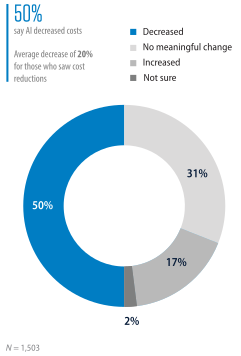
Half of marketing leaders report that AI has reduced overall operating costs, despite the increased expense of new tools and platforms with expanded capabilities (Figure 5).
Figure 5. AI decreases costs for half
Source: Infosys Knowledge Institute
The average cost reduction was 20% for those reporting lower costs.
The costs can’t fully be explained by workforce cuts. Marketing leaders we interviewed said their staffing had not significantly decreased, although some expect that to happen with the maturing of agentic AI. Some point to cuts in the use of agencies.
“I don't have to hire actors. I don't have to hire studios. It’s easy to redo things,” one marketing leader told Infosys. Previously, the marketer spent $2,000 to $3,000 per language for each video. “Now the cost is virtually zero.”
AI has allowed marketing organizations to bring some simpler work in-house, particularly content marketing, while still leaning on agencies for more creative or high-visibility campaigns.
WongDoody, an Infosys company, uses AI-powered photorealistic digital twins to render vehicles in real time, allowing the same digital assets to support both personalized video advertising and interactive online configurators.
Nearly one-third (31%) of marketing leaders we surveyed say that AI had no effect on their costs. In many of these cases, AI is making the marketing team more efficient, but the time savings are being redeployed elsewhere. For many marketing teams, AI has helped them increase output rather than decrease costs.
And 17% say costs have increased, which likely reflects the investment required to build their AI capabilities before realizing returns.
Brand equity: Lagging indicator
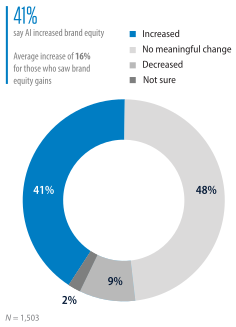
About four in 10 respondents (41%) report that AI has made a meaningful improvement in the brand equity of their companies (Figure 6). They reported an average increase of 16%.
A slightly larger group (48%) says there has been no meaningful change attributable to AI. It’s not certain whether this is a failure or simply a reflection of how brand impact accumulates over time.
Figure 6. AI's brand impact modest
Source: Infosys Knowledge Institute
Another 9% report a brand decline because of AI, while 2% are unsure. Brand risk from AI — whether through content quality issues, off-brand outputs, or audience perception — still worries CMOs and the rest of the C-suite. In addition, marketers are trying to find the right balance in their AI use for customer-facing efforts, which are polarizing in many cases.
Marketing leaders have told us they expect that AI’s impact on brands will be indirect. As AI improves overall marketing performance, the benefits will naturally extend to brand equity and other brand metrics.
In a Pew Research Center survey, 76% of US respondents consider it important to know whether pictures, videos, or text were generated by AI. However, that level of transparency comes with tradeoffs, according to research from the Nuremberg Institute for Market Decisions. Its study of consumers in Germany, the UK, and the US found that when organizations disclosed that content was AI generated, that fact made “people trust it less and engage with it less enthusiastically.”
ROI: Positive but still developing
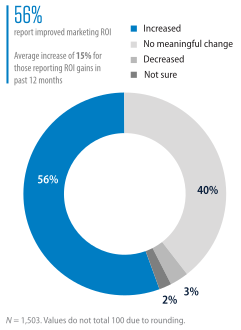
AI is already improving marketing ROI, but the gains are uneven. In our survey, 56% of marketers said AI increased marketing ROI over the past 12 months, with that group reporting an average 15% increase attributable to AI (Figure 7). Another 40% reported no meaningful change, and just 3% reported a decrease — suggesting the downside risk is low, even when results are mixed.
Figure 7. AI boosts ROI for most
Source: Infosys Knowledge Institute
Many of those early benefits come from productivity and workflow gains, rather than revenue growth directly attributable to AI. As one marketing leader put it, most of the ROI so far is showing up “on productivity and workflows and streamlining,” a category that's often difficult to quantify precisely in ROI terms.
Another leader described AI's impact across campaign planning, media strategy, and budget optimization, crediting it with helping the team launch campaigns faster and more efficiently. That matches our regression analysis, which found that significant improvements in speed to market are associated with an improvement of 2 percentage points in ROI.
AI's early ROI has resulted from performing marketing tasks faster and with less friction. Its larger potential will depend on whether organizations can connect AI to customer data, decision-making, and end-to-end workflows. This is the harder, more structural work that mature use cases require. Later in this report, we describe the specific actions companies can take to close their AI maturity gap and improve marketing ROI.
AI value: Modest but real
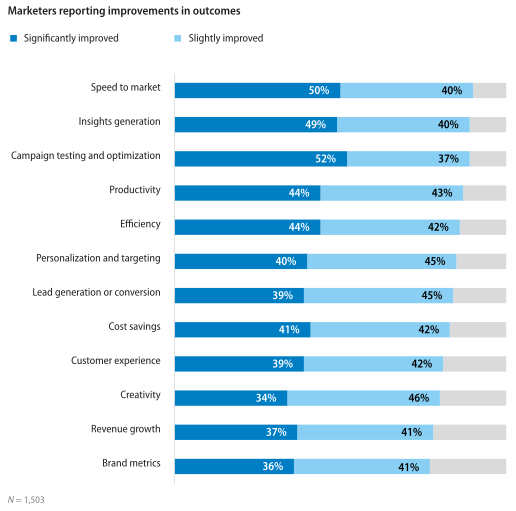
Marketers report AI-driven improvement across all 12 measurement areas, and 87% say that AI’s value is proven. But a closer look tells a different story. These figures describe how widely the value is spread, not how large it is. When we calculate how much of that reported improvement is significant, the number is roughly cut in half: About half of the total reported value comes from only slight gains rather than substantial ones (Figure 8).
Figure 8. AI is not delivering significant value for many outcomes
Source: Infosys Knowledge Institute
This isn't the result of a few weak categories dragging down the average. The three highest-performing outcomes — speed to market, insights generation, and campaign testing and optimization — fared better, with a higher share of their value coming from significant improvements. But the remaining nine areas were an even split at best, and often leaned toward slight improvement instead.
Right now, the data says AI's value is often wide but shallow. Given the scale of AI investment and the expectations riding on it, incremental gains like these are unlikely to satisfy many business leaders.
AI use cases in marketing fared even worse than the outcomes, with value particularly thin.
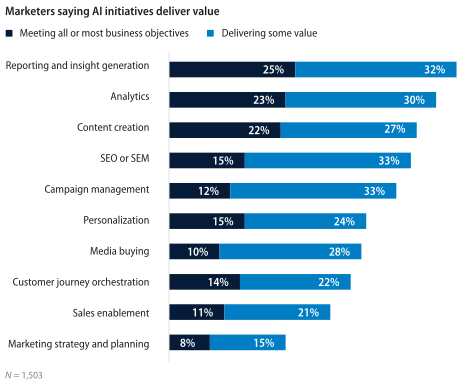
In every instance, a majority of the value was reported as some value, and just 9% met all or most business objectives. Reporting and insight generation met all or most business objectives in just one-quarter of deployments (Figure 9). That makes it the top use case among the 10 we surveyed. Two others, content creation and analytics, were close. But the rest were significantly lower, with marketing strategy and planning at the bottom (8%).
Figure 9. Most AI use cases deliver only some value
Source: Infosys Knowledge Institute
Marketing leaders consistently describe measurable improvements in productivity, speed, workflow automation, content creation, campaign execution, and efficiency. However, many say they struggle to tie those improvements directly to revenue growth, customer conversion gains, or transformational business impact.
Personalization stands out as a major area of opportunity. CMOs have long viewed AI as the path to hyperpersonalization at scale, but so far, expectations continue to outpace results. To contrast, 17% of personalization initiatives were either canceled before deployment, canceled after deployment, or deployed without generating value — the highest failure rate of any marketing activity we studied. Personalization initiatives generated significant value just 15% of the time, a mediocre outcome.
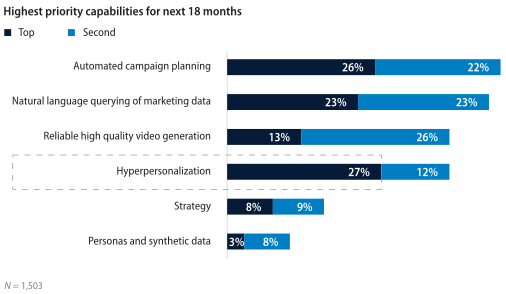
Perhaps because of these shortcomings, hyperpersonalization was identified by marketing leaders as their top-priority area, essentially tied with automated campaign planning (Figure 10). “The promise of AI for marketing is personalization at scale,” a marketing leader told us. “That was the Holy Grail for years. Now with AI, it’s possible to actually deliver on it.”
Figure 10. Hyperpersonalization is a top marketing priority in the next 18 months
Source: Infosys Knowledge Institute
The opportunity is real, but so is the implementation challenge. Unlike reporting or analytics, where AI can create value through optimization and efficiency alone, personalization depends on coordinated capability across data, content, customer journeys, governance, and channels. Success requires unified, real-time data; orchestration across systems; and consistent delivery at every touchpoint. These demands establish a higher bar than a single well-deployed tool can clear.
Personalization isn't alone. Analytics, search engine optimization and search engine marketing (SEO-SEM), and media buying also show higher failure rates than other marketing activities, with roughly 14% of initiatives in each area either canceled or failing to generate value after deployment. Part of this likely reflects where these initiatives are in their adoption: Analytics, SEO-SEM, and media buying are among the most widely deployed AI use cases, and many implementations are still in pilot or early stages. As they mature, more organizations should begin to see measurable returns.
Even accounting for that early-stage effect, analytics and SEO-SEM deliver value more consistently than most other use cases, at 53% and 48% respectively. This suggests companies can generate even greater value as they resolve the remaining implementation issues.
Media buying is the harder case: AI is rapidly improving bidding and budget allocation, but marketers are still working through issues of transparency, governance, brand safety, and integration with legacy advertising platforms. These organizational and technical hurdles limit how much of AI's operational improvement converts into measurable business value.
As AI shifts from optimizing discrete tasks to orchestrating customer-facing decisions, organizational complexity — not access to AI tools — becomes the primary constraint. The tools are increasingly plentiful; the harder work is integrating them across fragmented data, technology, and business processes.
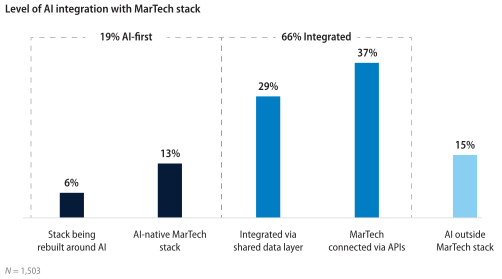
Our research suggests that marketing organizations understand these challenges. Around 15% have truly fragmented systems, with AI tools sitting outside of the MarTech stack (Figure 11). Two-thirds (66%) partially or fully integrate AI with their MarTech stack. In a sign of progress, the two most advanced groups of AI-first organizations (19%) together are larger than the category representing organizations with fragmented AI in marketing (15%).
Figure 11. More companies are AI-first than fragmented
Source: Infosys Knowledge Institute
Marketing on the brink
Marketing organizations have moved past easy wins. The next horizon of value, to fuel business growth, requires a different approach, even as spending rises and expectations accelerate. Marketers tell us that the next 18 months will determine whether that investment translates into the transformational value marketing organizations need to compete.
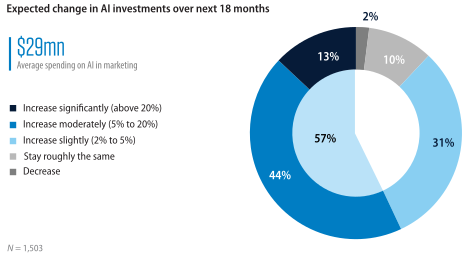
Confidence that AI will increase value delivered is already showing up in marketing budgets. Organizations we surveyed invest an average of $29 million in marketing AI, a figure that varies significantly by company size. Most expect that spending will keep growing (Figure 12). But the return on that investment depends on aligning technology, data, and strategy across the enterprise. Throughout this research, AI was consistently shown to demonstrate value within individual workflows and functions. What distinguishes leaders is how well those efforts connect to the business.
Figure 12. Most marketers plan at least moderate AI spending increase
Source: Infosys Knowledge Institute
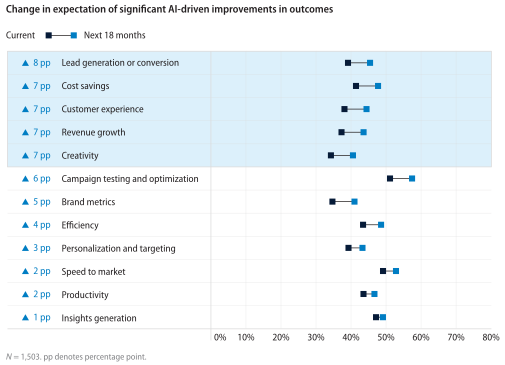
That pressure to perform is rising alongside spending. Marketing leaders expect AI to improve every outcome we measured over the next 18 months, although some of the smaller anticipated gains fall within the margin of error (Figure 13). Leaders expect the highest gains from AI on effectiveness rather than efficiency — but that's also where AI has underperformed so far. Four of the five highest-expectation outcomes were the least likely to deliver significant value; cost savings was the lone exception.
Figure 13. Marketing effectiveness outcomes have highest expectations
Source: Infosys Knowledge Institute
That gap between ambition and delivery narrows at the capability level. Conversational AI, predictive content personalization, and dynamic journey orchestration have become the foundation of AI-enabled marketing — capabilities most organizations have already deployed. Real-time intent modeling demonstrates value for some marketers. It’s associated with a 9% greater likelihood of significant improvement in campaign testing and optimization. In practice, this means using AI to interpret live behavioral signals — browsing activity, engagement patterns, and other real-time signals — to anticipate what a customer is likely to do next. Organizations that can recognize and respond to customer intent as it develops consistently outperform those relying on historical signals alone.
More advanced capabilities such as emotional and sentiment-based targeting, as well as dark data activation, remain earlier in adoption. For organizations that have strong data foundations and governance, these represent the next horizon of AI-driven marketing performance.
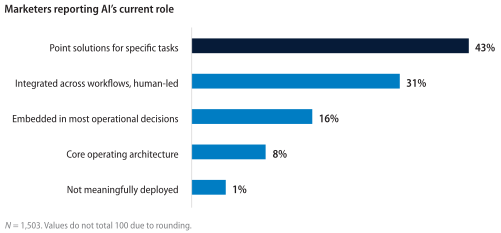
A small group of organizations already achieves transformational impact, offering a preview of what’s possible for others. More than half (55%) describe AI as an important technology that is embedded across workflows and most operational decisions. Another 8% have gone further, making AI the foundational operating architecture for marketing (Figure 14). Still a small minority, but this group represents AI maturity's leading edge — organizations that have moved past adopting AI to redesigning how marketing operates altogether.
Figure 14. The largest group still uses AI for point solutions
Source: Infosys Knowledge Institute
Unlock AI's next value
The initial wave of AI enthusiasm has largely given way to a harder reality: Most organizations remain in the middle stages of AI maturity. And they might be stuck there without a new strategy.
In interviews with Infosys, marketing leaders consistently said they've realized only a fraction of AI's potential. Many know greater value is possible, but they're less certain which initiatives to prioritize or how to redesign their organizations around AI. This uncertainty is compounded by the continual requirement to achieve their business objectives.
This section identifies the capabilities that enable marketing organizations to create additional value from AI today while building toward transformational results. Tactical initiatives can improve performance in the near term, while strategic investments in operating models, data, and governance equip organizations to compete with AI-first companies in the future.
Make AI marketing’s OS
Most marketing teams treat AI as a collection of individual tools. This approach worked well when generative AI arrived and increased efficiency in content creation, analytics, and other discrete tasks. Although that narrow focus delivered measurable value, its impact has reached the point of diminishing returns.
Our research shows that the greatest returns are produced when organizations progress beyond task-level automation and embed AI into the core of marketing operations: how decisions are made, work is orchestrated, and customer experiences are delivered.
Embedding AI as the core operating architecture is the strategy most closely correlated with the best marketing ROI. Yet today, only 8% of marketing organizations have done this, while 43% still rely on AI for isolated, task-level applications. The gap between highest and lowest AI maturity levels is substantial, but organizations don't need to fully transform to see benefits. Each step toward deep AI integration increases the likelihood of greater ROI as organizations build new capabilities, deliver value, and lay the foundation for continued gains over time.
Analysis of our survey data found that those using AI as their core operating architecture achieve an ROI improvement of 5 percentage points compared to those using point solutions. Marketers that embed AI into most operational decisions realize a 4-point gain. For respondents who identify as “human-led with AI integrated across workflows,” they average a 2-point improvement in ROI compared to the baseline.
Leaders we interviewed expect this pattern of deeper integration and improved business results to continue. They identify better segmentation, predictive analytics, and real-time decision-making on pricing, channels, and messaging as the next frontiers.

Integrate AI across workflows
Marketing generates the greatest value from AI when it connects tasks across stages rather than automating them in isolation. Leading organizations link AI throughout planning, audience intelligence, content development, and activation, so that insights generated at one stage inform the next.
Content workflows provide clear examples of this integration. AI-powered content systems help teams create, localize, personalize, translate, and adapt marketing assets at scale. This results in a connected process where content moves efficiently across channels, audiences, and markets with fewer manual handoffs.
This connectivity creates advantages that standalone tools cannot. Teams can then adjust targeting, spending, and content in near real time. AI becomes the connective layer that lets organizations respond faster to what's happening in the market.
Embed AI in decision-making
Workflow connectivity is necessary, but it only provides the foundation for the next wave of marketing advantage, which is the quality of decision-making. AI helps marketers identify patterns, discover insights, and evaluate options that would have been difficult to uncover through traditional analysis.
Leaders we interviewed described AI's value by how it reveals opportunities and detects bottlenecks — capabilities that matter more as business decisions increase in complexity. One marketing leader described using AI to connect customer needs, market signals, financial data, and operational metrics into a single view that supports smarter decision-making. Another said AI has improved scenario modeling, margin optimization, and revenue impact analysis by rapidly assessing large datasets and identifying the factors most likely to influence outcomes.
Marketing teams also use AI for predictive intelligence, bias mitigation in decision-making, and audience prioritization. Increasingly, AI functions as a strategic advisor, helping organizations decide where to invest, how to serve customers, and how to create value.
Make AI marketing's core
Integrating AI across workflows creates efficiency and agility. Embedding AI in decision-making improves insight quality and business outcomes. The next step is to combine these capabilities, so they reinforce one another. Learning from campaigns informs future planning. Customer engagement data refines content creation. And measurement becomes an input to ongoing optimization.
Marketing leaders we interviewed describe this as progress toward connected systems of work. Organizations use AI to create continuous feedback loops throughout audience intelligence, content development, activation, customer engagement, and performance measurement. Each workflow becomes more valuable because it draws on data, insights, and outcomes generated elsewhere, so AI's value compounds over time.
Organizations don't reach this stage by deploying AI everywhere at once. They build progressively, starting with workflow integration, extending AI into high-value decision-making, and connecting those capabilities across every marketing function. The result is a marketing organization that learns faster, adapts more quickly, and captures greater value from every interaction, campaign, and customer signal.
Unite the CMO and CIO on AI
Marketing cannot transform in isolation. AI delivers greater value when it supports enterprise objectives and is coordinated across functions, from IT and data management to finance and sales. Organizations often approach AI through disconnected priorities: Marketing invests in customer engagement, content, and personalization, while technology focuses on platforms, data, security, and governance.
Leaders from both sides repeatedly emphasized that AI creates the most value when the CMO and CIO align around shared outcomes. Marketing contributes customer understanding and growth priorities; technology provides the data and infrastructure to scale AI effectively.
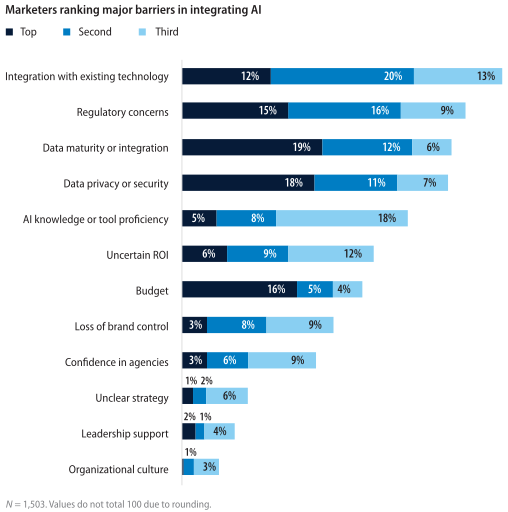
This alignment matters more as AI moves into connected workflows. Interviewees described how AI depends on collaboration among marketing, data, and technology teams. Leaders identified fragmented data, disconnected systems, and organizational silos as the most significant factors keeping AI from delivering value. Our data backs this up: technology integration and data maturity rank among the top three barriers to AI integration (Figure 15).
Figure 15. Data and technology integration are major AI barriers in marketing
Source: Infosys Knowledge Institute
Our findings also show that organizations that create formal enterprise alignment consistently outperform peers that don't. Strategically aligned organizations are more likely to significantly accelerate speed to market, improve customer experience, and enhance productivity, according to our survey data. Strategic alignment also correlates with faster content production and higher content quality.
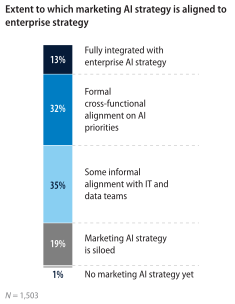
Most organizations aren't there yet. Only 13% report that their marketing AI strategy is fully integrated with enterprise strategy (Figure 16). Meanwhile, 32% have built formal cross-functional alignment, creating shared ownership across marketing, IT, finance, and other functions. The largest group (35%) relies on informal relationships — often with IT and data teams — which speed up implementation but rarely provide the governance or organizational commitment needed to scale AI enterprisewide. Nearly one in five organizations (19%) still has a marketing AI strategy that is largely disconnected from broader business priorities. The path from AI adoption to AI transformation runs through the core of the enterprise. Many marketing organizations are still operating in the margins.
Figure 16. Strategies not aligned
Source: Infosys Knowledge Institute
Shared responsibility for AI strategy enables CMOs and CIOs to modernize data environments, integrate marketing and enterprise systems, and build what AI needs to operate across workflows. This kind of alignment also changes how success gets measured, with less focus on adoption metrics or productivity gains. Leading organizations are more likely to evaluate AI by its contribution to growth, customer experience, and marketing ROI. Common priorities, shared governance, and collective accountability turn AI into a business growth initiative.
This level of alignment requires more than periodic coordination meetings. Leading organizations establish cross-functional teams that bring together marketing, technology, data, compliance, and business leaders around common goals. Together, these teams build AI into a scalable enterprise capability.
Scale with agentic AI
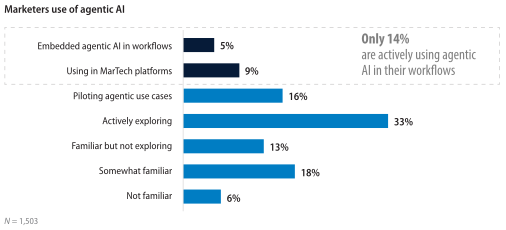
Marketers are intrigued by the promise of agentic AI. These systems are built on transformer models that can plan, take action, and pursue multistep objectives with limited human supervision. However, its use is still limited. Just 14% of marketing leaders we surveyed say they're using agentic AI (Figure 17).
Figure 17. Few companies use agentic AI
Source: Infosys Knowledge Institute
About two-thirds of that group are using the agentic AI capabilities built into their MarTech platforms, an easily accessible entry point to the technology. Agentic AI is now part of Salesforce, HubSpot Breeze, Google Ads, Amazon Ads, Jasper, Adobe, and many other platforms commonly used by marketing teams. A smaller group (5%) say they've moved past those initial stages and embedded agentic AI throughout their workflows.
Early adopters — no matter how they use agentic AI — already report meaningful benefits. These newly minted autonomous AI marketers are reducing costs, improving customer experience, strengthening brand performance, and increasing content value and production speed.
AI agents can continuously monitor performance, uncover opportunities, and automate routine decisions. Organizations can then respond to shifting customer behavior and market conditions in something close to real time.
The marketing leaders we interviewed told us the most promising capabilities are analyzing audience segments, flagging underperforming campaigns, rebalancing budgets, coordinating planning and production, orchestrating customer journeys, and continuously refining targeting and media allocation. In our survey, marketing leaders flagged automated campaign planning and hyperpersonalization as two of their top priorities in the next 18 months; both will benefit greatly from agentic AI’s autonomous workflows and continuous optimization.
“I don't think my expectations have been met from agentic perspective yet, but we're still in the very early days,” Kyall Mai, chief innovation officer at Esquire Bank, told us in 2025. He said they were “just playing with it right now. But I have a feeling things are going to change in the next couple of years very significantly in that space.”
Even with a high level of optimism about agentic AI, organizations aren't handing over the keys right away — or easily. They're expanding AI's autonomy selectively by automating analysis, coordination, and routine execution while keeping humans in the loop for strategy, brand stewardship, governance, and anything requiring significant judgment.
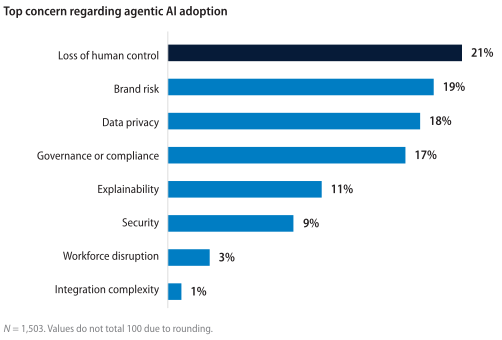
Loss of human control was cited most often as the most significant concern that marketing leaders have about agentic AI adoption (Figure 18). The levels of concern about brand risk were almost identical.
Figure 18. Loss of human control is the top agentic AI concern
Source: Infosys Knowledge Institute
The goal is to create an operating model where AI handles repetitive coordination so marketers can focus on creativity, direction, and accountability. There is value now in building agent-enabled workflows before the technology fully matures. Data integration, workflow redesign, governance, and change management kept surfacing in our interviews as the factors that separated successful deployments from ones that stalled.
Use governance to amplify AI
Governance is one of the five foundational capabilities required for enterprise AI, along with strategy, talent, data, and technology, according to the Infosys Enterprise AI Readiness report. The report’s central argument is that organizations cannot scale AI successfully without governance because governance creates the trust, accountability, and coordination needed to move AI from isolated pilots to enterprise adoption. It found that only about 10% of organizations have well-defined AI governance processes, making it one of the largest readiness gaps.
This gap is serious enough for traditional risk reasons. But our findings suggest well-planned governance can also be a performance advantage, expanding what AI can safely do across the marketing stack. Organizations with stronger AI governance are more likely to improve marketing speed, personalization, customer targeting, and campaign optimization, according to our survey findings. Governance creates the trust required to deploy AI more broadly — into customer data platforms (CDPs), campaign platforms, and customer-facing decisions — and to apply it to budget allocation, targeting, and other high-stakes decisions.
That trust starts with data. Multiple leaders linked AI's effectiveness directly to data quality, data security, and controlled access to information across their MarTech systems. And they traced concerns about hallucinations and inconsistent performance back to underlying data issues more often than to the AI models themselves. Without trusted, accessible data flowing cleanly among customer relationship management platforms, CDPs, and campaign systems, organizations will struggle to scale AI or agentic capabilities effectively.
When data, models, and processes are trusted, marketing teams are more willing to rely on AI for increasingly important decisions, from audience segmentation to real-time bid adjustments. Without trust, adoption slows, use cases stay siloed within isolated point solutions, and AI struggles to advance beyond tactical applications. Our analysis found that marketers with formal governance for data privacy are 8% more likely to significantly improve their speed to market, evidence that governance can accelerate AI performance.
Marketing leaders increasingly frame governance as how they maintain the right balance between automation and human judgment, with the goal of AI that marketers and customers can both trust. Companies moving fastest with AI institutionalize governance as they scale adoption, avoiding unnecessary brand, legal, or operational risk along the way. Governance becomes more important in direct proportion to how much autonomy AI is given, a consideration that matters increasingly as MarTech vendors build agentic features directly into their platforms.
This reflects a broader shift in how governance should be led. AI governance works best as an enterprise capability, not something managed independently by individual functions, brand teams, or project groups. Organizations need a centralized governance office or cross-functional committee to set policy, oversee risk, coordinate decision-making, and adapt governance as MarTech platforms, AI models, and regulations evolve. Bringing together leaders from marketing, IT, legal, risk, compliance, and data helps keep AI initiatives aligned with enterprise priorities.
Governance's design matters even more as organizations expand into agentic AI and autonomous decision-making within their MarTech stack. Rather than layering governance onto AI after deployment, the highest-performing organizations build it directly into workflows. Such an approach creates secure environments, maintains human oversight, involves legal and compliance teams early, and establishes clear controls around agentic AI, while still encouraging experimentation and innovation.

Pair AI speed and judgment
AI is dramatically increasing the speed at which marketers can gather information, generate ideas, and evaluate options. During our interviews, business leaders repeatedly described AI as something that expands human capacity. The technology can identify patterns, accelerate analysis, and offer a broader range of possibilities than a marketer could evaluate alone. But executives consistently emphasized that speed alone has little value unless organizations apply judgment, context, and accountability to the decisions that follow.
The most effective organizations use AI as an intelligent collaborator. They use AI to generate hypotheses, identify opportunities, and produce initial recommendations. Marketing leaders have told us that AI's value often comes from providing early input and exposing marketers to a broader set of ideas and perspectives. Several other leaders described AI as a catalyst for creativity and exploration, helping teams move from a blank page to a set of viable options far more quickly than traditional approaches allow.
This human-in-the-loop model is a well-established approach to AI. However, the term “human at the helm” is gathering momentum as a more precise way to look at this relationship. AI’s role is to accelerate the work, while the marketer's role is to validate, refine, and determine the appropriate course of action. Setting clear expectations about AI's role this way helps organizations avoid treating the technology as a substitute for expertise.
Human judgment becomes even more important as AI systems grow more sophisticated. Agentic AI can identify patterns across enormous datasets, simulate outcomes, and take actions at a speed impossible for humans alone. Yet executives remain cautious about delegating authority. Several described successful uses of agentic AI to develop customer-specific recommendations, sales strategies, and value propositions. But these recommendations are still reviewed and validated by people before anyone acts on them. The goal is to help marketers make better-informed decisions, faster.
The interviews also highlighted areas where human oversight remains indispensable. Marketers are responsible for protecting brand differentiation, evaluating risk, ensuring compliance, and preserving authenticity in a marketplace increasingly flooded with AI-generated content. AI can identify possibilities, but it cannot fully grasp organizational priorities, customer expectations, or the nuances of brand reputation — at least not as consistently as humans. As one executive observed, marketers must stay disciplined about listening, connecting patterns across the business, and building platforms, stories, and narratives that feel genuinely authentic. Those responsibilities remain firmly in human hands.
As AI becomes embedded across marketing workflows, its greatest contribution may ultimately be decision support rather than automation. The organizations generating the most value are designing systems that combine the strengths of humans and AI: AI provides speed, scale, and analytical power, while humans provide judgment, creativity, context, and accountability.
The next phase of AI value
AI is routine now in marketing departments, so much so that the breadth of deployment means far less than it did just a year or two ago. The organizations creating the greatest value from AI are the ones embedding it deepest into how marketing actually operates.
Taken together, the findings in this report tell the story of an industry that has already proven AI's value — and now faces a harder challenge: scaling it. What stands in the way are gaps in organizational readiness: data maturity, governance, enterprise alignment, operating models, and the talent needed to sustain AI at scale.
That's an encouraging finding. These barriers are structural — and structural problems can be solved through deliberate investment and organizational change. The next 18 months will be defined by whether organizations build the foundations that let capabilities scale.
The organizations that strengthen their operating models, modernize their data foundations, embed governance into everyday workflows, and align AI with enterprise priorities will be best positioned to capture the next wave of marketing value. Their advantage will spring from redesigning marketing, with AI embedded in how every decision is made, every campaign executed, and every lead generated.
Appendix: Research approach
Survey and interview demographics
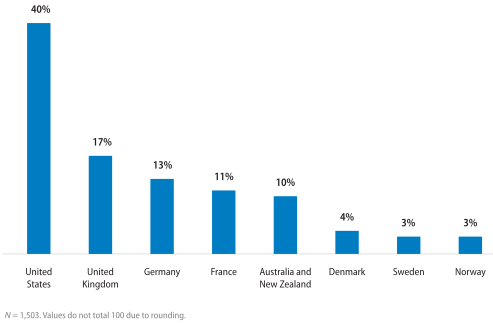
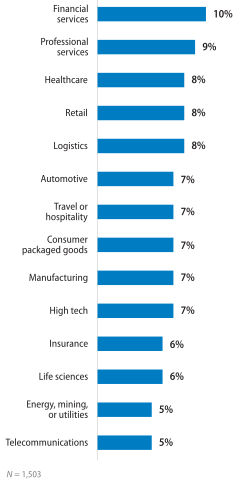
We conducted a quantitative survey of 1,503 respondents between March and April 2026 about AI’s effects on marketing now and expected effects in the next 18 months. Respondents were from businesses with more than $1 billion in annual revenue across nine countries or regions and 14 industries. All respondents in the survey were responsible for marketing at the divisional, regional, group, or higher level in their company.
We also conducted 10 in-depth, qualitative interviews with senior marketing leaders about the survey findings to help us interpret the data by providing context and real-world experiences and identifying the most important variables for success with AI in marketing. The report also included insights from more than 40 interviews with marketers who are members of the Association of National Advertisers conducted in 2025.
Figure 19. Percentage of respondents by country
Source: Infosys
Figure 20. Percentage of respondents by industry
Source: Infosys
Survey content
Respondents were asked about:
- Current role of AI in marketing
- Current and future perception of AI value
- AI’s current and expected impact on marketing outcomes
- AI’s impact on speed, costs, brand equity, ROI, content production time, and content value
- Number of AI initiatives in different implementation stages
- Highest implementation stage achieved by an AI initiative for various marketing activities
- Level of AI autonomy achieved for various marketing activities
- Strategic alignment of marketing AI strategy with broader business strategy
- Barriers to integrating AI in marketing
- Risks of using AI in marketing
- Extent of formal AI governance in bias monitoring, brand safety, data privacy, and regulatory compliance
- Agentic AI maturity, deployed capabilities, and concerns
- AI-related roles in marketing
- Procurement of AI capabilities
- Level of AI integration with MarTech stack
- AI engagement capabilities deployed
- Highest priority AI capabilities for next 18 months
- Estimated current AI investments and expected change in next 18 months
Impact on outcomes
We created 12 logistic regression models that estimated the likelihood of achieving significant improvements in 12 marketing outcomes: speed to market, cost savings, customer experience, personalization and targeting, creativity, efficiency, brand metrics, productivity, revenue growth, lead generation or conversion, insights generation, and campaign testing and optimization. The dependent variable was whether a respondent reported AI was responsible for significant improvement in the selected marketing outcome (coded as 1) versus all other levels of improvement (coded as 0).
In each model we controlled for:
- Country
- Industry
- Revenue
- Business model and tested for:
- Strategic alignment of marketing AI strategy with broader business strategy
- Current role of AI in marketing
- Agentic AI maturity
- Agentic AI deployed capabilities
- AI-related roles in marketing
- Procurement of AI capabilities
- Level of AI integration with MarTech stack
- AI engagement capabilities deployed
- Extent of formal AI governance
- Estimated current AI investments

Impact on marketing ROI
This analysis also used a logistic regression model but unlike the previous models which used a binary logistic regression, this model analyzed the actual percentage increase or decrease in ROI reported by respondents, enabling us to quantify the relationship between AI practices and their impact on ROI.
In this model we controlled for:
- Country
- Industry
- Revenue
- Business model and tested for:
- Strategic alignment of marketing AI strategy with broader business strategy
- Current role of AI in marketing
- Impact on marketing outcomes
- Depth of AI automation
- Agentic AI maturity
- Agentic AI deployed capabilities
- AI-related roles in marketing
- Procurement of AI capabilities
- Level of AI integration with MarTech stack
- AI engagement capabilities deployed
- Extent of formal AI governance
- Estimated current AI investments


CPG employees’ strong appetite for AI offers a solid base to close generational gaps and scale adoption enterprise wide.
- 22 Oct, 2026
- 8 min read

Healthcare payers can use agentic AI to coordinate complex workflows, improve operational efficiency, and maintain human accountability.
- 14 Oct, 2026

The technology for business resilience already exists. The advantage lies in how effectively logistics companies embed it into daily operations.
- 17 Sep, 2026
