
Insights
- CTOs can manage AI costs and unlock growth by shifting from copilots to governed agentic operating models built for scale.
- A secure AI control plane is essential to scale growth safely while preventing agent sprawl, security breaches, and runaway operational costs.
- AI delivers growth only when workflows are redesigned end‑to‑end; unchanged processes simply increase complexity and operating expense.
- Inference economics now determines AI return on investment. Growth comes from optimizing cost per task, workflow, and autonomous loop, not model size.
Executive summary
Three years after generative AI went mainstream, the center of gravity of enterprise AI success has shifted. We already knew that the technology could assist in key business processes and organizational decision-making. But even in 2026, we still don’t know whether reasoning systems and multimodal interfaces can make a significant impact on the enterprise.
The jury is still out on whether innovations in model size introduced in 2025 will be a catalyst for ongoing improvements in inference and computing. The move toward smaller and more deployable models like DeepSeek R1 proves the hypothesis that massive innovation is often fueled by both scarcity of resources and a commitment to be better than the competition.
What is certain is that this coming year will reward firms that can build a production-scale AI architecture where humans are firmly in the loop. Most importantly, the organization’s operating model will have to shift, becoming flatter and more networked, with software developers and product owners moving up the stack to manage architecture and product strategy.
Building on last year’s report, the top 10 AI imperatives for 2026 offer updated insights and the strategic know-how for moves that will redefine organizational success.
1. Move from copilots to agentic operating models
The biggest transition of 2026 is the move from isolated AI assistants to goal‑driven agentic systems that can plan, execute, use tools, and collaborate across workflows. McKinsey’s 2025 global survey found that 62% of organizations are at least experimenting with AI agents. Only a minority have scaled them, so the field is still open for CTOs who can industrialize this technology.
Ethan Mollick, an AI professor at the Wharton School, says the business advantage is shifting from access to a model to knowing how to organize humans, interfaces, and AI systems around business outcomes. Enterprises should think less about adding an assistant and more about building human plus agent teams around customer journeys, engineering platforms, operations, and service lines.
Enterprises need more than a model like DeepSeek R1 or Claude. They need orchestration, systems integration, policy enforcement, observability, and change management. The winning posture is modular AI agents, governed by outcomes, so enterprises can move from pilots to a repeatable operating model.
Dr. Ashok Hegde, delivery head and vice president at Infosys financial services, says the move to modular commercial-off-the-shelf products enables organizations to adapt and forge the right strategic moves, as systems can be replaced on the fly, building resilience in markets defined by constant change.
2. Secure the AI control plane before it scales
As agents connect to enterprise tools, companies must look beyond the models; the new strategic asset is the control plane layer that links models, data, application programming interfaces (APIs), and actions.
The model context protocol (MCP) has emerged as one standard for organizations embedding governance into agentic actions, tools, security, and policies. MCP is a popular control plane that gives enterprise systems a way to access external context, databases, and tools. OpenAI has added support for remote MCP servers in its Responses API, and Google has added MCP support in Google Gemini.
Agentic AI can use MCP to query real-time and historical data from proprietary software management systems, leading to autonomous, efficient, and fail-safe upstream operations.
What makes MCP so powerful also creates significant cybersecurity challenges. MCP guidance warns of confused deputy problems, where an AI agent is tricked into misusing its authority on behalf of someone who should have that access. Other MCP vulnerabilities include consent flaws and authorization weaknesses, while researchers and practitioners continue to find new hazards.
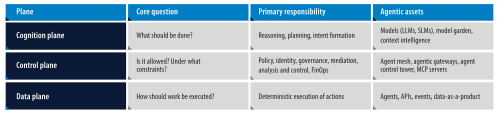
Instead of using MCP, a secure control plane for the enterprise can be found by embedding control into the enterprise architecture stack itself. Our work with clients splits the agentic architecture into three layers: a cognition plane, a control plane, and a data plane.
As explained in Figure 1, the control plane provides guardrails and controls what agents do within the perimeter of the enterprise. The cognition plane provides context-aware intelligence, which, as we write in Tech Navigator, is a key pillar of the perceptive enterprise, an enterprise that evolves and learns at market speed. Conversely, the data plane handles runtime agent execution, including reasoning, retrieval, tool calls, and guardrail enforcement.
Figure 1. Control plane adds governance to agentic systems
Source: Infosys
These innovations make a great case for centering governance and control when building agentic AI solutions. Responsible by design must extend beyond model safety into enterprisewide governance, ensuring all actions reduce risk while improving efficiency.
3. Standardize out of the box agents
Improving AI model speed is difficult when you also want good governance. Finding the right balance requires deep systems integration knowledge, which is why prebuilt agentic solutions are becoming more valuable, not less.
Solutions like Infosys Topaz Fabric provide out-of-the-box answers to key business problems, reducing development times while improving governance.
Other prebuilt agentic models stand out. OpenAI’s ChatGPT agent combines browsing, research, code execution, and file generation in a unified workflow. Claude Code and other hybrid reasoning models are aimed directly at production work. GitHub Copilot agent mode now plans, edits, tests, and iterates in real time.
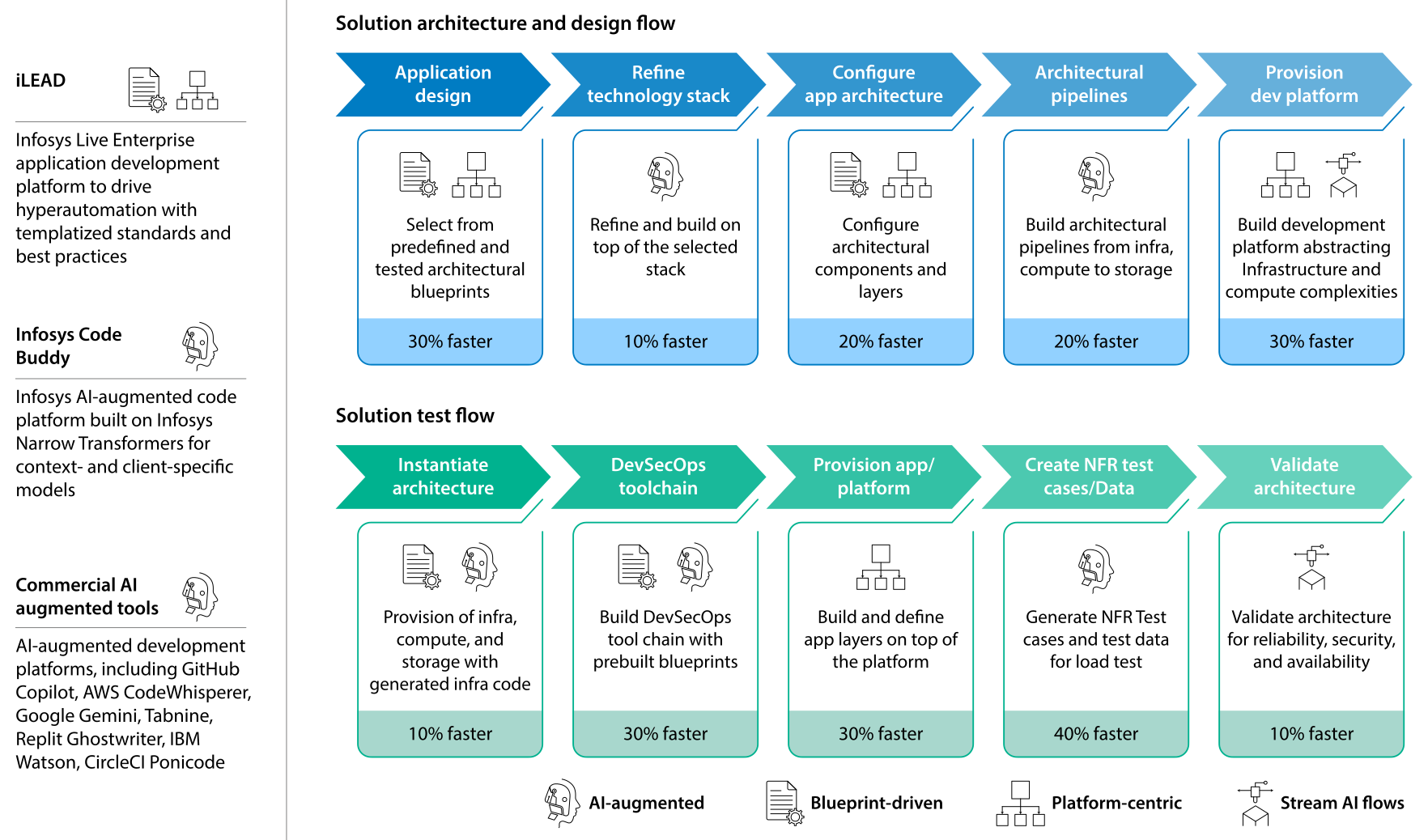
These capabilities also signal these agentic solutions are maturing from one‑shot answer engines into end-to-end workflow orchestrators (Figure 2).
Figure 2. AI delivers benefits across the software development life cycle
Source: Infosys
Andrew Ng, founder and head of DeepLearning.AI and cofounder of Google Brain, expands this argument, saying that out of the box agents are the future of enterprise success, as long as they are configurable, domain aware, and enterprise-policy-constrained.
System integrators can win by offering clients accelerated deployment of these solutions, helping them increase business benefit without surrendering their own business model, as exemplified by Infosys Topaz Fabric.
4. Choose use cases that justify workflow redesign
Many AI initiatives fail because organizations change the technology without redesigning for outcomes. Despite widespread adoption, enterprise AI isn’t yet delivering on its full potential, with just 50% of AI initiatives creating value as of 2025, according to our AI Business Value Radar report.
CTOs can differentiate themselves by redesigning workflows rather than building more sophisticated models. The winning use cases are ones where reasoning, orchestration, and data access materially change cycle times, quality, resilience, or experience. These are often industry-specific use cases, such as autonomous driving and usage-based insurance in the automotive industry or loyalty programs and visual merchandising for consumer packaged goods companies.
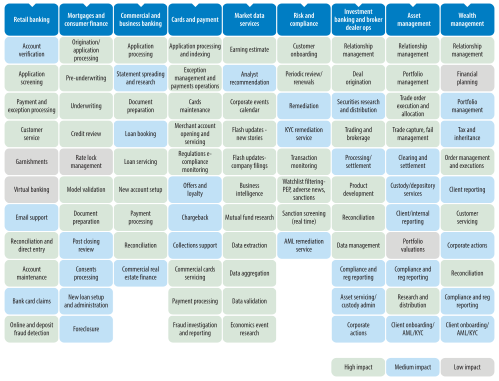
A good selection criterion is to think about the full value chain and only select use cases that will have high impact across the complete business processes. For example, financial services institutions should select use cases such as application screening, payment processing, and relationship management, as laid out in the report Tech Navigator: Applying agentic AI to industries.
Figure 3. Infosys AI blueprint for financial services
Source: Infosys Knowledge Institute
Leaders should ask two questions before approving an agentic investment. First, does this use case span fragmented systems or knowledge pools? Second, can the use case be governed as part of a redesigned workflow. If the answer is yes to both, agents can transform outcomes. If not, a lighter copilot or automation layer might be sufficient.
5. Treat responsible AI as a growth driver
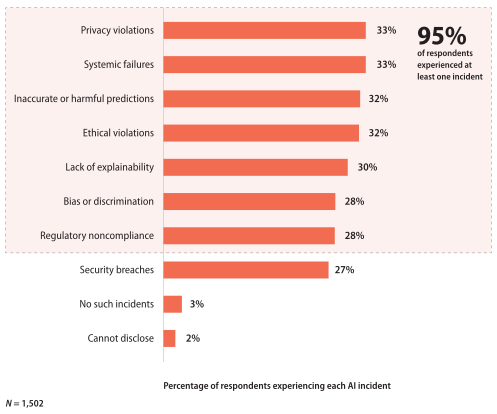
Responsible AI (RAI) is moving from a defensive tactic to a strategic imperative. The Infosys Knowledge Institute’s global research on responsible enterprise AI found that 95% of business executives reported AI-related incidents in 2025, while 86% expect agentic AI to heighten risk further (Figure 4). Companies increasingly take steps to mitigate risk, and almost four-fifths see RAI as a growth driver.
Figure 4. Business AI incidents are varied
Source: Infosys Knowledge Institute
The Infosys study, which surveyed 1,500 respondents last year about RAI readiness, implementation and investment, found that the most mature RAI organizations experienced the least financial loss and much lower incident severity. Only a small minority (2%) met the highest standards of RAI maturity. For CXOs, this means governance must be embedded in platforms, products, and delivery models.
Bias testing, explainability, red‑teaming — where teams probe their own systems to discover unknown vulnerabilities — along with incident response, model lineage, and transparency, must be designed into the enterprise stack.
As autonomous systems penetrate customer experience, engineering, operations, and decision flows, RAI becomes a route to scale.
6. Build observability for LLMs and agents
As agentic systems increase in power, observability is essential to ensure agents act as expected while inside the organizational perimeter. Traditional AI monitoring, comprising accuracy, latency, and token use, is not enough when systems can plan, call tools, act in the world, and adapt over multiple steps. Risk amplifies sharply when agents collude or take actions that are dangerous, economically hazardous, or have security ramifications.
OpenAI, for instance, has updated its large language model (LLM) GPT-5 with new platform features, such as reasoning summaries, background mode, and encrypted reasoning items. These are designed to improve reliability, debugging, and auditability for production-grade agents. Google is likewise highlighting thought summaries and stronger safeguards in Gemini enterprise tools. Thought summaries are compact, structured summaries of an agent’s internal reasoning steps, used instead of storing or exposing the LLM’s full chain of thought.
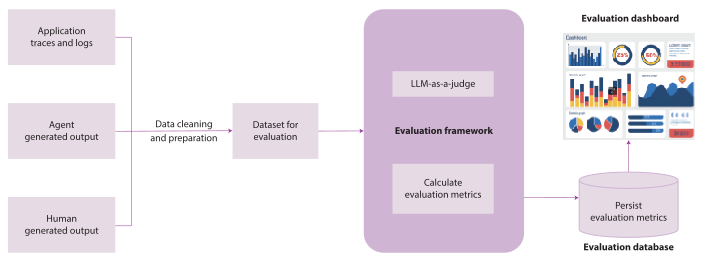
Observability also means using LLMs to observe other LLMs. This can identify malicious prompts, flagging any input that matches known patterns or disallowed content — ensuring no hate speech or confidential information makes it both inside and outside enterprise perimeters (Figure 5).
Figure 5. LLM-as-a-judge in the agentic evaluation layer
Source: Infosys Responsible AI Office
These are not everyday improvements but a recognition that production-grade agentic AI needs a way to add structured visibility so that organizations can look into what an agent is doing at every step, giving teams the ability to observe, measure, debug, and improve.
To get ahead, enterprises need layered observability across infrastructure, prompts, tools, policies, and human overrides. They need to know not just whether a model answered correctly but whether an agent chose the right tool, escalated at the right time, respected the right permissions, and stayed inside the token limit for the task, as set by the product architect.
7. Reskill software engineers as product architects
Software development has become the clearest laboratory for agentic AI. GitHub Copilot agent mode can now analyze codebases, plan changes, run commands, execute tests, and iterate toward completion. Claude and Claude Sonnet 4.6 can do even more, with an emphasis on coding, long‑running tasks, and codebase‑level reasoning. This has fed the rise of vibe coding, using natural language to express intent and letting AI handle the rest of the implementation.
However, the use of agentic AI to augment the software development lifecycle does not necessarily mean companies should replace their engineers. Instead, it is a way to move the engineers up the enterprise stack, toward managing architecture, context framing, platform thinking, and product judgment.
Ng calls this new pattern “agentic coding”, which works best when a company supplies engineers with context, tools, and iterative evaluation products.
Mollick also points out that new interfaces are starting to show signs of emergent capabilities that many users still underappreciate. Examples include self-invented task plans, novel control strategies in robotics, and cross-enterprise-domain problem-solving.
So saying, enterprises should redesign software delivery so that AI handles a larger share of low level implementation, while humans focus on architecture, compliance, integration, testing strategy, and domain nuance.
8. Think about inference costs, not just training costs
The AI market has spent the last three years focused on creating ever‑larger training clusters and GPU build‑outs. This is expected, given that Nvidia plans to spend approximately $1 trillion on hardware in 2026.
However, the next phase of enterprise AI implementation is about inference economics: cost per task, cost per workflow, and cost per autonomous loop.
Inference costs are exploding as agents run for longer, use more tools, process larger contexts, and operate multimodally. Gemini 2.5 uses long context and video understanding as its primary selling point, while Claude has detailed its 1 million token context window, a huge amount of information for an enterprise AI model to process.
DeepSeek R1 is a good example of how inference cost pressure drives creative and competitive solutions. Introduced in January 2025, R1 changed the conversation around AI development and deployment, achieving high performance at much lower cost than Google’s or OpenAI’s alternatives.
The launch also showed how reinforcement learning works, and how open weights, distillation, and efficient architectures compress the cost curve while preserving strong reasoning performance.
Analysts and researchers have also pointed to its use of innovative engineering techniques, including “mixture of experts”, topics discussed in our report, Tech Navigator: Building the AI-first organization.
9. Modernize the legacy core
A modern enterprise core is increasingly important. AI agents can only work at scale if systems, data, APIs, and workflows are accessible, intelligible, and governable.
AI agents can help reverse-engineer legacy estates and modernize them progressively without disruption.
AI can accelerate migration, code conversion, documentation, and testing. Renewing the core must remain a business transformation exercise. It requires prioritization, sequencing, governance, and the creation of road maps. With many developers and engineers retiring, AI can also document complex code bases and ensure business continuity even as organizations upskill and retrain their existing employees.
The most effective enterprises will bolt agents onto IT landscapes and use AI to rebuild the digital and cloud foundation on which the AI first enterprise depends.
10. Put human judgment at the center of AI
The final and most important trend this year is human, not technical. Infosys experts we interviewed for this report say that AI’s impact on the workforce is starting to show. A small number of client organizations say that enterprise AI will help increase employee growth, rather than accelerate turnover. The rubric depends on enterprise market penetration, team function, and the technological maturity of the organization.
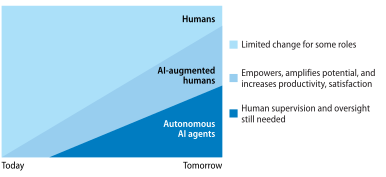
What is clear is that AI leaders should redesign work rather than merely automate tasks. The future belongs to organizations that build an operating model where humans and machines work together (Figure 6).
Figure 6. AI agents and humans work together in the future operating model
Source: Infosys Consulting
To balance this separation of work, management will become an AI superpower in a world of agents. Infosys CTO Rafee Tarafdar emphasizes skills, context, and practical building patterns over passive observation. The next workforce model is therefore not humans versus AI, but humans supervising, orchestrating, and governing AI systems.
To get ahead of your own enterprise AI transition, start with large scale reskilling in architecture, AI product management, governance, model operations, domain curation, and human in the loop control.
Change the narrative about AI. The agentic first company raises the value of human judgment rather than minimizing human relevance, delegating repetitive work to AI systems.
The future belongs to CTOs who can combine machine autonomy with human accountability, moving companies from laggards to leaders as we race toward an agentic-first era.

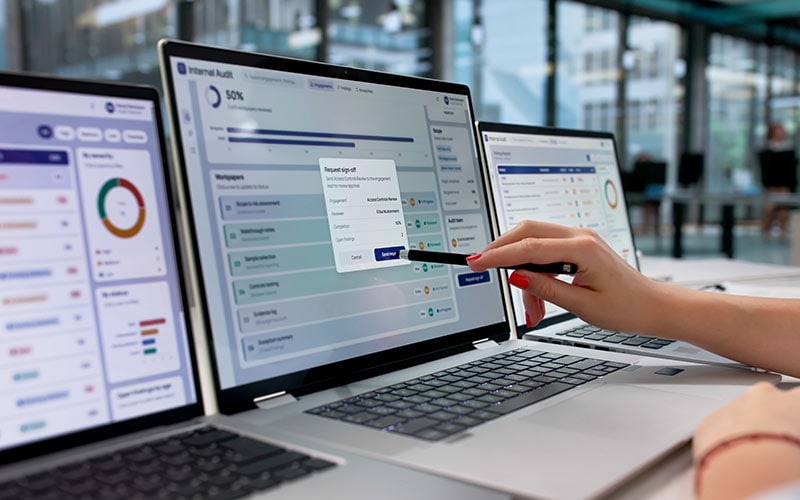
Regulatory change is accelerating and breach costs are rising, yet most institutions still rely on periodic, manual risk assurance. Three structural gaps, spanning visibility, third-party oversight, and governance, leave institutions unable to keep pace. Building risk assurance as a continuous, AI-augmented capability closes these gaps. A four-phase roadmap helps institutions get there.
- 11 Sep, 2026
- 15 min read

The difference between AI work and AI that works lies in the discipline to scale adoption, governance, and value realization
- 10 Sep, 2026

Learn how automated integrity checks and human oversight can help enterprises control AI agent sprawl, reduce duplication, and manage risk at scale.
- 08 Sep, 2026
