

Insights
- Digital education requires institutions to redesign teaching, assessment, and engagement for digital-first models while also upskilling educators.
- Policy changes, a stronger focus on skills and vocational training, responsible AI adoption, and rising emphasis on sustainability are reshaping institutional priorities.
- When implemented with equity and affordability in mind, technology can help bridge access and quality gaps, particularly in fast-growing regions such as Asia-Pacific and MENA.
- Institutions embracing scalable platforms, collaborative ecosystems, and industry-aligned lifelong learning will emerge as leaders in the evolving education market.
Executive summary
The global education market is projected to expand significantly over the next decade. Some reports forecast it to reach around $10 trillion by 2030, up from $7 trillion in 2025, reflecting healthy annual growth, with early childhood and workforce education emerging as the fastest-growing areas. Increasing consumer demand, evolving learning needs, innovation, technology adoption, and substantial investment inflows are driving this growth.
That said, challenges such as intense competition, regulatory complexities, and infrastructure limitations are affecting market dynamics. Access to high-quality education remains uneven. Socioeconomic disparities limit the ability of many learners to afford quality institutions, digital tools, or private education. Variations in education policy, funding, and institutional capacity lead to inconsistent learning outcomes across regions. Another challenge is a global shortage of teachers, particularly in the US, due to the demanding nature of the job, low compensation, and rising need for advanced technological skills.
Technology can help close the gap over the next decade: Online courses, open educational resources, and scalable platforms can deliver high-quality education at a fraction of the cost of traditional systems, improving affordability for learners from lower socioeconomic backgrounds. Online and hybrid delivery models reduce geographic and capacity constraints.
AI-powered adaptive learning systems can tailor content to individual learners’ pace, skill level, and learning style. This helps address learning gaps early and improve outcomes across diverse learner populations. Online certifications, micro-credentials — targeted, bite-sized credentials that validate specific skills or capabilities rather than broad academic disciplines — and skills-based platforms aligned with industry needs can enable faster workforce readiness, particularly for adult learners and those seeking reskilling or upskilling opportunities.
Organizations across the education ecosystem who invest in platforms, partnerships, and learner-centric innovation will define the education market of the future.

Financial insights
Market size
The global education market was estimated at $7 trillion in 2025. The higher education market holds the biggest market value compared to primary or secondary education due to rising enrollment in advanced degree programs, demand for specialized skills, and the growth of online and hybrid education models. Online learning represents the largest subsegment, as demand for flexible education intensified during the Covid period.
Globally, government investment in early childhood education is rising through targeted policies and tax incentives, although workforce shortages continue to constrain expansion. The K-12 segment — elementary, middle, and high school — is projected to grow at a 3.5% compound annual growth rate (CAGR). This growth is driven by increased participation from students due to greater awareness of education’s long-term benefits, expansion of public education systems in emerging markets, and sustained investment in digital infrastructure. In developed regions, declining birth rates could cap longer-term growth.
Revenue
Globally, the US is expected to account for the largest share of revenue. This could be because it has one of the highest per-student spends across K-12 and higher education, including tuition, research funding, and institutional infrastructure. It can also be attributed to the large concentration of globally ranked universities, research institutions, and private colleges in the region, which drives substantial domestic and international enrollment. However, the Trump administration has introduced headwinds for higher education in the US, through tighter international student policies, increased scrutiny of universities, and pressure on federal funding. The US is still expected to retain the largest revenue share globally due to high per-student spending, strong domestic demand, and concentration of top-tier institutions. But there has already been a drop in international student enrollment in US universities.
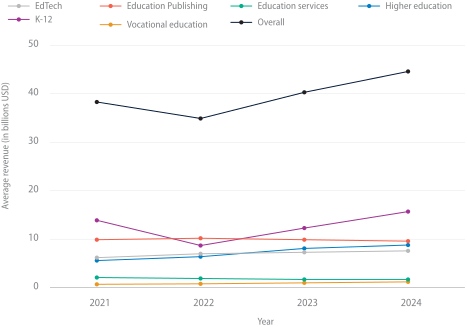
The global education technology (EdTech) segment has shown steady growth in the last four years (Figure 1), indicating consistent investment and digital adoption across the education sector. However, year-on-year revenue growth rate has declined, indicating a slowdown in EdTech adoption since the end of the pandemic and the return to classroom-based learning.
Figure 1. Revenue growth driven by K-12 and higher education
Source: Companiesmarketcap.com
The normalization from pandemic demand is largely complete, so double-digit growth rates are less likely over the next one to three years.
Education publishing has remained relatively stable. Higher education has grown strongly, driven by more learners pursuing advanced degrees in response to changing labor market requirements and by university investments to drive growth.
K-12 education companies globally display volatility but ended with strong growth in 2024 and 2025, possibly driven by the tapering of emergency pandemic spending on digital tools. Vocational education shows slow but steady gains, due to rising interest in skill-based learning pathways also reflected in its increase of market capitalization. This can be attributed to the increased demand for technical, vocational, and applied training programs.
Market value
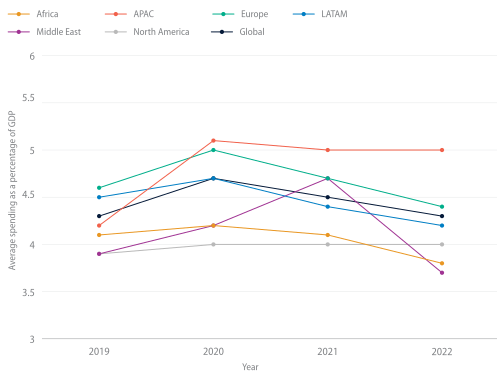
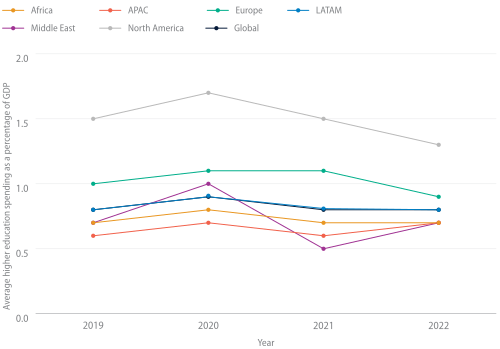
The global education market was valued at $7.3 trillion in 2024. Spending on higher education, however, differs widely across regions. Between 2019 and 2022, education spending in most countries remained broadly steady, with a slight dip after Covid as governments shifted funding to priorities such as healthcare. Europe, Asia‑Pacific, and Latin America showed fairly consistent spending levels, while Africa saw larger year‑to‑year swings.
Many countries experienced a dip or plateau after 2020 (Figure 2), reflecting pandemic-era fiscal constraints and shifting national budget priorities. Overall, the 2019 to 2022 window suggests moderate volatility but no major upward trend, indicating cautious or constrained public investment in education.
Figure 2. Global education spending fell post Covid
Source: UNESCO Institute of Statistics
Average government spend was between 4% and 5% of GDP, while private spending was estimated at around 2% in 2024. Europe had the highest spending across early childhood, K-12, and post-secondary education, while the Middle East and North Africa (MENA) countries spent the most on workforce education.
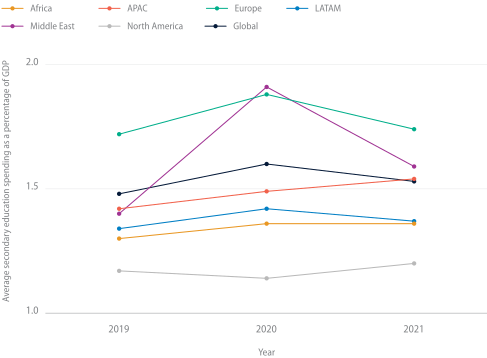
Europe’s spending trends in secondary education (Figure 3) and higher education (Figure 4) were also similar between 2019 and 2022. This is largely because many European countries heavily subsidize education through government spending, especially in early childhood and compulsory schooling. Slower population growth in Europe could also be responsible for investing more per student to maintain workforce quality and productivity.
Figure 3. Europe has highest secondary education spend from 2019 to 2021
Source: UNESCO Institute of Statistics
Many MENA countries are investing heavily in upskilling and reskilling to reduce dependence on oil and gas and to grow sectors like technology, tourism, and services, as just the oil sector cannot generate enough new jobs. Their large, young workforces also create urgency to build job-ready skills through vocational training and workforce programs. These large-scale, centrally funded programs are often tied to national visions, such as digital transformation or localization of talent, and are driving higher workforce education spend.
Figure 4. Europe, North America top higher education spend from 2019 to 2022
Source: UNESCO Institute of Statistics
Industry dynamics
Economic environment
The US, India, and China dominate the global education market due to a combination of large populations, sustained investment in education infrastructure, a strong emphasis on R&D, and universities that attract significant numbers of international students.
Several structural factors further reinforce their leadership. In all three countries, national policies position education as a strategic lever for economic growth, innovation, and global competitiveness. A strong presence of private institutions, EdTech businesses, and corporate training providers expands the market well beyond public education systems.
Rapidly evolving labor markets and persistent skills gaps drive continuous demand for higher education, vocational training, and lifelong learning. Public-private partnerships and international collaborations also help attract diversified funding flows.
Online learning penetration is expected to increase globally, with a projected CAGR of 6.8% from 2026 to 2030. This growth is driven by wider access to high-speed internet, rapid adoption of mobile devices, and increasing demand for flexible learning solutions.
The digital education market is a significant growth driver, growing at a 24% CAGR from 2025 to 2030. Key players are Coursera, Udemy, edX, Pluralsight, and Udacity. APAC is expected to grow at the highest rate due to heavy investment in EdTech infrastructure, online learning platforms, and AI-driven education tools.

There’s increased investment in educational technology by governments and private sectors globally, as the pandemic highlighted the need for education systems that operate smoothly during disruptions. Rapid technological change is forcing faster upskilling and reskilling, making digital learning platforms essential for workforce readiness, and EdTech enables governments to reach larger and more diverse learner populations including rural and underserved communities, cost-effectively.
Data-driven, AI-enabled tools also improve learning outcomes through personalization, analytics, and adaptive learning pathways.
Regulatory changes
The focus on integrating technology, particularly AI and online learning, and expanding international collaborations is influencing regulatory changes globally. Countries are developing new frameworks and regulations for EdTech companies to address data privacy, ethics, and quality control. The EU’s General Data Protection Regulation and AI Act, along with US laws, including Family Educational Rights and Privacy Act (FERPA) and Children’s Online Privacy Protection Act (COPPA), are driving global policy alignment toward stricter data localization and more ethical, transparent AI adoption in learning tools. FERPA allows parents access to their child’s education records, request corrections, and control the sharing of personally identifiable information. COPPA protects children online by regulating how websites and digital services collect, use, and safeguard their data. The UK Online Safety Act 2023 requires EdTech platforms to embed safety-by-design principles, robust content moderation, and age checks to safeguard users under 18.
In response, EdTech vendors are increasingly publishing transparent privacy policies that explain what data is collected, why it is collected, and whom it’s accessible to.

Sustainability initiatives
Research shows that sustainability is a decision-making factor for international students, as it reflects an institution’s long-term responsibility and commitment to addressing climate change. Universities with strong sustainability practices signal ethical governance, future-ready campuses, and alignment with students’ personal values, while also offering opportunities for sustainability-focused learning and careers.
Climate literacy is also gaining importance. Some universities include sustainability information in orientation, and some require students to complete a climate literacy subject.
The University of California, San Diego, introduced a Climate Change Education Requirement for the fall 2024 cohort, requiring undergraduates to take a course with at least 30% climate-related content. Arizona State University took a major step in 2024 by launching General Studies Gold, ensuring that sustainability is embedded in its curriculum through a mandatory three-credit course for every incoming student. As part of a sustainability initiative by Dublin’s Trinity College, in the last two years, over 340 academics and researchers have received climate leadership training, alongside the appointment of Fellows in Education for Sustainable Development to design a mandatory sustainability module.

Trends
Rise of online learning
Universities globally are using more digital methods alongside traditional classroom instruction, especially after the pandemic pushed many schools to adapt quickly. Institutions are investing in technology to make learning more accessible and enjoyable for learners everywhere. They are adopting systems that help organize courses, offer shorter skill-focused modules, and use intelligent tools that adjust to individual needs, as well as immersive technologies such as augmented reality and virtual reality, and global collaboration platforms.
Although remote learning has reduced since the peak of the pandemic, this shift is allowing learners to join programs from far away without relocating, supports those balancing work and study, reduces expenses tied to travel and housing, and helps schools attract a wider audience of learners. As campuses continue to evolve, these blended approaches are shaping international education by expanding opportunities for students and educators alike. Industry leadership in this space is being driven by platforms such as Coursera, Pearson, and Khan Academy.
Cross-location collaboration
Established exchange programs afford domestic students international exposure and allow universities to deepen their understanding of different cultures, supporting more effective outreach and recruitment in those regions. International collaboration programs play a crucial role by equipping students with the skills and experience needed to study, work, and travel across borders. Universities that fall under the American Association of Universities maintain global faculty and student exchanges, study abroad programs, joint degrees, and research collaborations, both formal and informal. The UK is seeking to finalize an agreement in the coming weeks to reenter the EU’s flagship student mobility program, Erasmus.
India has marked a significant advancement in the globalization of higher education with the establishment of foreign universities at Gujarat International Finance Tec-City. By mid-2025, four foreign universities had established a presence at GIFT IFSC. The first movers were Australia-based Deakin University and the University of Wollongong which commenced operations in 2024.
Growth in corporate training
The global corporate training market stood at $361 billion in 2023 and is expected to more than double to reach $805 billion by 2035, expanding at a CAGR of 7%. This momentum is fueled by rising demand for skills in machine learning, data analytics, and cybersecurity as organizations respond to technological change. Adoption is particularly pronounced among IT and telecom industries: They lead in corporate training adoption compared to other sectors, reflecting highly competitive, innovation-driven nature of these industries and their need to manage complex, rapidly evolving technologies and systems.
Additionally, internship programs facilitated by global corporates — such as InStep, Infosys’ global fully paid flagship internship program — allow students from universities to gain exposure to real-time projects and industry experience, and a chance to turn the internship into a job offer.
Educator-facing chatbots
Survey results indicate that, on average, 40% of teachers in the Organisation for Economic Co-operation and Development countries agree or strongly agree that AI meaningfully improves individualized student support. AI chatbots are being used by educators for tasks like lesson planning, curriculum design, creating student quizzes or exam papers, managing parent communications, and summarizing student work. AI streamlines the message creation process by allowing teachers to input a topic, select a student, choose a template, and adjust tone, style, and length. Well-known AI chatbots for teachers include Claude, ChatGPT, Duck AI Chat, Copilot, and Raina.
The AI trend makes it important for educational institutions to upgrade technology regularly and keep their teaching staff trained in its usage and in data privacy. AI-led tutors can help bridge the resource gap by providing personalized attention and supporting students where teacher availability is limited. UNESCO has created AI competency frameworks to support teachers in using AI safely and effectively. Together, these efforts ensure that technology adoption in education remains responsible, inclusive, and focused on improving learning outcomes.
Technology outlook
Artificial intelligence
The AI-powered education market is expanding rapidly, with projections suggesting it could exceed $136 billion by 2035, up from an estimated $10 billion today.
According to the Digital Education Council’s 2024 Global AI Education Survey, 86% of students now use AI in their studies, underscoring a decisive shift toward AI-enabled learning. EdTech companies also are integrating AI into their platforms to improve learning at scale. By analyzing student performance, these systems adapt content and lessons to individual needs, moving away from uniform instruction toward more personalized and effective learning.
A global online university for undergraduate and postgraduate students was facing issues with sustaining student pass rates and engagement levels. Infosys helped the client implement an AI-powered predictive analytics system that could assess the likelihood of students passing and trigger timely interventions. This helped the client increase its student pass rates by 15%, by initiating early and focused interventions.
AI tools raise concerns around ethics, data privacy, bias, and overreliance on automation. To address these issues, AI should be used alongside human judgment to ensure assessments remain fair, transparent, and educationally meaningful.
Integrated admin systems
These systems unify administrative, academic, and communication functions onto a single digital platform, simplifying how schools operate. By automating processes such as attendance, fee management, and timetabling, they cut down manual work and improve data reliability. These strengthen collaboration by enabling real-time information sharing among teachers, students, parents, and administrators. As a result, schools can make smarter, data-led decisions, use resources more effectively, and drive better learning outcomes.
Enterprise software platforms
The global education software market is growing: it was valued at $15 billion in 2024 and is forecast to reach $21 billion by 2029. Education enterprise resource planning (ERP) systems which integrate functions like student data, finance, HR, and academic processes are expected to climb in value, because institutions are under growing pressure to do more with fewer resources while improving outcomes. Cloud-based enterprise solutions, including learning management systems (LMS), student information systems (SIS), and analytics, now dominate adoption as institutions streamline administration and learning processes. Digital platforms such as ERP and LMS are increasingly essential across K-12, higher education, and corporate learning environments, as schools embrace hybrid and data-driven teaching models. Cloud-based SIS solutions now account for a major share of new deployments, about 61% globally, as schools shift to scalable, remote-friendly systems.
For a large public research university in the US looking to improve student success and engagement, Infosys implemented an SIS integration. It used data analytics to analyze student engagement patterns, predict withdrawal risk, and integrate the data with student information systems. This helped the client enhance student retention by improving decision-making with predictive insights, and streamlining academic processes for students with withdrawal risks.
Key takeaways
- Digital education is no longer a supplement but a structural pillar of the global education ecosystem. With online learning penetration expected to more than double by 2030, institutions must redesign pedagogy, assessment, and student engagement for digital-first delivery. There’s also a need for teacher education on these aspects.
- Regulatory reforms, an emphasis on skill-based and vocational learning, responsible AI use, and growing expectations around sustainability and climate literacy are reshaping institutional priorities.
- Technology has the potential to close access and quality divides, especially in high-growth regions like Asia-Pacific and MENA, if deployed with equity, affordability, and outcomes at the center.
- Those who invest in platforms, partnerships, and learner-centric innovation will define the $10 trillion education market of the future.
- Institutions that align curricula with industry needs and offer lifelong, modular learning pathways will remain relevant.



For retailers, the AI advantage will come from building the organizational muscle that lets employees use AI confidently.
- 09 Sep, 2026
- 6 min read

Retailers must prioritize AI-powered supply chain intelligence, seamless omnichannel experiences, and personalization to drive growth and resilience.
- 08 Sep, 2026
- 15 min read

Companies that tailor their offerings and messaging to evolving consumer priorities will be better equipped to sustain demand as spending becomes more selective.
- 30 Jul, 2026
- 12 min read
