

Insights
- AI in manufacturing focuses on execution. But, it must succeed on the shop floor, not in the strategy binder.
- Strategic intent alone does not create success. Manufacturers need to combine ambition and execution for impact.
- Manufacturers prioritize cybersecurity. But, competing priorities between cybersecurity and data create friction.
- AI polarizes manufacturers. But the sentiment sharpens with strategy maturity.
Introduction
By Jasmeet Singh, executive vice president and global head, manufacturing
Artificial intelligence (AI) is at the forefront of manufacturing transformation. The question is no longer whether it will reshape operations but how quickly and confidently manufacturers will embed it into their business.
The Infosys Manufacturing Tech Index explores enterprise AI usage and trends shaping their journey. Between October and November 2025, we surveyed 650 executives from large manufacturers, uncovering several compelling insights.
The findings show a clear evolution in AI deployment. Companies have moved beyond pilots, committing significant investment per initiative and deploying many initiatives across multiple functions. However, most of these efforts are upstream in the planning and pilot stages, highlighting a mix of ambition and persistent challenges to scale AI in complex operational environments.
A striking dichotomy emerges in cybersecurity. While this area attracts the most AI implementations, it also stands out as a primary barrier to scaling AI, along with data challenges which continue to persist. Additionally, companies that embed AI into their strategy tend to pursue more initiatives, establishing a stronger foundation and deployment readiness than those that don’t.
This research also reveals two distinct perspectives on AI: Nearly as many respondents view AI as transformational as those who view it as overstated, underscoring a wide variety of maturity levels and expectations across the industry.
Manufacturers’ confidence in AI is rising as they move from experimentation to operationalization. The next frontier requires integrating AI into core processes and addressing foundational challenges such as cybersecurity and data readiness. We will continue to track these trends and provide insights. To discuss the research or explore how you can accelerate your AI journey, we invite you to connect.
Key findings on AI in manufacturing
AI in strategy and success
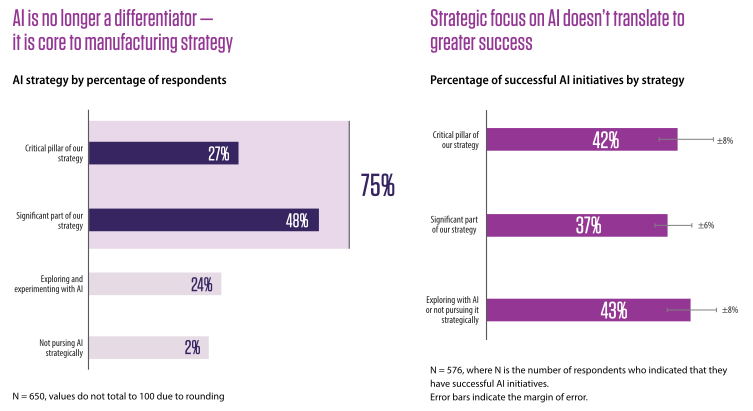
For manufacturers today, AI is core to manufacturing strategy. However, a strategic focus on AI does not always guarantee success. Most organizations identify AI as pivotal, but strategic intent must match the execution framework to realize measurable value.
- [Graph 1: AI is no longer a differentiator – it is core to manufacturing strategy]
- [Graph 2: Strategic focus on AI doesn’t translate to higher success]
Cybersecurity and sentiment: priority and polarity
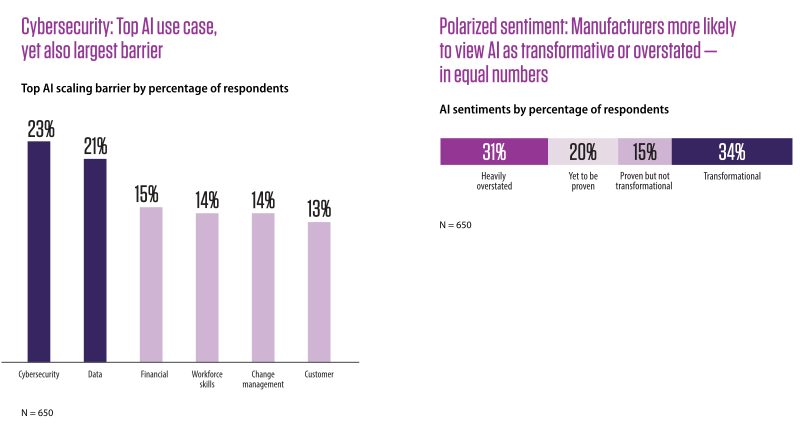
Cybersecurity is the leading AI use case in manufacturing and the largest barrier to scale. Industry sentiment, though, is sharply divided, with nearly as many leaders seeing AI as transformative as those who believe its benefits are overstated. This polarization reflects the varied levels of maturity and experience with AI across manufacturers.
- [Graph 3: Cybersecurity: Top AI use case, yet also largest barrier]
- [Graph 4: Polarized sentiment: Manufacturers more likely to view AI as transformative or overstated – in equal numbers]
AI investment in manufacturing
Spending trends and allocation
More than half of manufacturers are investing over $2 million per AI initiative, reflecting a clear commitment to deploying AI at production scale.
- [Graph 5: AI spending per initiative by percentage of respondents]
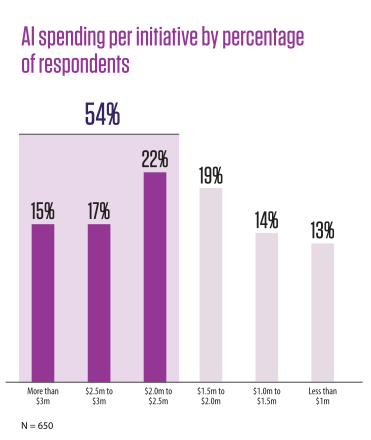
The median investment per initiative is between $2 million and $2.5 million, highlighting the operational commitment in manufacturing. This demonstrates that AI investment in manufacturing now demands the same capital discipline, governance, and focus on value, as traditional operational programs. Unlike IT-focused initiatives in other industries, AI in manufacturing requires significant investment in data engineering, system integration, and workforce enablement — costs that extend well beyond model acquisition. Regardless of strategic commitment, 54% of manufacturers allocate over $2 million per initiative.
The role of external partnerships
Nearly 75% of manufacturers rely on an external technology partner to meet their AI needs, while only a quarter build AI in-house.
- [Graph 6: Average percentage of AI implementations by AI sourcing approach]
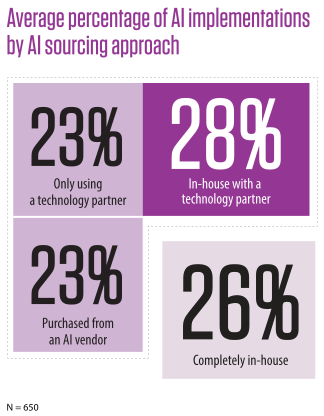
In-house development delivers stronger control over intellectual property but requires long-term investment and advanced expertise. External or hybrid models give access to specialized capabilities and overcome talent or technology gaps, enabling faster deployment and scalability.
Further Infosys research shows that strategic choices about AI sourcing are heavily influenced by organizational readiness. With only 2% of companies fully prepared to scale AI, many turn to external experts, particularly in data management, governance, and talent to advance their AI investment strategy.
AI strategy in manufacturing
Core to enterprise strategy
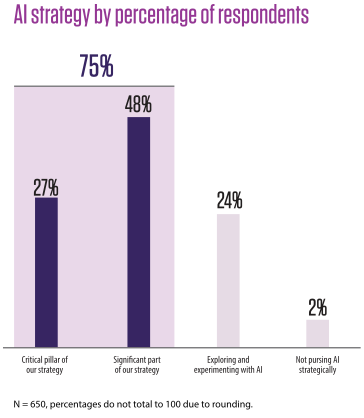
With 75% of manufacturers embedding AI into their enterprise plans, AI strategy in manufacturing has shifted from being a peripheral consideration into a central pillar for growth and competitiveness. The challenge now is to translate this strategic intent into measurable operational outcomes.
- [Graph 7: AI strategy by percentage of respondents]
As cost pressures intensify and manufacturing processes grow complex, AI has become essential to reduce unit costs, enhance responsiveness, and accelerate innovation cycles across the industry.
Focus on operational impact
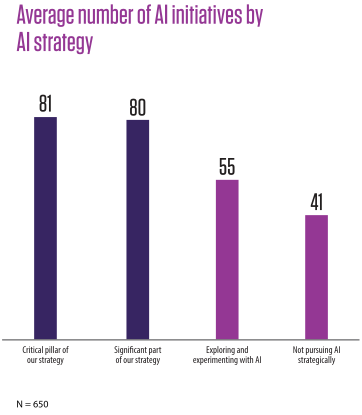
Manufacturers that incorporate AI into their strategy tend to launch significantly more initiatives, using shared technology platforms and established funding processes. A higher volume of initiatives reflects that manufacturers are actively investing, learning, and building momentum toward long-term value and success. Moreover, manufacturers demonstrate their strategic commitment through action as they reinvest in and scale up AI use cases that achieve early results.
- [Graph 8: Average number of AI initiatives by AI strategy]
AI implementation in manufacturing
From initiative launch to value creation
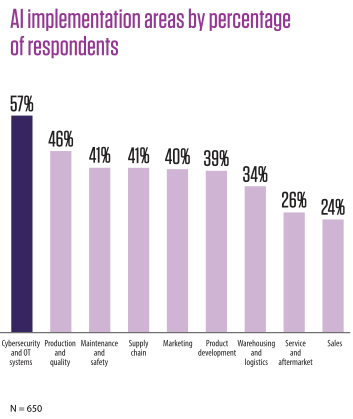
Manufacturers are launching numerous AI initiatives, but value at scale requires disciplined execution. Nearly 60% of manufacturers use AI in cybersecurity and operations technology (OT) systems, followed by nearly 50% in production and quality — areas where structured data and immediate impact drive results.
- [Graph 9: AI implementation areas by percentage of respondents]
The Jaguar Land Rover cyberattack underscored the need to monitor IT and OT systems and respond before incidents escalate.
Progress, challenges, and value realization
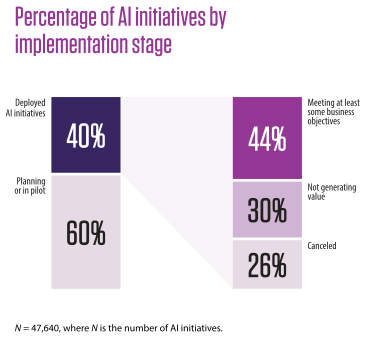
Only one in five AI initiatives in manufacturing meets business objectives, while most initiatives remain in early stages. This markup resembles a venture portfolio, where the expectation is that a handful of successful initiatives will drive returns amid a field of less impactful attempts.
- [Graph 10: Percentage of initiatives by implementation stage]
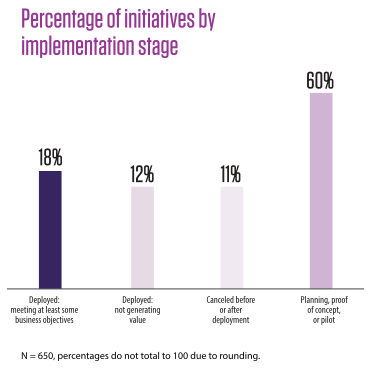
Of all deployed initiatives, 44% meet some business objectives, while a quarter are cancelled and a third are not delivering value. This underscores that success demands intense early focus, tighter stage-gate criteria, and the courage to kill projects and reinvest elsewhere.
- [Graph 11: Percentage of AI initiatives by implementation stage]
Barriers to scaling AI
In manufacturing, cost is not the biggest blocker to AI pursuits. Cybersecurity (23%) and data (21%) constrain broader AI adoption and effectiveness.
- [Graph 12: Top AI scaling barrier by percentage of respondents]
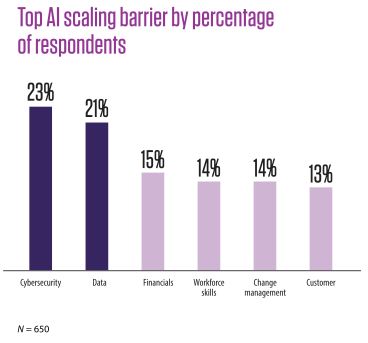
Addressing these foundations is essential to scale.
Execution drives success
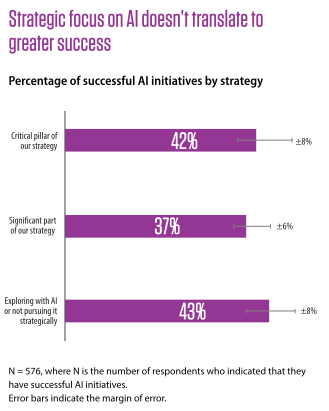
A strategic commitment to AI alone does not ensure positive outcomes. Strategically committed manufacturers report more AI initiatives but not a higher success rate.
A successful AI implementation in manufacturing depends on execution infrastructure, such as their operating model, data architecture, and workforce readiness.
- [Graph 13: Percentage of successful AI initiatives by strategy]
AI sentiment in manufacturing
Divided perspectives and industry impact
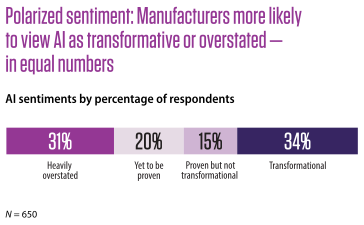
Manufacturers are divided on AI’s value, though overall sentiments are positive. Nearly 70% of respondents believe AI has value, whether it’s proven yet. Nearly one-third of respondents see AI as transformational, while 31% believe that AI’s value is overstated and not yet proven at scale.
- [Graph 14: AI sentiment by percentage of respondents]
Strategic focus shapes AI sentiment
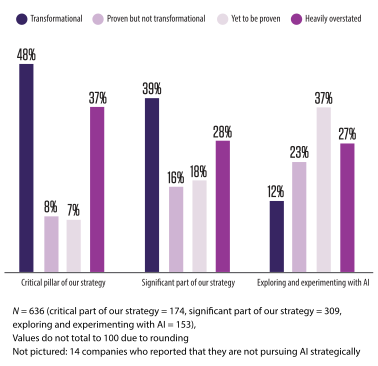
Manufacturers that embed AI in their strategy launch more initiatives, increasing the potential for transformative value and signaling commitment. However, skepticism persists even among these strategic adopters, with 37% respondents unconvinced about AI’s benefits. Those that remain in the exploration stage are particularly at risk of falling behind, as early movers build momentum and advantage over time.
- [Graph 15: Percentage of respondents by AI sentiment and strategy]
Appendix
APPENDIX A: METHODOLOGY
The Infosys Manufacturing Tech Index is a survey-based research study that benchmarks AI technology investment, strategy, implementation, and adoption across the manufacturing sector. This edition draws quantitative data from 650 manufacturing companies with revenues above $1 billion, spanning 14 product lines across Asia-Pacific, Europe, the Middle East and Africa, and North America.
Our survey captures a significant share of manufacturing revenue generated across these regions. Our executive respondents are senior leaders responsible for AI strategy and enterprise-wide AI implementation. The survey was supplemented by interviews with manufacturing executives and Infosys manufacturing experts.
As we collect and synthesize data in future volumes, this research will deliver a dynamic view of trends, monitor shifts in patterns and support decision-makers in manufacturing organizations in making informed choices on AI technology and talent.


For retailers, the AI advantage will come from building the organizational muscle that lets employees use AI confidently.
- 09 Sep, 2026
- 6 min read

Retailers must prioritize AI-powered supply chain intelligence, seamless omnichannel experiences, and personalization to drive growth and resilience.
- 08 Sep, 2026
- 15 min read

Companies that tailor their offerings and messaging to evolving consumer priorities will be better equipped to sustain demand as spending becomes more selective.
- 30 Jul, 2026
- 12 min read
