
Thought Leadership
Enterprise marketing stacks are typically highly connected, yet AI tools often produce strategically shallow outputs because they lack a shared understanding of what data means. The missing layer is ontology: a structured map of relationships between customers, personas, journeys, content, and intent. While databases store facts, ontologies store meaning.
This page brings together both the business and technical perspectives on ontology-powered marketing AI, exploring how Knowledge Graphs and contextual intelligence enable more effective decision-making, personalization, attribution, lead scoring, and customer engagement.

Business Perspective
Discover how ontology helps marketing leaders improve lead quality, customer journeys, attribution, and AI-driven decision-making through contextual intelligence.
Read the Business POVTechnical Perspective
Explore the architecture, frameworks, and implementation approach behind ontology, Knowledge Graphs, semantic layers, and AI-driven marketing systems.
Not sure where to start? Browse the summary below for a high-level view of how ontology and Knowledge Graphs help organizations build contextual intelligence for AI-driven marketing.
Summary
Enterprise marketing stacks unify CRM, behavioral, intent, and audience data to power AI-driven lead scoring, personalization, journey orchestration, and optimization.
On paper, the architecture should work. But marketing practitioners still struggle to answer the questions that matter most:
Most marketing AI implementations are fully connected. The intelligence, however, is still shallow.
Marketing AI is effective at identifying patterns, but not necessarily their meaning.
A lead scoring model may mistake engagement for intent, regardless of whether the interaction comes from a genuine buyer or an intern doing research. A journey orchestration tool may route prospects without considering buying stage or buying role, while a personalization engine may optimize behavioral similarity rather than business relevance.
Rather than resolving inconsistencies across systems, AI absorbs, encodes, and scales them.
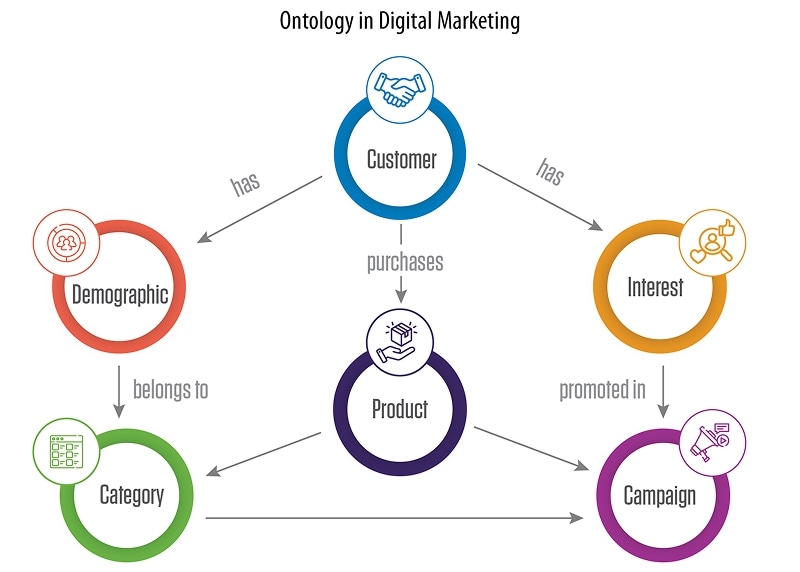
In computer science, ontology is a shared semantic resource model: a structured map of relationships between entities such as customers, accounts, personas, content, journeys, intent, and outcomes within a domain. In marketing, ontology is a map of meaning.
Where databases store facts, such as clicks, revenue, and reach, ontologies provide meaning. They define relationships between customers, accounts, personas, intent, and journeys, enabling AI to reason across data rather than simply identify patterns.
For example, a Director of Demand Generation visiting a pricing page during a quarterly planning cycle is in a different buying context than a graduate student clicking the same link. The AI system that understands that difference will make better decisions.
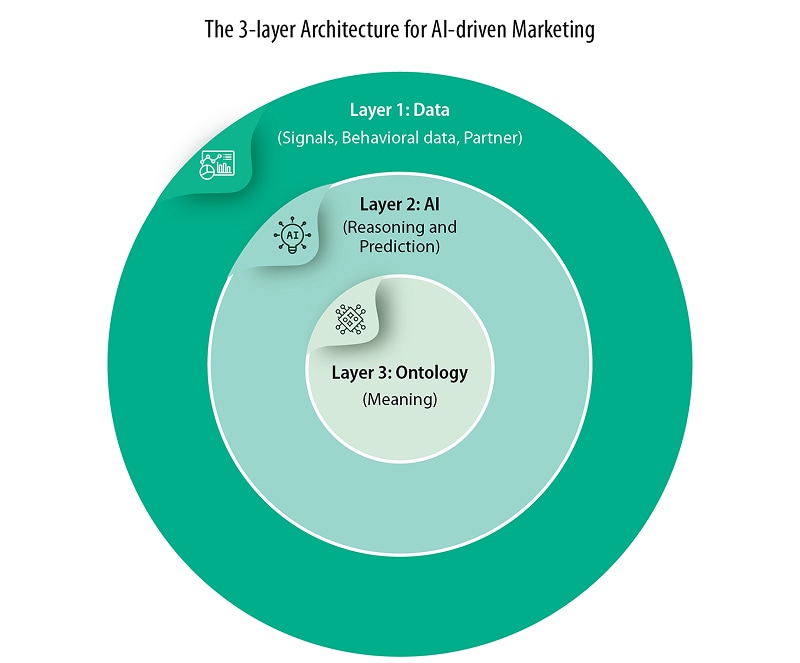
AI-driven marketing requires three layers:
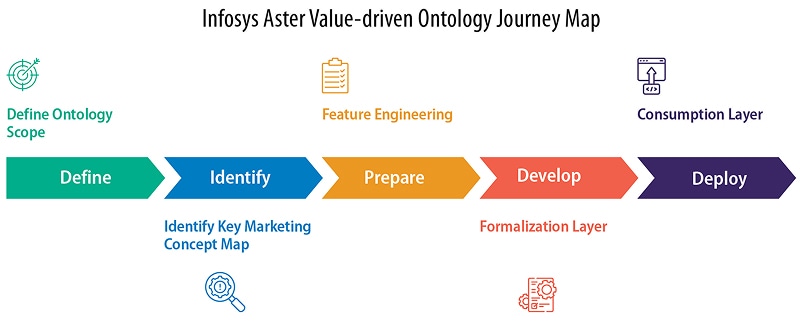
Building an operational ontology requires five stages:
Define: Establish clear definitions for personas, journey stages, intent, and buying roles
Identify: Map relationships between customers, accounts, personas, and intent signals
Prepare: Convert relationships into usable data structures and classifications
Develop: Create a shared, machine-readable model of entities and relationships
Deploy: Activate the ontology through a Knowledge Graph that AI, analytics, and Customer Data Platforms (CDPs) can continuously enrich and consume
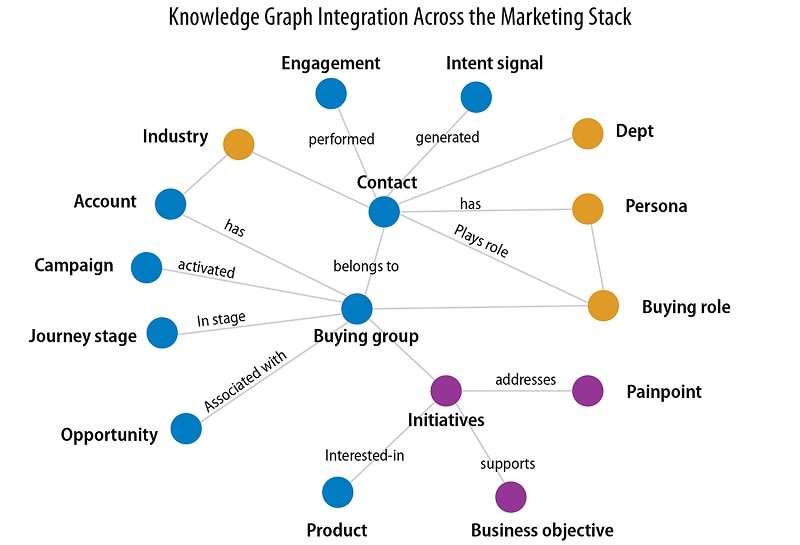
The Knowledge Graph is the operational artefact produced by the five-stage process. It encodes marketing entities such as personas, accounts, journey stages, and content assets as nodes, and the relationships between them as typed, directed edges.
This is what separates a Knowledge Graph from a data warehouse. A data warehouse answers: what happened? A Knowledge Graph answers: what does it mean, and what should happen next?
Integration occurs at four primary touchpoints:
The most valuable work is achieving agreement on what core marketing entities mean before any graph schema is written. Start with one vertical, define key entities and relationships, build a Knowledge Graph, connect AI tools, measure impact, and then scale across the enterprise.
Every AI investment a marketing organization makes is only as valuable as the semantic foundation it sits on. Without shared meaning, AI optimizes noise. With it, AI reasons towards superior outcomes.

Ontology has moved beyond being an experimental technology in marketing AI. Early movers who build the foundations now, before contextual intelligence becomes the baseline expectation, will establish an advantage that is difficult to replicate once the market catches up.
Infosys Aster combines a pre-built Knowledge Graph, a proven five-stage ontology framework, and deep industry alignment to accelerate contextual intelligence. With Infosys Topaz integration, MarTech orchestration, and enterprise-scale governance, it helps organizations move from data abundance to AI-driven decision-making.

The Infosys Aster team will be in touch with you shortly.