
Unlocking AI’s True Potential: Enterprise Value & Transformation with Jimit Arora


-
 00:00
00:00
Jimit Arora
It's apparently something that's attributed to Confucius, although it's debated, which went like this. I hear, I forget. I see, I remember. I do and I understand. So I think what leaders need to do today is not delegate AI to someone lower in the organization. They have to be doing it to really understand the art of the possible. And it's not something that as a CIO or a CDO or a CTO, you can delegate in the organization. You have to be the most visible advocate and the most visible user of AI to really drive adoption in the organization. So make sure you're the one who's also doing it.
-
 00:54
00:54
Subhro Mallik
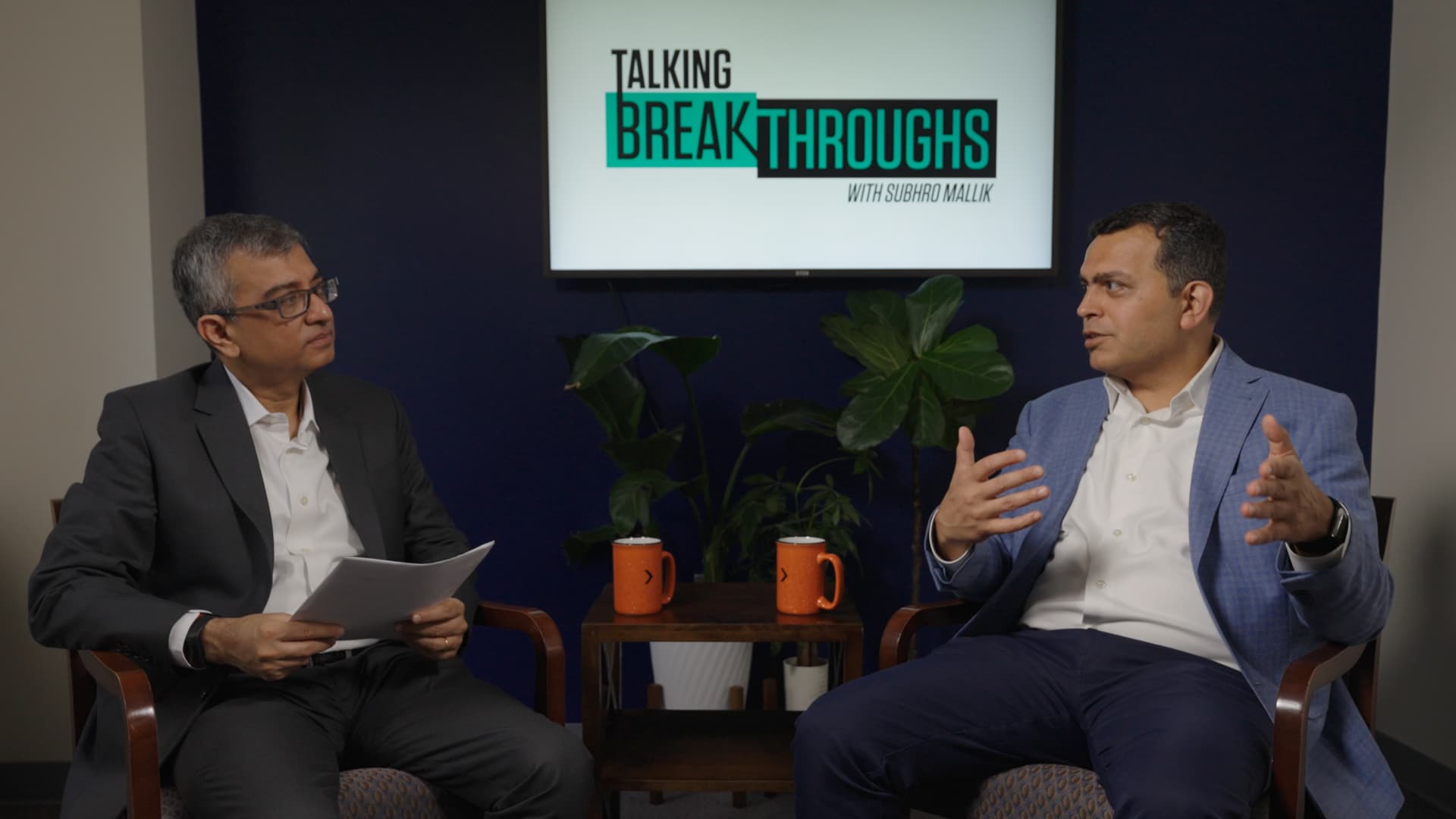
Arguably, we are witnessing one of the greatest revolutions of all the time in the world today. From the industrial era to the internet age and now an AI world where machines will coexist with humans with breakthroughs every day. Welcome to another new episode of Talking Breakthroughs. I'm Subhro Mallik and this series is about big ideas, bold conversations and the breakthroughs shaping the future of business and indeed life and beyond. Today, I am pleased to sit with Jimit Arora, CEO of Everest Group and talk about all the breakthroughs that he sees that's spanning across the industry.
-
01:43
Subhro Mallik
I think we are in an era where we want to see unprecedented changes because of AI. And there's a lot of talk around what AI can do. But today the challenge is, how do you see real business impacts? So when you think about breakthroughs in the context of AI, how will leaders distinguish between experimentation, hype, and outcomes that truly matter?
-
02:11
Jimit Arora
I completely agree with the intro you provided, the parallels with the industrial era, the internet era, and now AI. And if you think back to those time horizons, for us to really see where the breakthrough happens is not when we did things better, but when we did things different. And if you think about what a lead indicator might be, whether something is going to create breakthrough change versus incremental change, it's going to be fundamentally about whether we are changing the operating model or not. If we are changing the operating model across aspects of people, process, tech, and culture, more likely than not we'll see breakthrough impact. If we are just changing the technology layer, I think the impact will stay incremental. A lot of the value that people are looking at has been framed around productivity to date, and I don't think that's the end-all and be-all of how we need to think of AI. That's actually causing a lot of disappointment because we're thinking of AI so narrowly as an efficiency or productivity enabler. So for us to really distill whether AI is creating that breakthrough impact, we have to challenge the organization to address some of the hardest problems of revenue growth, around customers and NPS, and around core profitability that translates to earnings per share. I think it's unfair, given how early we are in that journey, to start expecting to see those results immediately.
-
04:29
Subhro Mallik
So let's move a little bit now to the world of life sciences. In life sciences, across clinical trials, R&D, manufacturing, and commercialization, there's again a lot of talk about AI. But from your vantage point, given you are talking to so many of these clients, big and small, what are you actually seeing in terms of measurable ROI today?
-
05:04
Jimit Arora
In the pharma life sciences space, that's actually one area where we're really encouraged about the long-term impact of how AI shapes humanity. If you go back to the core purpose of all life sciences and pharma companies, it is to help with longevity. It is to make people healthier. So I think one area where AI can, will, and is already creating rapid acceleration is in the R&D cycles. Some chips are being designed which are custom-made for the R&D life cycles — this is precision AI being created for R&D cycles, which I think creates long-term impact. Are we there yet? Absolutely not. But the fact that people are thinking about how to rapidly compress R&D cycles and enable this in trials is where I'm most excited. Overall, AI value is about creating systems of execution plus A to the power of four, minus PTSD. PTSD here means process debt, tech debt, skills debt, and data debt. That's what's holding value creation back in pharma companies for AI. You have to start with process first, data second, make sure you have the right skill sets, and then the tech. So it's process, data, skills, tech in that order. What we are creating is systems of execution on top of existing systems of record — systems that can act and deliver autonomy. We'll build on top of it and create autonomous workflows there, with the four aces: generative AI, agentic AI, deterministic machine learning, automation, and arbitrage.
-
09:13
Subhro Mallik
That's very well put, Jimit. You just made it into an engineering problem by putting a formula to the whole problem of AI. I think that's very beautiful, and I think our listeners will remember that equation.
-
09:31
Subhro Mallik
I do agree that how we will get past it is to get rid of the PTSD and leverage the four A's that we have, and then remember that systems of record are not going away. The stories we hear that there's going to be a new product out there which is going to rewrite every code in the world — I also believe, like you do, that's not going to happen so easily. Our pharma companies, by the way, are very deliberate by nature. They don't take short-term decisions, so I'm sure they'll be able to live through it. However, the angst that they have that they should get AI immediately is possibly not a fair expectation.
-
10:27
Subhro Mallik
Let's now talk a little bit about private equity. The world of private equity operates very differently with portfolio companies from what we see in monolithic organizations. Each portfolio company inherently has different levels of maturity from a business perspective, so it creates a very different level of complexity when you think of it from a lens of AI and value creation. If you look at the private equity investment life cycle from asset assessment to value realization, what do you see as the role of AI? From your perspective, what is the future of AI in the whole private equity lifecycle?
-
11:26
Jimit Arora
Coming to private equity, I think that world can operate a lot faster. It relies on value unlock at different stages, and what we are already starting to see is the speed with which people are able to move becoming a lot faster, right from the sourcing stage to due diligence and evaluation, and then through a lot of the value maximization phase. Part of the thesis that we see AI enabling is that operating partners have better data and better judgment. That's a judgment arbitrage that you're taking a play on, and it gets amplified with the use of AI. What's really going on right now is understanding information assets early on and establishing lead indicators — because we are using AI in a much more strategic manner. So that creates value upstream versus just trying to do it during the classical value maximization phase. In the world of private equity, AI is not just going to be a value maximizer from an efficiency perspective. I would also like to see a lot more of it impacting the growth engines of these companies.
-
14:19
Subhro Mallik
That's a fantastic point. We are also seeing some of that — how private equity firms can leverage AI very early on in assessment, and not only use it for arbitrage. The biggest value eventually will be on revenue, like you said, but it'll take some time. And you're right — they're some of the smartest people we know, and they'll surely get there.
-
14:45
Subhro Mallik
So if you think of AI as it stands today, many AI programs are not successful not because the technology doesn't work, but because today we may actually have too much technology. It's becoming difficult to keep track of the technology itself. What do organizations need to think about as they design themselves to be AI-ready so that they can get the true power of AI and not just focus on the technology? Because our belief is that today's technologies may not even exist two years from now, and we'll have brand-new technologies come in, but the foundational principles will remain.
-
15:32
Jimit Arora
Fundamentally, the environment we live in is shaped not only by AI but also by the mega forces impacting our world. You've got geopolitical uncertainty, demographic and anthropological shifts, and what we describe as a world of perma-crisis. There's always some crisis or another that business executives are responding to. The right response to perma-crisis is perma-agility. You have to keep responding. Drastic change and uncertainty are the only constants, so as an executive you have to lean into it. One of the other things uncertainty creates is a need to think in scenarios. When you think in scenarios, that gives you the resilience to adapt to different outcomes. Helping people think in scenarios is a great exercise when it comes to creating alignment. You bring IT leaders, business leaders, procurement leaders, and finance into a room together and showcase different scenarios — an evolutionary scenario, a reinvention scenario, and something in between. Then you ask: where do we want to be three years from now? Use that cross-functional discipline to create alignment. Future-cast, think in scenarios, and bring people together to align early and align often. That's the power of how you affect change because this is not just a technological problem. It is deeply human.
-
18:48
Subhro Mallik
Great point, Jimit. We are always in a perma-crisis and something or the other is always happening. The ability for organizations to survive those moments and actually come out stronger depends on people. I think at the start of every crisis we want to forget the basic principles you talked about, like scenarios, and we think this is completely different and the basic principles don't apply. But as you rightly said, they do apply — whether it's AI or something else entirely.
-
19:31
Subhro Mallik
So when we come down to technology layers like coding, engineering, and software lifecycle development, this is more of a technology question now. We have talked about process and how AI impacts business. Where do you see the most impact of AI from a tech perspective? And again, what's genuinely working from your vantage point, since you study all of this deeply and in client environments?
-
20:11
Jimit Arora
I would say the three areas across large enterprises, large pharma, and large portfolio companies where we are seeing AI create the most impact today are first, SDLC; second, customer experience, including contact centers and experience management; and third, the whole service desk environment. So it's really two broad categories: software development and service management. Those are two areas where we are seeing the most impact today, and that's because these are the areas that got a head start. We're moving from prompt engineering to context engineering. But in those two areas, if you're a CIO or CTO and you're not seeing progress, you need to drive harder, and you need to drive harder today. The concept that AI may create value in the future in SDLC and service environments is no longer theoretical. We should be seeing meaningful, measurable breakthrough value today — at least going 2x faster.
-
22:10
Subhro Mallik
Great point, Jimit. I think we also agree that SDLC and the service areas are where it is possibly more ready. The other areas — we can imagine them, we can create some code in a vacuum — but the moment you put them into context, like in the R&D area or generating revenue for a portfolio company, it becomes more complex, and even the technology needs more maturity.
-
22:39
Subhro Mallik
Just from your perspective, if leaders take away just one mind shift — one mind shift they should make — what would that be?
-
22:53
Jimit Arora
Let's not forget the role that humans are going to play in this. We talk about 'and-vantage' — not advantage, but and-vantage. The mind shift is to think in terms of technology and operations, human and AI, not tech or ops, not human or AI, not onshoring versus offshoring. It's and. So a mindset of and is very important in today's world because that operating model requires convergence and connectedness. We are trying to collapse silos, not create new ones. The second mind shift: I hear, I forget. I see, I remember. I do and I understand. What leaders need to do today is not delegate AI to someone lower in the organization. They have to be doing it themselves to really understand the art of the possible. You have to be the most visible advocate and the most visible user of AI to really drive adoption in the organization. So make sure you're the one who's also doing it, not just talking about it.
-
24:33
Subhro Mallik
So thank you, Jimit, for joining this Talking Breakthroughs series. It's been wonderful chatting with you today.
-
24:44
Jimit Arora
Thank you so much, Subhro. Appreciate you having me on. Wonderful conversation today.
In an era of accelerating disruption, Subhro Mallik joins Jimit Arora, CEO of Everest Group, to decode how AI is redefining enterprise value—uncovering real-world strategies for operating model reinvention, intelligent decision-making, and scalable transformation powered by human and AI synergy. It further offers a forward-looking lens on how future-ready enterprises are embedding AI into the core of strategy, unlocking new growth frontiers while building resilience in an ever-evolving business landscape. Yet, as momentum around AI accelerates, a critical question remains—what truly differentiates organizations that experiment from those that consistently translate AI into sustained competitive advantage?
Speakers
-
Subhro Mallik
EVP, Infosys
-
Jimit Arora
CEO of Everest Group