


Transcript
-
 0:09
0:09
Venky Ananth:
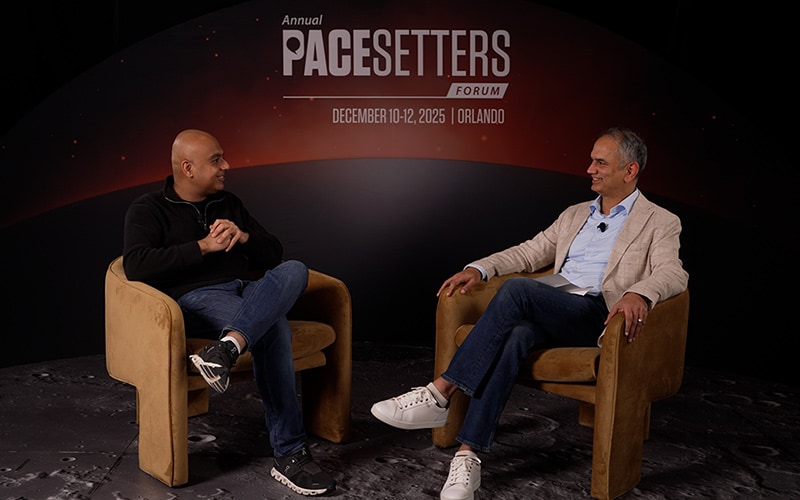
Hello and welcome to the next edition of Pace Setters.
-
0:13
Venky Ananth:
This edition, I have an exciting guest for us. He is the CEO of Everest Group.
-
0:21
Venky Ananth:
Everest is a consulting and research firm and they play at the intersection of technology, industries they serve into and services and product firm that serve into these industries.
-
0:35
Venky Ananth:
So I have Jimit who I know for about a decade. He is a very deep thinker, a very experienced practitioner and has got a lot of wisdom from the field.
-
0:47
Venky Ananth:
So we want to combine that and see what's going to unfold tonight.
-
0:53
Venky Ananth:
Welcome to the show, Jimit. Very happy to have you here.
-
 0:56
0:56
Jimit Arora:
Venky, thanks for having me here.
-
0:58
Venky Ananth:
First off, let's start with Everest. Just give us a background about Everest itself. What you do.
-
1:05
Venky Ananth:
Of course, I introduced you as a research and consulting firm, but just for the audience, it would be useful to know what all you cover and what's the value proposition that you bring to the market.
-
1:16
Jimit Arora:
No, and Venky, you kind of touched upon it, right?
-
1:19
Jimit Arora:
So yes, we are a research advisory firm that's at the intersection of technology, technology services and business.
-
1:27
Jimit Arora:
So we're trying to not just look at technology or technology services from a tech perspective, but we're trying to make sure that clients are able to solve real business problems.
-
1:38
Jimit Arora:
So applying tech and tech services to solve real business problems in a research-first mode is our firm.
-
1:45
Jimit Arora:
What's slightly different about us is that unlike some other research firms, we have a combination of memberships and projects.
-
1:53
Jimit Arora:
The projects where we are doing research based problem solving is what keeps it real and make sure that the research is grounded in real world problems.
-
2:02
Venky Ananth:
You said research first firm.
-
2:04
Venky Ananth:
What does that mean?
-
2:06
Jimit Arora:
So what that really means is we think that the world around us is changing dramatically.
-
2:10
Jimit Arora:
It's very important to look at real empirical data, look at real evidence.
-
2:14
Jimit Arora:
You know, in healthcare and life sciences, we talk about real world evidence.
-
2:18
Jimit Arora:
So we're trying to bring that real world evidence into problem solving.
-
2:22
Jimit Arora:
And so some of the things we find is that it's not all the hype that you'll see from us, but trying to distill it down to the reality of what's happening, you know, so as research firms, there are some that really want to talk about the future of and then some want to take a more pragmatic perspective.
-
2:36
Jimit Arora:
We try to balance both, right?
-
2:38
Jimit Arora:
So that's the playbook.
-
2:40
Jimit Arora:
And I think that's really worked well for us in terms of bringing to clients what's really going on.
-
2:46
Venky Ananth:
We were talking about, earlier, you were telling me about this S curve and AI being the new S curve.
-
2:55
Venky Ananth:
Unpack this for us. First of all, what is an S curve or a Sigmoid curve?
-
2:59
Venky Ananth:
And more importantly, what is the AI as a new S curve?
-
3:04
Jimit Arora:
As you think about different industry horizons, right, there's, there's this notion that, you know, things move along a maturity curve, S curve where you start in an emerging phase, you know, you go through a bit of a plateau or a bit of a dip, then you get to accelerating adoption, then you hit maturity and then you bounce off from that S curve to another S curve, right?
-
3:28
Jimit Arora:
So if you think about the technology services market, which we cover, we've seen at least 4.
-
3:34
Jimit Arora:
There's some small S curves along the way as well.
-
3:37
Jimit Arora:
Branches.
-
3:38
Jimit Arora:
The first S curve was from the 1980s or so, the outsourcing and shared services S curve, right?
-
3:44
Jimit Arora:
This was when ERP came out. Companies tried to standardize around large functions that the ERP's conformed to, right?
-
3:52
Jimit Arora:
That was our first journey and I think of this as a journey to frictionless.
-
3:57
Jimit Arora:
The ERP was supposed to remove friction in the corporate functions, right?
-
4:02
Jimit Arora:
So that was the first S curve. And as we had these big ERPs, we said, OK, we need services to support them.
-
4:08
Jimit Arora:
We need big mainframes on which these can be deployed, right?
-
4:12
Jimit Arora:
So that was the first productivity S curve.
-
4:16
Jimit Arora:
The second productivity S curve came in right around Y2K.
-
4:21
Jimit Arora:
When we found out that we had the issue of Y2K to resolve. We also discovered that labor arbitrage, moving things to India would create productivity and try to do this cheaper.
-
4:34
Jimit Arora:
So the second S curve was the arbitrage S curve.
-
4:39
Jimit Arora:
The third S curve, essentially, you know, that was around the 2000 time frame.
-
4:42
Jimit Arora:
The third one came in 2008, 2010, when cloud came about, we had an explosion of mobility, the iPhone was launched, right?
-
4:51
Jimit Arora:
You know, so the whole digital era was fueled by the growth of social, mobility, analytics, cloud, and that was the third S curve of productivity.
-
5:02
Jimit Arora:
There was another one, by the way, which we think of as a branch S curve around productivity, which happened during the pandemic.
-
5:09
Jimit Arora:
The big productivity unlock there was people working remotely, right?
-
5:15
Jimit Arora:
And therefore that changed how we work.
-
5:17
Jimit Arora:
So all of these S curves have changed how we work.
-
5:19
Jimit Arora:
And so the fifth one is AI, where because of generative AI and increasingly agentic AI, we are changing fundamentally how we work.
-
5:29
Jimit Arora:
Now I will say that of all of these S curves that we have seen, the AI one, like people want to compare, hey, AI is similar to Y2K , AI is similar to cloud.
-
5:40
Jimit Arora:
We think it's actually far more embedded. AI to us is almost similar to electrification than cloud or ERP.
-
5:50
Jimit Arora:
So it's going to be a really intense and different feel than some of these other previous S curves around tech services.
-
5:58
Venky Ananth:
And you spoke about the ERP, then ERP slash mainframe lead productivity, then Y2K, digital, mobile 1st and now AI and roughly each of them will expand a decade or so, right?
-
6:19
Venky Ananth:
Decade, 15 years, give or take. Now, on a time horizon, what do you think of the AI S curve in terms of, you know, first off picking up momentum and then reaching peak of the momentum and then of course plateau, right?
-
6:40
Venky Ananth:
And eventually that's the S curve.
-
6:43
Venky Ananth:
How do you think about the AI journey?
-
6:46
Venky Ananth:
I mean, I'm asking you for the crystal ball. It's hard. But this is, however, supposed to be, after the Industrial revolution or the electrification, this is supposed to be the next one.
-
6:57
Venky Ananth:
So, how do you think about that in that frame?
-
7:00
Jimit Arora:
So I think, I think the four that I mentioned, right, all of them are still very viable, active today.
-
7:12
Jimit Arora:
So the ERP curve from a tech perspective has been around with us for the last 45 years, right? Y2K, like if you think about arbitrage, arbitrage as a value prop continues to be important even now.
-
7:28
Jimit Arora:
And that's been around with us for the last 25 years.
-
7:30
Jimit Arora:
We still have companies that are adopting arbitrage based bonds for the first time, 25 years after it became a thing. Public cloud adoption, if you think about it, you know, we started that journey roughly 15 years ago and we are roughly 50% of workloads migrated to cloud, right?
-
7:54
Jimit Arora:
Most of that happened post pandemic.
-
7:57
Jimit Arora:
So you know, it's been a slow burn.
-
8:01
Jimit Arora:
So I think we're very early in the AI scope, very early, right?
-
8:07
Jimit Arora:
And there's a lot of hype, there's a lot of expectations about AI creating impact here and now.
-
8:12
Jimit Arora:
I think there are some situations where we are getting a lot of benefit.
-
8:16
Jimit Arora:
But the true reality of this is going to play out over a long time frame, right?
-
8:23
Jimit Arora:
So we are talking about a 10, 15 year journey, right?
-
8:29
Jimit Arora:
Using a baseball metaphor, if I may, right, we're still in the early innings.
-
8:36
Jimit Arora:
I have to say that, you know, probably in the bottom of the first innings when it comes to AI adoption.
-
8:42
Jimit Arora:
So our view, which is verified by speaking to lots of clients, is that AI is going to be a value marathon.
-
8:49
Jimit Arora:
We're going to get tremendous amount of value. We just have to be realistic in terms of the timing of it.
-
8:55
Jimit Arora:
And if you don't have that realism, that's why you have those MIT type studies that say just so many percent of these use cases or 5% of these deployments are getting value.
-
9:04
Jimit Arora:
We are way too early to see this impact, but it's going to be tremendous impact over a 10/15/20 year horizon.
-
9:12
Jimit Arora:
And I don't think it goes away. It gets embedded everywhere.
-
9:16
Venky Ananth:
So Jimit, you said research first firm, right?
-
9:20
Venky Ananth:
And so your research in terms of how AI technology is evolving, combine that with the adoption in the various industries, combine that with everything else around in terms of human capital and what's happening, your prediction is that this is still in the early stages of the adoption, right?
-
9:42
Jimit Arora:
Yeah, we're still in the early stages of adoption.
-
9:44
Jimit Arora:
I think, again ,as a research first firm, we look at patterns, we look at history, you know, one of the things we say is history doesn't repeat, but it often rhymes.
-
9:55
Jimit Arora:
So one of the things around this is, this curve will move faster than some of the other ones.
-
10:03
Jimit Arora:
And we believe why that's going to happen is a) it's a board level issue, everyone's interested. Two, we are seeing a lot of capital investments.
-
10:12
Jimit Arora:
If you look at it right, most of the US economy GDP growth is because of the CapEx in AI.
-
10:18
Jimit Arora:
The third, if you think of any of the other S curves, those were not nation state issues.
-
10:23
Jimit Arora:
AI is a nation state issue. The US wants dominance, China wants dominance. So there's almost an AI arms race that's running on.
-
10:32
Jimit Arora:
So the technology is gonna develop really fast. So this is not gonna be slowed down by the development of technology.
-
10:40
Jimit Arora:
I think most of it is organization, then applying it to the enterprise.
-
10:44
Jimit Arora:
So consumer adoption of AI will again be very fast.
-
10:47
Jimit Arora:
It's the enterprise adoption where we'll have to have a slightly slower paradigm.
-
10:51
Jimit Arora:
But even there, I think we'll make lots of progress in the first five years.
-
10:55
Jimit Arora:
And we continue to extract value, but it's still, we're still talking a 5 year journey when it really starts to create impact.
-
11:04
Jimit Arora:
But we still, we can't wait.
-
11:06
Jimit Arora:
We still have to make, we have to take actions now.
-
11:09
Venky Ananth:
Now I heard you, you know, share an interesting phrase. You said AI is a value marathon. You know, unpack that for us.
-
11:19
Venky Ananth:
You know, are we really talking about huffing and puffing to the end?
-
11:25
Venky Ananth:
Or is this more about the fact that you need to kind of pace yourself and kind of work through it to extract maximum value out of it?
-
11:35
Venky Ananth:
Or are we talking about the fact that, you know, only a few are going to survive because it is damn hard to run a marathon still?
-
11:43
Venky Ananth:
So I mean, tell us about it.
-
11:47
Jimit Arora:
All of the above. Think about it because, if you, let's start with the third one, not everyone will make it.
-
11:54
Jimit Arora:
That's what happens during these S curve transitions, right?
-
11:57
Jimit Arora:
If you just look at US enterprises, we say that about half of the S and P 500 rotated out over the last 25 years.
-
12:06
Jimit Arora:
AI is going to accelerate some of that, right?
-
12:08
Jimit Arora:
So yes, there will be some that won't make it.
-
12:12
Jimit Arora:
You need to take a long position on this, which is why we say, hey, it's going to take time.
-
12:16
Jimit Arora:
And that's why it's a value marathon. Now, when you think of marathons, it seems long, but people think it's slow. But the best runners are really fast.
-
12:25
Jimit Arora:
And what's going to be different about this marathon is in agile, we talk about sprints.
-
12:32
Jimit Arora:
You have to figure out a new mode of running mentally, I call that self a sprintathon.
-
12:39
Jimit Arora:
We'll have to keep sprinting over sustained bursts for a period of time, for a long period of time.
-
12:46
Jimit Arora:
So yes, you will be huffing and puffing as well in this journey.
-
12:50
Jimit Arora:
But we think like any transformation, this is a journey.
-
12:55
Jimit Arora:
We have to settle in for the long haul.
-
12:59
Jimit Arora:
Yes, we can pace ourselves, but we will have to learn how to increase the pace as we go along.
-
13:05
Venky Ananth:
Just a curiosity question, Jimit, your educational background, are you an engineer by training?
-
13:11
Jimit Arora:
Unfortunately, yes.
-
13:12
Venky Ananth:
OK, I guessed so.
-
13:13
Jimit Arora:
Was it that obvious?
-
13:14
Venky Ananth:
Yeah, I mean, I heard you speak about this AI value equation, and I said either you are a math major or you're an engineering major for sure.
-
13:25
Venky Ananth:
So you talk about AI value equation, you know, systems of execution -8 to the power of 4, minus PTSD.
-
13:36
Venky Ananth:
Tell us what's going on.
-
13:37
Venky Ananth:
What is this equation and what are you talking about?
-
13:40
Jimit Arora:
So the equation unfortunately is not a scientific equation.
-
13:44
Jimit Arora:
We want it to be, but it isn't.
-
13:46
Venky Ananth:
You may want to talk. I mean, look, people in our audience may not know the equation itself.
-
13:50
Venky Ananth:
You may want to share what the equation is, how you came up with it and what are the take aways in that.
-
13:56
Jimit Arora:
So as we thought about AI value, and some of this was really triggered by all of the media that has been asserted this year in 2025 that AI value is so elusive.
-
14:08
Jimit Arora:
There's so many articles about the ROI of AI, right?
-
14:11
Jimit Arora:
That's the big question.
-
14:13
Jimit Arora:
So we've been thinking about how do you get true value from AI?
-
14:17
Jimit Arora:
And we've kind of distilled it down to AI value equals SOE plus A to the power of 4 minus PTSD.
-
14:27
Jimit Arora:
OK, SOE plus A to the power of 4 minus PTSD.
-
14:31
Jimit Arora:
I want to start with PTSD because that's something, and again, the reason we came up with this fundamentally is for people to be able to have a new language of how we articulate and explain what we need to do to ourselves, right?
-
14:47
Jimit Arora:
So this is more of a vocabulary thesis than a true mathematical equation, right?
-
14:54
Jimit Arora:
So I'll start with the last portion of this equation, which is we have to subtract PTSD.
-
15:00
Jimit Arora:
I don't think anyone should have PTSD, and people remember it. One of the things that we've seen from a lot of our clients is they went out and deployed AI in the firm. They said, hey, let's give everyone in the firm some form of a major LLM Model, right?
-
15:17
Jimit Arora:
Chat GPT or Microsoft Copilot, Gemini, whatever.
-
15:23
Jimit Arora:
So they went technology first.
-
15:25
Jimit Arora:
Our thesis is any transformation requires us to take a process first approach.
-
15:32
Jimit Arora:
And so this whole thing of, you know, we've got a lot of tech debt, more tech is not going to remove that tech debt.
-
15:38
Jimit Arora:
So to remove tech debt, you have to displace 4 forms of..sorry, to drive transformation, you need to eliminate 4 forms of debt-process debt, tech debt, skills debt, data debt-process P, tech T, skills S, D data.
-
15:56
Jimit Arora:
So when we can remove all four forms of debt, that's when value happens.
-
16:06
Jimit Arora:
So as you get on this value marathon and you're looking to get value, make sure you're eliminating these 4 forms of debt- process, tech, skills, data.
-
16:16
Jimit Arora:
We believe there's a sequence. Go process first, data a close second or parallel. Skills third, make sure you have the right skills and you're retiring the skills debt because you need new skills.
-
16:28
Jimit Arora:
Fourth is tech.Tech is the easy part in this equation.
-
16:31
Venky Ananth:
Tech is really coming at the end.
-
16:32
Jimit Arora:
Tech is coming at the end. So you know, it's actually PDST. PTSD is more memorable.
-
16:38
Jimit Arora:
So you want to eliminate that.
-
16:39
Jimit Arora:
So that should be your objective function and be process first.
-
16:42
Jimit Arora:
Always be process first, business first.
-
16:45
Jimit Arora:
That's why you go after it.
-
16:46
Jimit Arora:
Just throwing technology at a broken process amplifies the broken.
-
16:51
Venky Ananth:
Couldn’t agree more, yeah.
-
16:53
Jimit Arora:
So that's that.
-
16:54
Jimit Arora:
Now we think there's four levers, which is the A4 on this journey, and we used to have three. And then we realized that, you know, in some of this we will need more humans and more humans will probably come from my first debt.
-
17:07
Jimit Arora:
So there's three forms of technological interventions we are applying- automation, generative AI and agentic AI.
-
17:17
Jimit Arora:
Right now, there's a lot of talk about generative and agentic AI.
-
17:21
Jimit Arora:
One of the things we're realizing is that most of the value unlock that's happening today in conversation with clients is happening because of deterministic machine learning models, also AI, right?
-
17:33
Jimit Arora:
So it's automation, Gen AI and agentic AI.
-
17:37
Jimit Arora:
You have to figure out the right combination and you don't have to apply all three.
-
17:41
Jimit Arora:
Now in business, most of the occasions, you cannot do with a probabilistic answer, which is why deterministic models are also very important.
-
17:52
Jimit Arora:
And we think when people take a holistic approach of saying, OK, which landing zone do I need or which combination that I need, that becomes really important.
-
17:59
Jimit Arora:
So that's three of the As.
-
18:00
Jimit Arora:
The fourth one is actually arbitrage.
-
18:04
Jimit Arora:
So the model and we said that was a second S curve.
-
18:08
Jimit Arora:
Reconfiguring this is going to require a lot of investment and you also require a lot of human capital.
-
18:15
Jimit Arora:
So you need real capital and human capital.
-
18:18
Jimit Arora:
You combine those together and you do that in a cost efficient way with arbitrage.
-
18:22
Jimit Arora:
So some of the big AI pilots that we are seeing which are moving into production, they are combining all four value levers.
-
18:29
Jimit Arora:
So arbitrage with offshoring or near shoring with automation with generative with agentic, that's where you get the value.
-
18:37
Jimit Arora:
Common misconception- everything should be agentic. Won’t work.
-
18:40
Jimit Arora:
Well, everything can be generative.
-
18:43
Jimit Arora:
Most use cases don't need a generative solution, and so when you do that, what you start creating is the systems of execution, SOE, and systems of execution are these autonomous systems that sit above our systems of record, systems of engagement, systems of insight.
-
19:04
Jimit Arora:
We are creating a new stack, systems that can be autonomous, take action.
-
19:09
Jimit Arora:
We are going to build this using a combination of these three technologies plus labor arbitrage- the humans while we are removing process, tech, skills and data debt.
-
19:19
Jimit Arora:
And we think that's the long term simple story that we are working with CIOs to explain to boards to say here's how you get autonomy, here's how you eliminate friction from the enterprise.
-
19:29
Jimit Arora:
So that's the value equation.
-
19:31
Venky Ananth:
Love it. I love the equation. And easy to remember too, actually.
-
19:35
Jimit Arora:
Yeah, that’s the intent, right? How do you really create language that we can attach to?
-
19:39
Jimit Arora:
So we've been on systems of record. Now we're creating systems of execution.
-
19:43
Jimit Arora:
Yeah, we've been using arbitrage.
-
19:45
Jimit Arora:
Let's extend that to different forms of technology. Let's take PTSD out of the equation; maniacal focus on PTSD.
-
19:53
Venky Ananth:
Brilliant. So how are clients responding? How are you seeing adoption?
-
20:00
Venky Ananth:
My own experience has been there's simply no consistency. Everybody seems to be doing different things, seem to be at different stages of adoption.
-
20:11
Venky Ananth:
And like you said, the first knee jerk reaction was let's give Copilot to everybody, let's give Claude to all of our technology folks to start using it and expect overnight, you know, 80% productivity, reduce headcount by X percent.
-
20:32
Venky Ananth:
But now, some of them are beginning to realize that it's not just throwing some technology and hoping suddenly magically things will happen. But are you seeing a structured approach to this?
-
20:45
Venky Ananth:
For example, data debt- it's easier said than done, each of them are mountains to move.
-
20:52
Venky Ananth:
Data in itself was never designed for a need like this, right? They've all been in islands, very hard for them to talk to each other, you know, then came API and services and the ability to kind of at least get them to talk.
-
21:11
Venky Ananth:
And then there were of course, data warehousing and data lakes, the whole 9 yards around that. Then there are different technology, different formats, you know, the whole extract, transform load.So it's like a massive problem, right? And that's just the data piece, right?
-
21:28
Venky Ananth:
And then the technology that you spoke about, processes are broken. Firms obviously grow through acquisitions, you know, they shed the assets. So there is a plus and minus happening in the business side because of which processes get very complicated.
-
21:45
Venky Ananth:
So, and then of course, now the new technology comes along, you suddenly before you can get your head around Gen AI, people are talking about agentic AI.
-
21:53
Venky Ananth:
Then there is the GCC's cost arbitrage that you spoke about that people want to take advantage of.
-
22:00
Venky Ananth:
And while all this is happening, markets are moving fast in terms of expectations, new revenue streams getting created because of AI, and massive productivity gains to magically come about, right?
-
22:14
Venky Ananth:
And this is really the context that the real world is operating in and the board and the senior leadership is struggling with.
-
22:22
Venky Ananth:
So my question to you is where do you think what are you seeing in terms of industries and clients, you know, in this curve?
-
22:33
Venky Ananth:
I mean, I shared with you some, some of what I'm seeing, but is that something that you share?
-
22:40
Jimit Arora:
Absolutely.In fact, I would say that you would expect to see people at all the forms of adoption, right?
-
22:47
Jimit Arora:
There's this phrase, Tina, right? There is no alternative. That is one of the things that people have latched on to. And we love our mental models just to remind things to us.
-
22:56
Venky Ananth:
But there's fomo too happening, right?
-
23:00
Jimit Arora:
Yes. So you have to do something. I think there's a lot of value to doing something. So inaction is not an option.
-
23:09
Jimit Arora:
And yes, you'll fail, but those failures are what success is built on.
-
23:15
Jimit Arora:
Saw this moon, the theme. There were so many steps to the final successful Apollo launch.
-
23:24
Jimit Arora:
So to me, there is a lot of parallelism between what we are doing with AI and what we've done with other technologies. You need to give yourself the permission to fail.
-
23:33
Jimit Arora:
And if you don't make the mistakes, you won't build the institutional muscle to move along because this can't be done in a small pool, right?
-
23:41
Jimit Arora:
So our, you know, the best thing is when people start off, they democratize it. So the whole debate is should you democratize or should you centralize this, right? What's the right structure?
-
23:55
Jimit Arora:
We're like, a, we don't know because it's still too early to declare the right structure. But what people who've done, who've played with one model, they want to flip it.
-
24:02
Jimit Arora:
So the ones who've gone central want to try the democratized. The ones who've got democratized want to try central.
-
24:09
Jimit Arora:
Our belief is that when something gets to scale, you absolutely want to centralize it and push it out, but you won't know what your organization's muscle is till you start experimenting.
-
24:19
Jimit Arora:
So I will tell you that what clients are saying is, or what we are seeing is a lot of adoption, a lot of experimentation.
-
24:26
Jimit Arora:
Yes, there's money being wasted. We think that's a feature, not a bug. That's how we'll learn and actually have real progress.
-
24:33
Venky Ananth:
Awesome. That's a great way to look at it.
-
24:37
Venky Ananth:
It's a feature, not a bug because you're going through a learning process.
-
24:43
Venky Ananth:
So I mean, given all this, what do you think of the, what are the skill sets of the future, Jimit?
-
24:48
Venky Ananth:
You know, I spoke about math majoring, engineering major, etcetera. But you know, how should we think about what are the skills of the future? You know, it has never been more ambiguous in my opinion.
-
25:03
Venky Ananth:
You know, we could, I mean you earlier, you earlier spoke about the journey from the 80s or 90s to where we are. At least, you had a sense of what skills you needed to kind of stay relevant.
-
25:20
Venky Ananth:
But in the world of AI, the skills itself seems to be.. any skills you can think of, it looks like AI can do it.
-
25:29
Venky Ananth:
And we are now bordering on things like AGI and super intelligence, which then essentially talking about cognition, deep cognition, intuition even. So where does this end? And you know what, what's your take on this?
-
25:47
Jimit Arora:
That's one where I will say that, you know, I don't want to fall into the trap that history will repeat.
-
25:55
Jimit Arora:
This is a break theme, right? What history has taught us about a lot of these previous breakthroughs is that every time there's a big tech intervention, there's fear about ..all the jobs I don't know.
-
26:11
Jimit Arora:
And we've been 100% wrong every time. So there's one part of me, and I don't know if that's a foolish part of me that wants to believe that's what's, oh, yeah, that's all it’s going to be.
-
26:20
Jimit Arora:
I don't know. I really don't know.
-
26:22
Venky Ananth:
Sure.
-
26:23
Jimit Arora:
What we do know is that these productivity cycles create different jobs.
-
26:30
Jimit Arora:
So here's some examples of things we did not have back in 2000. We did not have the full stack engineer. We did not have the social media manager.
-
26:42
Jimit Arora:
You know, we didn't have business analyst as a role in technology. So there were lots of high value jobs that did not exist. We didn't have any content moderation jobs in the past.
-
26:57
Jimit Arora:
So there's already talk about how you need different forms of prompting, but I actually think that the prompting is going to become very easy and there's going to be recursive prompting models that will eliminate the need for prompt engineering.
-
27:08
Jimit Arora:
What I do think we're going to need a lot of in this environment is different forms of governance and trust. So historically we had armies of people doing assurance ,QA, testing of code. Now we just need to do a lot of assurance of what the agents are building.
-
27:26
Jimit Arora:
Now the agents will oversee agents as well. So what's unclear to us is the match of how these jobs play out.
-
27:39
Jimit Arora:
One of the other use cases, which often get talks about is hey, SDLC is coming up. 90% of the code that has to be written will be created by AI. Code has to be integrated, right? Most large enterprises have massive tech debt. You have to integrate it.
-
27:58
Jimit Arora:
So one of the things we are seeing is the shift moves away from development to different forms of integration. But now because we are developing so much more on demand, the need for integration increases.
-
28:12
Jimit Arora:
So I do think that there's gonna be a shift, significant shift in what we need to do. But that shift will create new jobs, new offerings.
-
28:22
Jimit Arora:
So long term, I'll say that we want to be very bullish about the future of jobs and new skills, but I have lesser conviction.
-
28:33
Venky Ananth:
Yeah, I mean, it's, it's a tricky one for sure.
-
28:36
Venky Ananth:
Because I wonder, net of it all, would we have far lesser jobs than today or we would have, like you said, newer jobs, but just that we don't even know that they exist today.
-
28:50
Venky Ananth:
We don't even know that we…
-
28:51
Jimit Arora:
Yeah. So there's the unknown, unknown now. If you extrapolate further, right, I've been thinking about this, we move from a service economy to actually a care economy as our populations become more senior.
-
29:08
Jimit Arora:
We have an aging demographic. The pyramids are turning in. You know, you've got countries like Japan where there's a lot of aging folks.
-
29:16
Jimit Arora:
So care economies are going to emerge, right? So the last several years were service economies.
-
29:24
Jimit Arora:
Let's also recognize that these massive data centers are going to create blue collar tech jobs, which you didn't have enough of, right?
-
29:30
Jimit Arora:
So think about all of the work that's going to go into now, all of the work that's going to go into the data centers in terms of, you know, swapping out equipment.
-
29:41
Jimit Arora:
There's a piece that says that the humanoid robots will be able to do all of it. Yeah, that's 10,15 years away maybe, right? So work as we know it will shift. And this is the one part about this whole change that is unclear to me.
-
30:01
Jimit Arora:
But again, agriculture was supposed to be completely dead as a profession and you were, you know, because of all the industrial revolution and all the progress that we made in that front.
-
30:14
Jimit Arora:
But we still have increased productivity so much and all the jobs that put in agriculture that we thought, OK, that's it, we move them to a different forms of knowledge work.
-
30:23
Jimit Arora:
So some of this service work will move to blue collar technical work, there'll be some adjacent work, and then there's a massive new care economy that's going to be needed in the future.
-
30:36
Venky Ananth:
Which brings me to the last question for this episode, Jimit.
-
30:41
Venky Ananth:
Tell us what kind of mindset one needs to build for success given the uncertainties of the future.
-
30:53
Jimit Arora:
Now, we like to think of this as mind shifts because we need to shift. It's not a set frame anymore. So you need a growth mindset.
-
31:01
Jimit Arora:
I like to think of it as how are the mind shifts that need to come in. I think in some of this we are actively working with a lot of technology leaders to figure out how they want to do it.
-
31:14
Jimit Arora:
There's one mind shift that has already started happening. There were some companies, if you could remember the analogy to cloud. People said cloud first, then people said public cloud first.
-
31:24
Jimit Arora:
Having a declared position on this is helpful. So the shift we've seen is some people went in and said if you have anything, make it AI first.
-
31:34
Jimit Arora:
And they're realizing AI first may be too extreme and it's not giving us trust. So now they're saying it has to be AI amplified, right?
-
31:41
Jimit Arora:
So from AI first moving to AI amplified. So I think that's one interesting mind shift we've seen.
-
31:47
Jimit Arora:
I think this tech first to process first is another very interesting mind shift that we've seen where people are saying to get true value, you have to eliminate the process debt.
-
32:01
Venky Ananth:
Sure.
-
32:02
Jimit Arora:
So that's another interesting one.
-
32:06
Jimit Arora:
The feature versus bug that we spoke about earlier, permission to fail, right?
-
32:11
Jimit Arora:
That permission to fail is going to be so important to make more progress on this. That I think is it's what, it's a carry over from the earlier agile days as well.
-
32:24
Jimit Arora:
If you think about it, we said, hey, fail fast, fail often, right? I think there's an extension of that where you need to create that psychological safety for people to deploy AI, especially when people are so afraid of AI.
-
32:36
Jimit Arora:
And I learned a new term the other day, AI Vegans. These are people who are saying I'm not going to use AI because it's going to, you know, I'm anti AI, right?
-
32:46
Jimit Arora:
Invoking the matrix. I don't want the agents coming in, AGI coming in, Agent Smith. So there's some AI vegans out there.
-
32:52
Jimit Arora:
So if you think of a workforce which has AI vegans, I love that phrase. You need to give them permission to fail while creating the psychological safety that this is not going to take your job away.
-
33:05
Jimit Arora:
Which brings you to the last one. We all hear about human in the loop.
-
33:10
Jimit Arora:
You think it should not be here, you're in the loop, you're somewhere out there. I think that's a very demeaning frame.
-
33:16
Jimit Arora:
We believe in human at the core, right? And so people are saying, OK, what you're trying to do has to be human centric. It has to be about bringing human at the core.
-
33:23
Jimit Arora:
And so that shift again is let's not just think of the human as an afterthought, embed them at the core because success of this is going to be made on whether or not the people who are going to be impacted accept it at scale and therefore designing it with human at the core becomes really important.
-
33:43
Jimit Arora:
But this is not an option. This is not going to be an option. There is no alternative. It's best to deal in.
-
33:50
Venky Ananth:
Sure.
-
33:51
Jimit Arora:
Otherwise, as you said, there will be a lot of fomo.
-
33:55
Venky Ananth:
Amazing, wonderful. Thank you so much, Jimit.
-
33:58
Venky Ananth:
Truly enjoyed the conversation and the very deep take that you have on so many topics, including I love this value equation that you shared with us, the system of execution plus A to the power of 4 minus PTSD kind of gives a nice frame and easy to remember to kind of bring together so many different concepts.
-
34:19
Venky Ananth:
So thank you so much. I hope, you know our audience enjoyed too on the very deep conversation. Jimit Arora, CEO of Everest. Thank you.
-
34:29
Jimit Arora:
Thank you, Venky. I appreciate it.

