


Sudeep Gupta on GlaxoSmithKline’s (GSK’s) Conversational AI Initiative
23 Aug 2021
Welcome to the Infosys Applied AI podcast where we converse with our clients, partners, and industry veterans in this exciting space of Applied AI. In our first episode of this show, we meet Mr. Sudeep Gupta, Director of Data and AI Platforms at GSK Consumer Healthcare. Sudeep takes us through the Conversational AI strategy and journey at GSK and walks us through a future proof architecture of their platform.
Hosted by Abhiram Mahajani, Sales Director, AI and Automation Services, UK and Europe, Infosys
“Primary point of interest was basically conversation AI platform within GSK. This platform serves GSK as an enterprise.”
“People have started realizing the power of this platform, not only for use cases like chatbots, but also case management, how this platform can help them within marketing function, within commercial function, etc.”
“I think all these different capabilities, even though have their own specific roadmap, but at some point of time, I definitely see them working hand in hand.”
- Sudeep Gupta
00:00
00:00
Show Notes
-
00:01
What is The Applied AI Podcast?
-
00:52
Abhiram introduces himself and Sudeep
-
02:27
With that Sudeep, I'll let you introduce yourself and we'll get into the conversation.
-
03:39
My focus, of the topics that you mentioned, would be the AI and automation space. So, in that space, what exactly is being done within GSK right now and what are some of the key focus areas?
-
06:28
It seems that you have not gone a single platform route. You've gone with an architecture which is rather open to multiple platforms and it is like a polycloud or a multi-cloud strategy that that you have. Is this a strategy across GSK? Or is this specific to the conversational AI platform itself?
-
08:53
Does this mean that, for the end user or the business user, let's say if a department wants to create its own chatbot, what does that effort look like? I mean, is this kind of democratized for them to do this relatively easier? Or how does that look like for the end user?
-
11:30
One is the Canada example that you that you just spoke about, what has been the adoption like, so what has been some of the success if we were to call it for this platform? And what would success look like in 2021? And say for the year to come, for the platform?
-
14:08
Any other initiatives beyond conversational AI that would come into focus in the coming years on the RPA front or any of the other areas that you see happening?
-
17:06
Abhiram shares how to connect with Infosys applied AI experts

Abhiram Mahajani: Hello and welcome to the Infosys applied AI podcast. We at Infosys, believe that AI is at a vital inflection point where enterprises have started their AI journey and are now willing to see it scale. Infosys applied AI is aimed specifically at helping such clients find true value use cases for AI, helping them scale and democratize AI initiatives, and derisking AI as it starts seeing wider adoption. In this show, we host our clients, partners, and Infosys applied AI professionals who are doing some remarkable work in this exciting space of AI and cognitive automation. We explore what does it take to build successful scaled AI journeys, and how the industry is evolving to make this a reality. Welcome onboard.
Abhiram Mahajani: Hello everyone, my name is Abhiram, I look at the AI and automation practice for Infosys in the Europe region. Welcome to the Infosys applied AI podcast. Today we have with us - Mr. Sudeep Gupta, who is the Director of Data and AI platforms at GSK. Before I ask Sudeep to formally introduce himself, I would just like to call out a rather curious incident that happened with this podcast. So Sudeep was gracious enough to accept an invitation, to meet me in person, a while ago. In fact, this was a few weeks ago. That was the first time when, after almost 12 to 15 months, both of us were meeting someone physically at work and it was a great feeling. We thought we will also record the session there, but as luck would have it, because it was a public place, we went into a few glitches there. We could not record it as for the quality that we would want. This is like a re-recording of that conversation and here we are, on a virtual platform. Firstly, thanks a lot Sudeep for giving time again, for this session. And secondly, you remain the first guest officially because we've had a couple of recordings in the making since then, but we would want to publish this as the first podcast in the series.

Sudeep Gupta: So that's a privilege, isn’t it?
Abhiram Mahajani: Thanks, thanks for that. With that Sudeep, I'll let you introduce yourself and we'll get into the conversation.
Sudeep Gupta: Yeah, thanks Abhiram. Hello all , I'm Sudeep Gupta. I work in consumer healthcare division for GSK. And as Abhiram said, I look after Data and AI platforms within GSK. So, what that role entails? Say if there is a capability or a platform, which is required to serve or solve a business purpose, and we at GSK, don't have it, that's where my role comes into play. I help in incubating and rolling out these platforms at enterprise layer. Currently, we are doing lots of work in data governance and MDM space. We have also basically achieved quite a few things, within AI and automation space, but we can speak about it Abhiram, during the course of this conversation.
Abhiram Mahajani: Great. Great, thank you. Thank you Sudeep for the for that quick introduction. And yes, my focus of the topics that you mentioned would be the AI and automation space. So, in that space, what exactly is being done within GSK right now and what are some of the key focus areas?
Sudeep Gupta: Sure. So primary point of interest was basically conversation AI platform within GSK. This platform serves basically GSK as an enterprise, even though I am part of consumer healthcare, but the platform which was created was basically created to serve different views, different personas, across GSK. This is a fantastic solution which enables our business to basically improve digital interaction experience with our customers, consumers and other- outside & inside personas. And we have basically, if I can very briefly explain how this capability looks like, for people who don't understand technology that deep – then if you can imagine a triangle with one vertex, you have various channels like Facebook, WhatsApp, Teams and even voice channels like Alexa. On the other vertex, you imagine, we have GSK applications, our ERP, Salesforce, and other internal applications. And third vertex is where the AI engine set; where basically they interpret, translate, whatever interaction or conversations are happening. We are currently using two major platforms - from Microsoft as well as IBM Watson. We are also planning to incubate Google at some point of time. But this is in short, the capability which today GSK is using for conversational AI.
Abhiram Mahajani: Fascinating. So that Sudeep tells me two things, one is, of the different areas of focus, conversational AI is sort of a priority, it is something that you are specifically focused on, which is which is great to know, I see a lot of other clients also talk about conversational AI, there's immense focus there. So, it's nice to see GSK also doing that. Second thing, the more interesting thing is, it really seems that you have not gone a single platform route. You've gone with an architecture which is rather open to multiple platforms and it is like a polycloud or a multi-cloud cloud strategy that that you have. Is this a strategy across GSK? Or is this specific to the conversational AI platform itself?
Sudeep Gupta: So yes, there are two things to focus. Firstly, yes, as you rightly said Abhiram, the architecture of platform was developed in form of services and these services get interlinked using APIs. So, it's kind of a very futuristic, very scalable model, which was created. And to your question that, is multi cloud GSK’s policy or just basically, we are only using that kind of capability for this platform. It is GSK wide; we are moving from on-prem to cloud. GSK of future will be a cloud only organization. Even though in some spaces, we do have primary cloud and secondary cloud, but it is eventually if you see from 30,000 feet view, it is a multi-cloud strategy where we are moving towards and depending on, case by case, what fits where, rather than just focusing or getting restricted by a single cloud. We see what exactly the business is asking for, what is the challenge, and which solution or which cloud provider can fit that challenge to the best. That’s where we take a call whether to go with Microsoft, or IBM or Google or something else. Because it's a micro service-based architecture, it enables us to expand very quickly. That’s the beauty of this platform specifically!
Abhiram Mahajani: Great! Does this mean that, for the end user or the business user, let's say if a department wants to create its own chatbot, what does that effort look like? I mean, is this kind of democratized for them to do this relatively easier? Or how does that look like for the end user?
Sudeep Gupta: Yeah, so it is a federated development model, which we have adopted. It is a very light tech-touch model. Because many times I've seen in various organizations, tech becomes a bottleneck and every feature enhancement – if we want to increase intensity, if we want to basically increase channels or anything else, on these kinds of platforms. We wanted to remove tech as a bottleneck and that's where basically we went ahead with federated development model, where we empowered our business or markets, to develop and maintain their intents. And see what kind of interactions are coming, what's the data coming out of that, where they need to improve, and what is already working well. We have empowered business, to develop insights on top of the data and based on those insights, they themselves have the power to alter or improve the intents on the AI engine. The services to keep these up and running, there’s the tech part. So yeah, this model is working very, very well for us. In fact, we developed a solution in Q2, and that solution was specifically focused on Canada use case and was developed in a span of three to four weeks, to take that solution into production. So, it was a very quick turnaround time for any new capability or to scale existing capability to any new region or market.
Abhiram Mahajani: That's fantastic. And in fact, that's not just at par, in fact, even better than what we've seen as an industry standard for turning around, say use cases on a conversational AI platform. So great, great to know that! One is the Canada example that you that you just spoke about, what has been the adoption like, so what has been some of the success if we were to call it for this platform? And what would success look like in 2021? And say for the year to come, for the platform?
Sudeep Gupta: Sure. So yes, the platform adoption has been great! People have started realizing the power of this platform, not only for use cases like chatbots, but also case management, how this platform can help them within marketing function, within commercial function, etc. So, if we just go by data, then yes, we have seen growth in number, of API curve, month on month, that translates into that adoption is growing. If you look at it objectively, the number of API curve or number of conversations which are happening, that data directly implicates, tells you that. So, there is no denying that this platform is growing internally as well as externally, as I said, (it) not only solves the problems of BUs (Business Units), but also internal use cases; where employees want to ask about something or there is a tech problem where people want to reset the password, they don't want to call helpdesk every time, there are standard FAQs, which are in their hand. And it's a kind of a multilingual platform as well. So, it can be very easily rolled out across geographies, irrespective of language barrier. So yes, the adoption is happening very quickly. Platform usage is basically expanding very fast.
Abhiram Mahajani: Fantastic! So that is helpful. In fact, when we think of AI today at Infosys, the way we see AI today in the industry, is a lot of clients have started their AI journey, but very few have scaled it up at an enterprise level. This conversational AI platform that you have (talked about) is a clear example of something like that, which is not just something which is initiated, but truly an architecture which can be rolled out across the enterprise is business user friendly, does democratization and so on. So great to hear that. I think that this has been great. Any other initiatives beyond conversational AI that would come into focus in the coming years on the RPA front or any of the other areas that you see happening?
Sudeep Gupta: Yes, I think all these different capabilities, even though have their own specific roadmap, but at some point of time, I definitely see them working hand in hand. And specifically, with the micro services kind of model. I see all these different capabilities working together for solving business problems, business should not be bothered how we are tackling the question of how to serve our customers more effectively. But I do see RPA and conversational AI working together in tandem, to serve a bigger purpose. But yes, we have our own roadmaps like conversation AI, as I said, basically have a roadmap where we move from FAQ to case routing on case status, etc., to more of a marketing product and commercial focused, basically use cases. And similarly, on automation side, RPA journey is also moving very, very fast, with adoption of more cloud-based RPA platform which have more capabilities around AI. But I think, in future, I would like to see, and I can very well emphasize that (in) future, both these capabilities are working hand in hand.
Abhiram Mahajani: Brilliant! Thank you so much. This has been very insightful, and we wish you all the best on this digital journey. Let’s have another conversation like this maybe six months down the line to know more about what's happening with this initiative. Thank you so much for your time.
Sudeep Gupta: Indeed! Thank you for inviting me. It was It is a pleasure to speak with you always. During COVID times when we met physically, I think in month of late June, it didn't work, and we are now back to zoom meetings. It's very interesting that people are so much dependent on these technologies, right zoom teams, etc. to have successful meetings and outcomes. And I think, let's see what the future holds for us. But thank you for inviting me. It's always a pleasure.
Abhiram Mahajani: Thank you once again for spending time with us. We'll of course be in touch going further.
Sudeep Gupta: Definitely. Thank you.
Abhiram Mahajani: We hope you enjoyed this conversation! For more such talks, do subscribe to the Infosys applied AI podcast on any of your favorite podcast platforms. To know more about what we do in this space, do visit infosys.com/appliedAI. And if you happen to have any suggestions or if you feel like joining these conversations, do feel free to write to us at appliedai@infosys.com. Thank you for listening.
About Sudeep Gupta
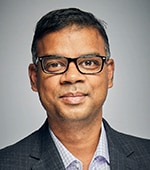
Sudeep leads the Data and AI platforms for GSK-Consumer Healthcare.
He is instrumental in evaluating the value cases, understanding the challenges and then evaluating and incubating the right platforms, technology solutions and capabilities.
In previous roles, Sudeep headed the global data analytics products and engineering teams. He has extensive experience of leading and delivering right Digital, Data and BI strategies and products for business. He is data and digital transformation champion leading the organizations on cloud and DevOps/Agile mindset and journey.
Sudeep has worked across industry sectors - Finance, Travel, Pharmaceutical and Consumer. He has extensive experience in delivery large programs and enterprise platforms towards success of businesses and customers.
Mentioned in the podcast:

