
Offerings
Overview
The mortgage servicing industry has long loan portfolio lifecycles. During this time borrowers may face a variety of life circumstances that can prevent them from keeping up with mortgage payments. Owing to this, about 2-4% of loans tend to go into default. Infosys’ Mortgage Default Prediction System leverages Artificial Intelligence and Machine Learning (AI/ML) to identify potential loan defaulters and take preemptive action.
Our solution can help mortgage companies flip the industry trend in handling loan defaults by moving from reactive to proactive mode. With a high degree of accuracy in predicting loans that could go into default, clients can rely on our solution to take corrective action with considerable year-on-year savings.
Bank – Mortgage Loan Data
Public Data Bureau of Labor Statistics
Mortgage Investor Data
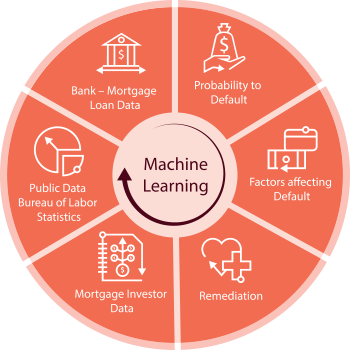
Probability to Default
Factors affecting Default
Remediation
Infosys' Mortgage Default Prediction System uses a combination of available industry data, artificial intelligence and machine learning algorithms to provide the mortgage industry with a fairly accurate view of potential defaulters.
This is how it works. The lending bank has the customer's loan portfolio. This includes information about any loan payment defaults already recorded in the system. In addition, our solution uses public APIs to collate historic information from mortgage investors such as Fannie Mae and Freddy Mac. Lastly, macro-economic influencers such as unemployment statistics in the area where a borrower lives are gathered from government sources.
This intelligence is passed through the machine learning model to generate a default score for each borrower. On a scale of 1 to 100, the higher the score, the greater the chances of the borrower defaulting on the loan payment.
Clients can use this score to negotiate remediations with the borrowers. This data can in turn be used to automate remediations over time.
Infosys' Mortgage Default Prediction System: A future-proof, automated solution for mortgage default prediction
Up until now, there has been no single source of truth that could aggregate borrower and industry data to accurately predict defaults.
Our solution combines modern, scalable technology to provide a future-proof solution that uses:






Find out more about how we can help your organization navigate its next. Let us know your areas of interest so that we can serve you better.